The EU is facing an impossible challenge when it comes to housing.
EU Commission research has indicated that Europe needs over two million new homes per year over the next decade. Given current projected construction, that leaves a shortfall of 650,000 new homes annually, which will require about €153 billion per year of investment. For context, the entire annual EU budget in 2026 is about €193 billion. There is no way that the EU can plug this gap on its own.
What’s more, strictly speaking, housing is not even the EU’s job. The EU’s role is defined by a series of treaties, which give it different roles or competencies. Housing is not an EU competency. It’s mostly a member state issue.
To be clear, some EU directives do affect housing. Environmental regulation, for example, restricts where housing can be built, which is a fairly major intervention. And a lack of EU integration also affects housing: harmonising regulation, for example, through the forthcoming Construction Services Act, could make housing development easier. Fixing these will help at the margin, of course, but they won’t solve the issue on their own.
Despite housing being outside of its competencies, the EU has now taken the decision that housing is simply too important to ignore any more. It matters for competitiveness, growth, and political stability. Ursula von der Leyen’s 2025 State of the Union speech put it front and centre for the EU.
Given that the EU can’t, and arguably shouldn’t, get into the nuts and bolts of housing – which are up to member states – how can the EU be helpful?
It’s already using its money to address housing problems. Billions of euros are being mobilised into the housing sector, and it’s likely that efforts will be stepped up in the coming years. But how can this money be used to produce the most amount of good?
At present, these grants and loans are based on the perceived merits of particular projects on grounds of sustainability and affordability. But if the EU wants to help the housing problem, it needs to think bigger. We need to encourage much, much more housing in the areas where it’s most needed, which will also help competitiveness.
The best system we have for showing where goods are needed is the price system. Prices signal what people want – and when it comes to housing, people want to live in Europe’s biggest cities. That’s where the best paying, most productive jobs are. Companies set up offices in these cities because it gives them access to a deep labour market. It’s a win-win, but housing supply hasn’t kept pace with all of this demand.
Why aren’t people responding to that price signal by building in areas with high housing prices? As we’ve discussed before, decisions about new housing construction are typically taken at a local level. However, existing residents will face concentrated costs when new development happens, such as pressure on schools and transport infrastructure. This makes it politically costly for local government to approve that housing. By contrast, national governments (or supranational governments, in the EU’s case) reap the benefits of new housing in the form of innovation and economic growth, but face few of the costs.
In Galway’s case, voters are likely to punish the local authority if they allow lots of new housing to be built. Meanwhile, officials and politicians in Brussels are facing lots of political pressure for new housing. If Brussels can make it more attractive for Galway to reform its planning policy and build more, both sides win.
But how can the EU incentivise member states to fix housing supply problems?

It’s all about incentives
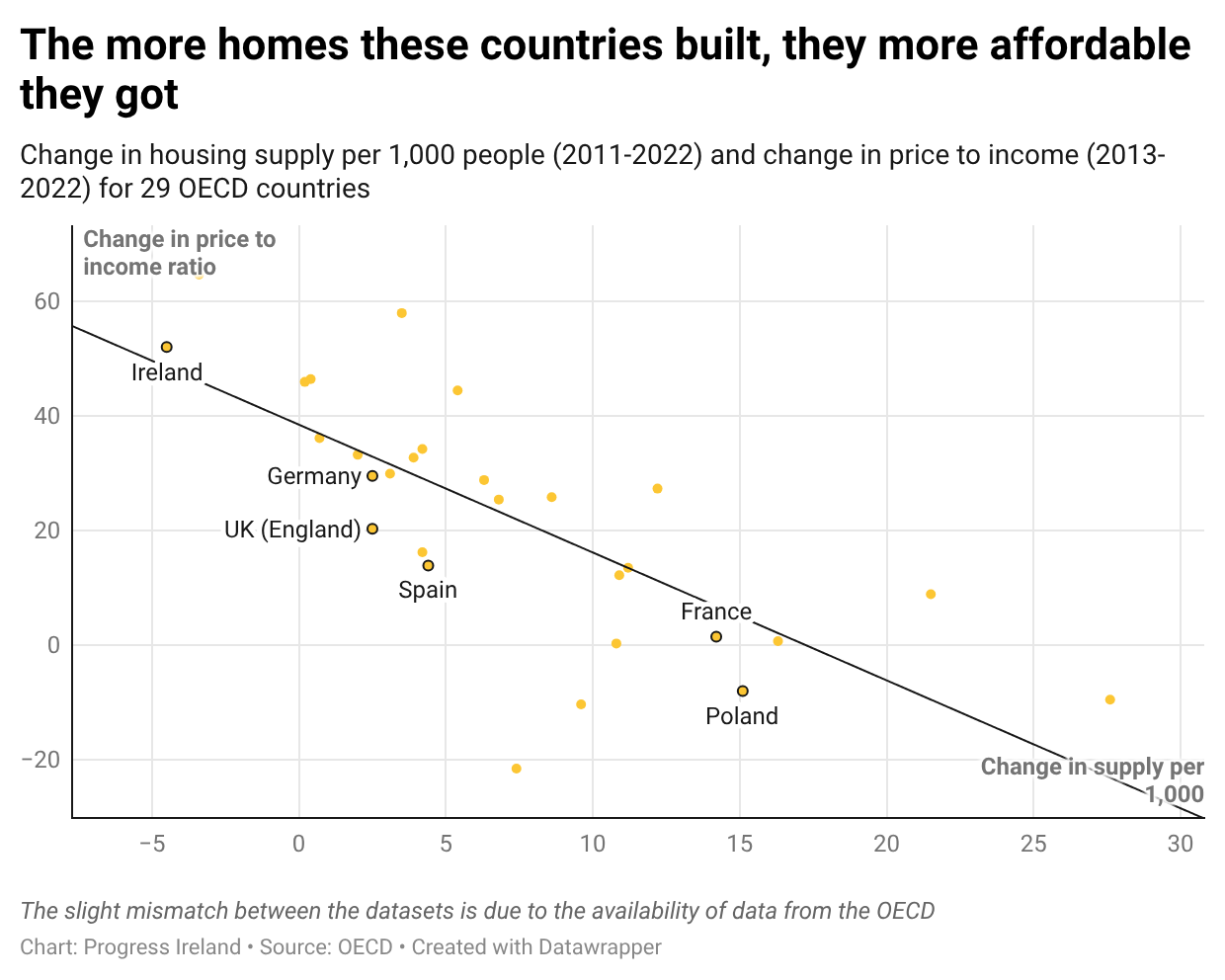
Housing funding conditionality offers an answer. Jurisdictions who apply for housing funding could be ranked according to the amount of housing they created the previous year. Top performers receive a higher level of EU funding for affordable housing, while poor performers receive less, or even none.
In other words, jurisdictions would be awarded housing subsidies if they can show that they’ve actually increased the overall supply of housing in their city. This could be measured by working out the housing value created, not just the number of units (which might lead to housing being built in places where it isn’t as needed). More on this below.
This mechanism has a series of advantages. First, as mentioned above, local governments set planning rules but find it politically difficult to build new housing. By offering financial rewards for housebuilding, Brussels can make it easier for jurisdictions to increase supply by reforming their planning systems.
Second, it works with the price mechanism. History offers a long and unhappy record of countries and systems that have tried to work against the price system. By contrast, a policy that rewards jurisdictions for creating housing value – homes where the price mechanism shows that they’re wanted – works with the price mechanism rather than against it.
Third, market rate housing is an important part of the solution in Europe. The sheer quantity of homes needed (over two million a year) means that private capital will need to be mobilised. It’s only going to flow where it receives a return, which means investment opportunities where it can receive a return. It’s sometimes claimed that market rate housing is bad for those who are worse off, but filtering means that additional housing eases pressures all the way down the distribution.
Fourth, this policy will help Europe’s most important cities grow. This matters because economic growth is increasingly happening in cities. Larger cities are able to create deeper and more specialised labour markets, and produce more innovation.
Open questions
So how would this policy work? There are many details to work out, but an overview of some associated open questions follows.
As discussed, the policy focuses on value added because the price mechanism provides a strong signal of where people want to live. Simply adding more homes within a country isn’t necessarily good, and can lead to ghost estates. New homes need to be in places that people want to live, as demonstrated by price signals.
There are a few ways to measure value added. One option is net new residential units multiplied by a baseline local price index (this baseline price may be simpler rather than trying to add up the value of the new units in fluctuating markets). Another is to measure the floor space added, again using a baseline local price index.
As mentioned, the goal of this mechanism is to reward jurisdictions for building houses where there is high demand and insufficient supply. Another option, moving away from a strict ‘housing value created’ concept, would be to focus on places with a high rent to earnings ratio, and reward those jurisdictions for net additional units. This emulates aspects of the United States’ ROAD to Housing Act. Alternatively, separate programmes could be launched for large cities and smaller municipalities to make sure that each kind of settlement faces incentives to grow.
The policy would have to run for multiple years in order to allow jurisdictions enough lead time to actually implement reforms. A commitment lasting a full EU budget cycle may be the best way to bolster credibility, given the time that may be needed to actually execute planning reforms within member states.
There are already funding streams for housing, like the European Investment Bank’s housing finance plan (€6 billion) and InvestEU’s budget guarantees (€26.2 billion). These aren’t necessarily grants, but a mix of different kinds of funding. The next Multiannual Financial Framework (MFF) may well seek to increase overall spending on housing, but the EU will have limits. As mentioned above, the EU simply does not have the capital required to make a meaningful dent in the housing problem on its own. It needs to attract other funding by easing restrictions on housing development.
Working out how much money might be needed to change member state behaviour is a complex question, but let’s consider Galway. Their total budget is around €200 million, and their housing and building budget within that is €33 million. A 10 per cent uplift in their budget would cost €3 million per year. Larger metro areas, like Paris, have correspondingly larger budgets: €800 million for social housing in 2026. A 10 per cent increase there would be as much as €80 million. If the EU decided to give €20 million per year as a rough average reward size, then the amount needed to reward, say, fifty municipalities, could plausibly be in the range of €1 billion for a single year. Over the seven years of an MFF, this adds up to some €7 billion. If a smaller number of total winners are selected, then rewards could be larger.
Again, the goal is to attract private capital and so build millions of new homes, not try to plug the gap with government funded housing. If this policy works as expected, these jurisdictions will reform their domestic planning systems to enable more house building each year than they otherwise would have enjoyed.
There is already international precedent for a policy like this. We previously discussed the ROAD to Housing Act in the United States, and a particular subsection, the Build Now Act, creates a new formula which makes federal funding for economic development in high cost cities based on housing outcomes.
There are other examples too. Canada’s Housing Accelerator Fund grants federal funding to jurisdictions that hit various targets (reforms to zoning; approvals; permitting; and the delivery of additional units). This funding can be used to carry out the reforms themselves, build supporting infrastructure, or create affordable housing. The early results have been positive: 16 per cent more permits than expected were issued.1 Participating jurisdictions permitted 31 per cent more units in total and had 5 per cent more starts, while non-participating jurisdictions had 15 per cent fewer permits and 28 per cent fewer starts.2
Australia’s New Homes Bonus offers another instructive case. Jurisdictions are awarded funds from a $3 billion (AUD) performance payment pool if they build more homes than their share of the national target of 1 million “well-located homes”. This cash can be used to fund enabling infrastructure, pay for faster approvals capacity, or even compensate resistant localities.
The rest of the world is beginning to focus on the gap between local incentives and national ones, and act accordingly, providing rewards to local governments. The EU should pay close attention and, as evidence piles up in favour of these kinds of mechanisms, follow suit.
Given the capital required to flow into housing development, there is little alternative. The EU has to do everything it can to get member states on board, and bridge the gap between the incentives of local authorities and (surpra)national governments. For Brussels to help Galway – and the likes of Barcelona, Munich, and Nice – it should consider using housing conditionality.
22,000 more than expected, of 160,585 total residential building permits issued. Source: https://www.cmhc-schl.gc.ca/observer/2026/boosting-housing-supply-housing-accelerator-fund-progress
https://www.pbo-dpb.ca/en/additional-analyses--analyses-complementaires/BLOG-2526-005--an-update-housing-accelerator-fund--point-fonds-accelerer-construction-logements