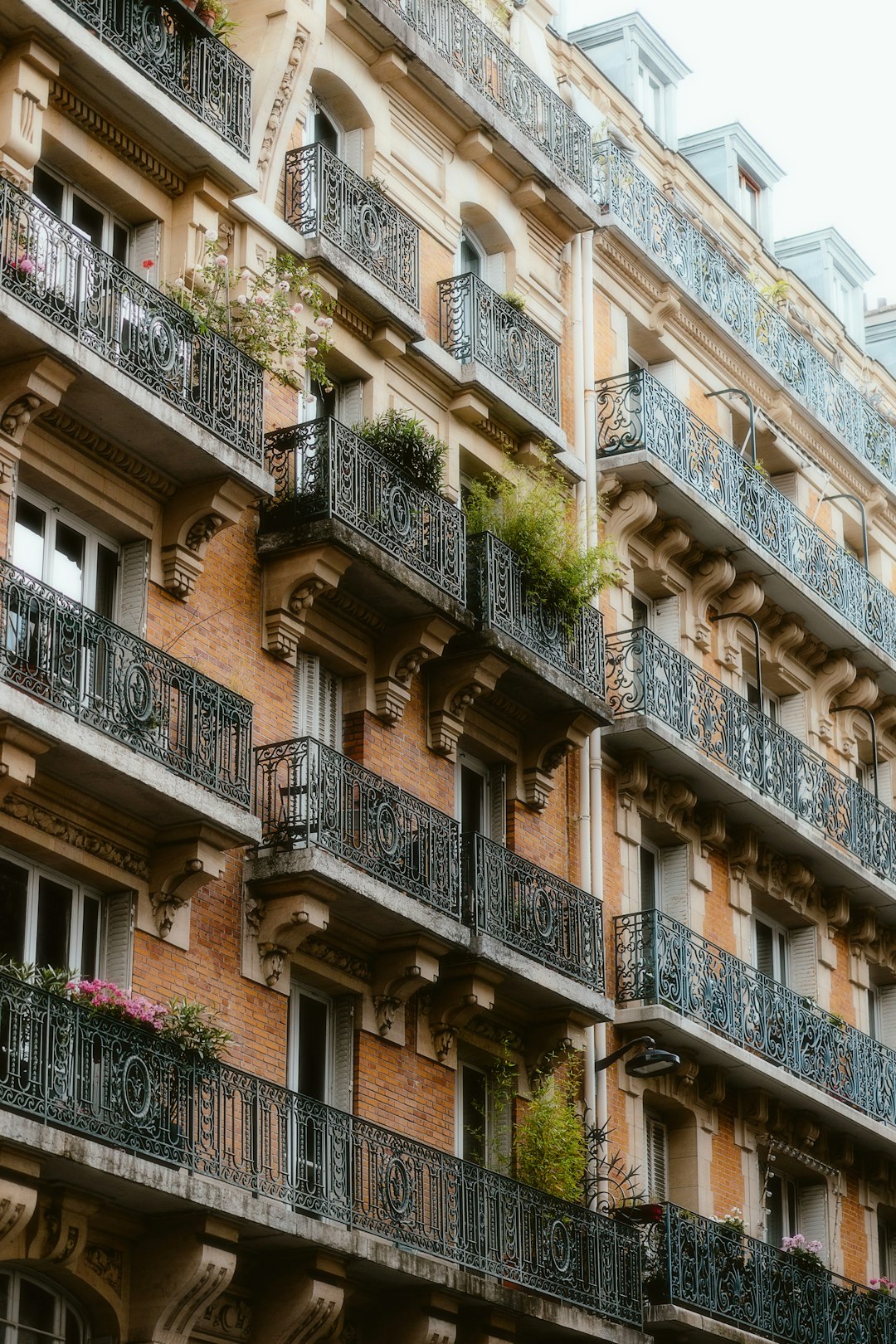
The centres of European cities are full of life. People live in historic buildings above shops, cafes, and restaurants. But walk around Cork, Limerick, or Dublin (not to mention towns like Killarney or Portlaoise), and you will see empty spaces above shops. At night, it is striking how empty many parts of central Dublin feel.
A hollowed out city centre, with vacant rooms over Irish shops, is a legacy of history. But fixing it will mean changing our regulations.
How we got here
Why do other European cities have thriving city centres with people living above shops and restaurants?
One hypothesis is that the historic cities of Europe never fully hollowed out the way Dublin did.
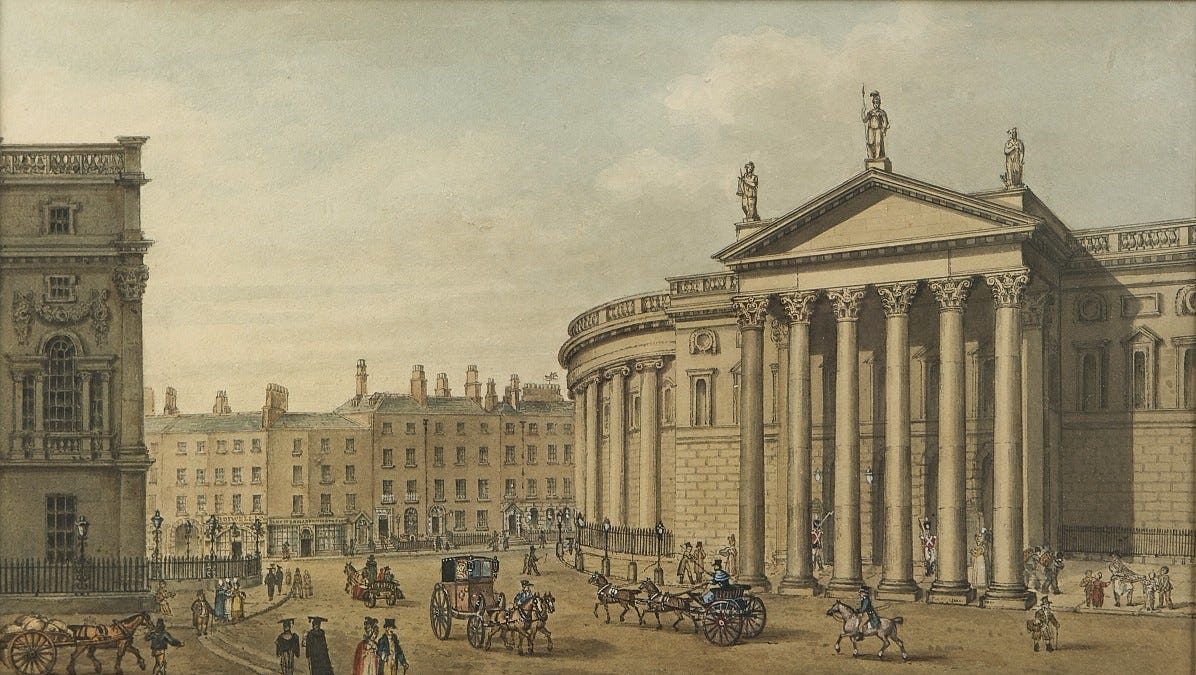
In the 18th century, Dublin was considered one of the best cities in Europe. As Kevin Nowlan wrote
The eighteenth century saw a rapid growth in the size and population of Dublin. The city prospered. The medieval walls were swept away and new broad streets and squares constructed in the open countryside on either side of the Liffey. The river itself was embanked and graceful bridges built. Dublin was a wonder among cities – admired for its buildings, wide streets and promenades.
In his A Picturesque and Descriptive View of the City of Dublin, James Malton wrote in 1799
Dublin is the second city in his Britannic Majesty’s dominion and may rank with the very finest cities of Europe for extent, magnificence and commerce.
But Dublin’s 18th century reputation for magnificence has since declined. What happened?
One thing that happened was the rich people left. Dublin’s position as a fashionable host to the wealthy began to decline as early as the 19th century. In the mid 1800s, Dublin’s population grew as people migrated from the “poverty stricken countryside.” Toward the end of the Napoleonic wars, agricultural prices dropped, leaving many to seek refuge in the city.
At the same time, the wealthy fled to the suburbs. The famine, An Gorta Mór, exacerbated this trend.
The wealthy left for a variety of reasons. One was the loss of the Irish parliament with the 1800 Act of Union. Second was the influx of poorer rural migrants. A third, related reason, was the desire for social exclusivity. Fourth, was the independence governance of the new and emerging townships. These include places like Rathmines and Pembroke in Dublin or Sunday’s Well in Cork. And fourth, improved transportation made the possibility of commuting much more attractive.
The result was an unusual one in Europe. Once the owners of beautiful Georgian buildings, the wealthy hollowed out from the city, leaving historic buildings to become tenements. As tenements, the buildings fell into ruin.
A weak industrial base kept the city centre impoverished. The trend persisted well into the twentieth century. Between the 1960s and 1990s, the industrial floor space of the inner city declined by 550,000m² (about 30 per cent). In that same period, the population of the inner city halved.
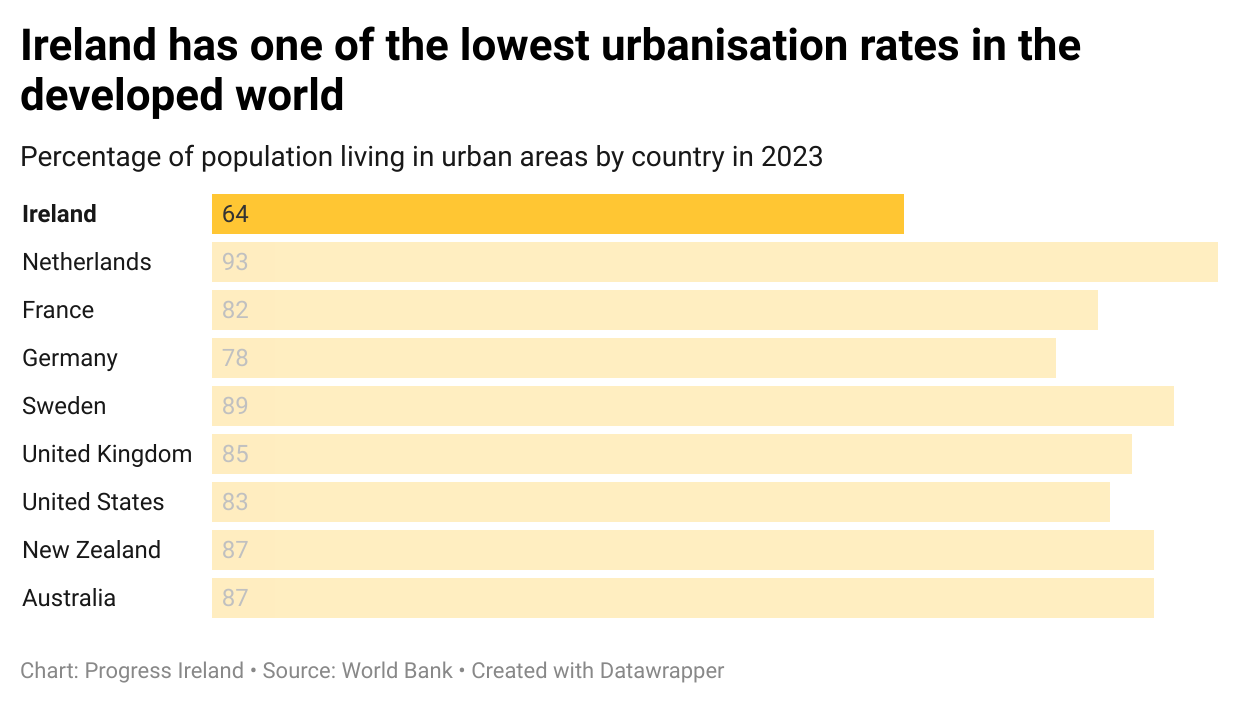
Today, Ireland’s low urbanisation rate may be the enduring legacy of the decline that began in the 19th century.
What have we been doing about it?
But the trend is now reversing. And policy has played a significant role. The Urban Renewal Acts 1986, 1994, and 1998 brought in generous tax subsidies.
It wasn’t just tax subsidies either. Ambitious planning measures were taken too. These include the Custom House Docks Development Authority (CHDDA), Temple Bar Renewal and Development Act 1991, and the Dublin Docklands Development Authority Act 1997.
To be sure, many of these measures included tax subsidies. But they also included detailed masterplans.
Masterplans are important, as I have written about before, for at least two reasons.
First, they give everyone certainty about what can be built and where. One major problem with Ireland’s planning system is its opacity. Masterplans fix that. They allow developers to know what they are allowed to build. They allow the public to know what their city will look like. And they allow the planning authority to set out a coherent plan to build new neighbourhoods.
Second, they solve a tricky coordination problem. Let’s take the case of a run down street. Anyone who wishes to fix up their property faces a first mover problem. They don’t want to be the first. If no one else develops their plot, they will have a nice property and a bad street. That isn’t a very enticing proposition for an investor. What they need is some reason to believe that everyone else will develop their property as well.
This is where masterplans work as a coordination mechanism. If the plan lays out a specific vision for the street, the first mover can be more confident that others will follow their lead. The neighbours will be in the same boat: They will have more incentive to invest in the area because they know they will get planning permission if they follow the plan. As a result, everyone has more incentive to invest, making redevelopment more likely.
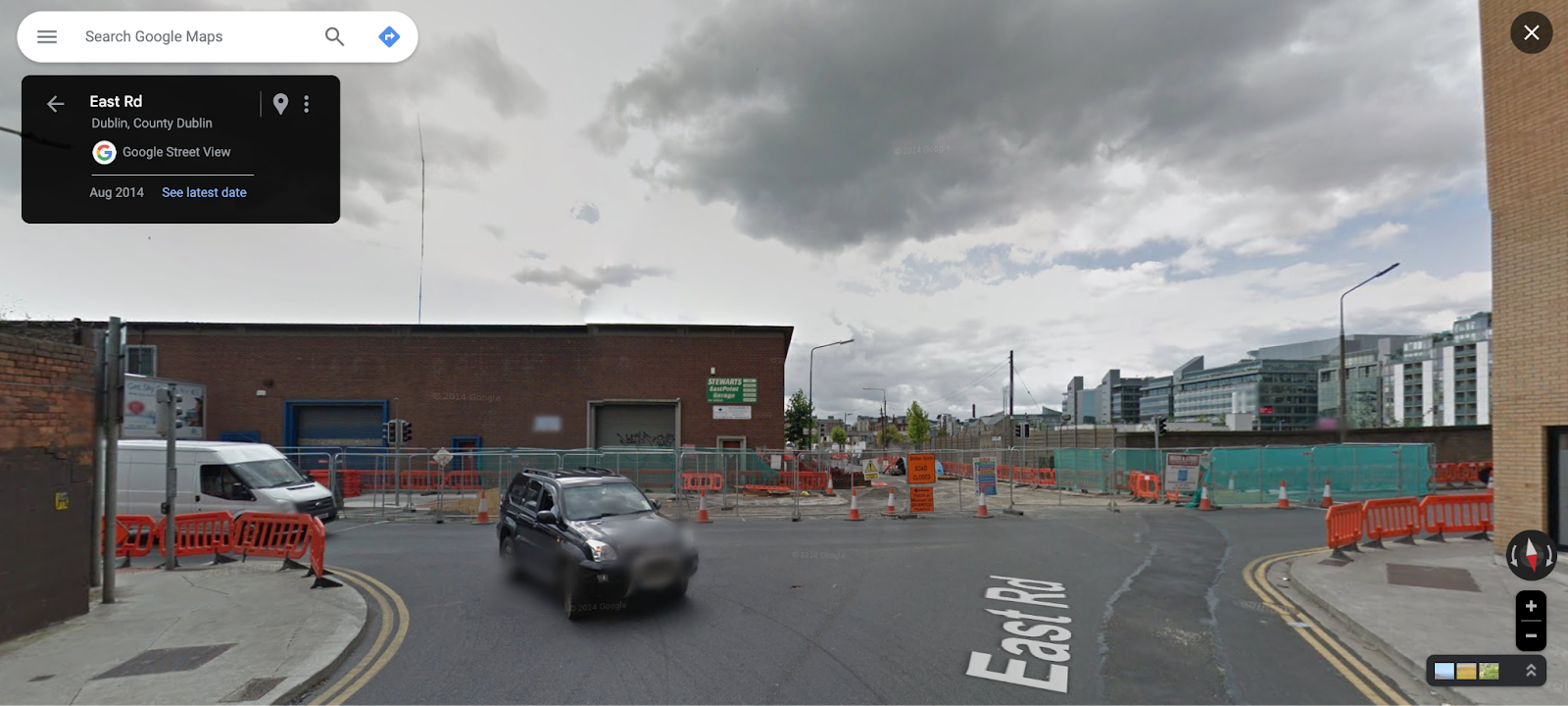
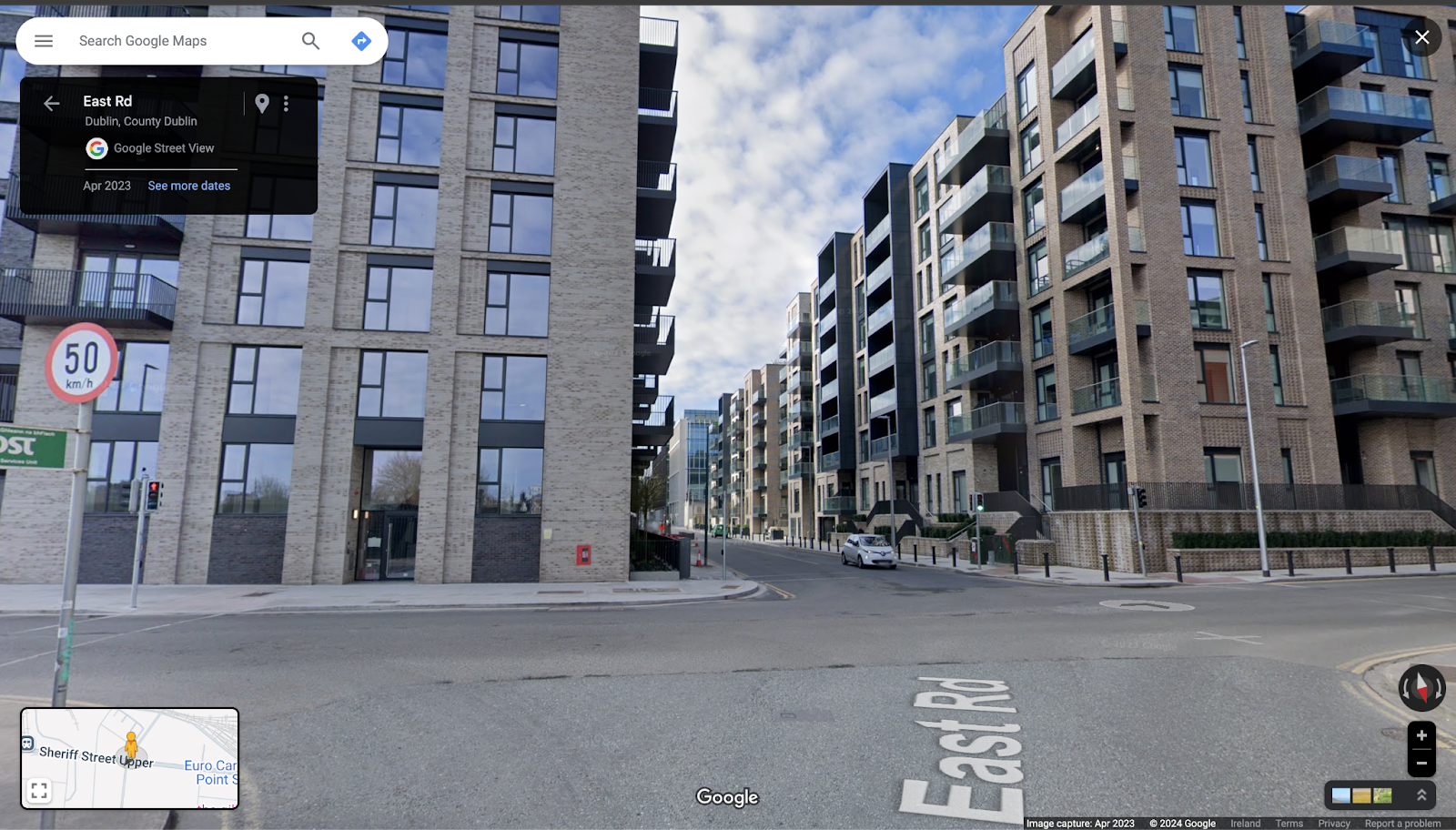
Here, you can see the masterplanned transformation of Dublin’s Docklands from East Rd in the North Docks.
Today, there is a dizzying number of schemes attempting to continue the progress. I have included them in this table. Most, as you will see, are grant programs.
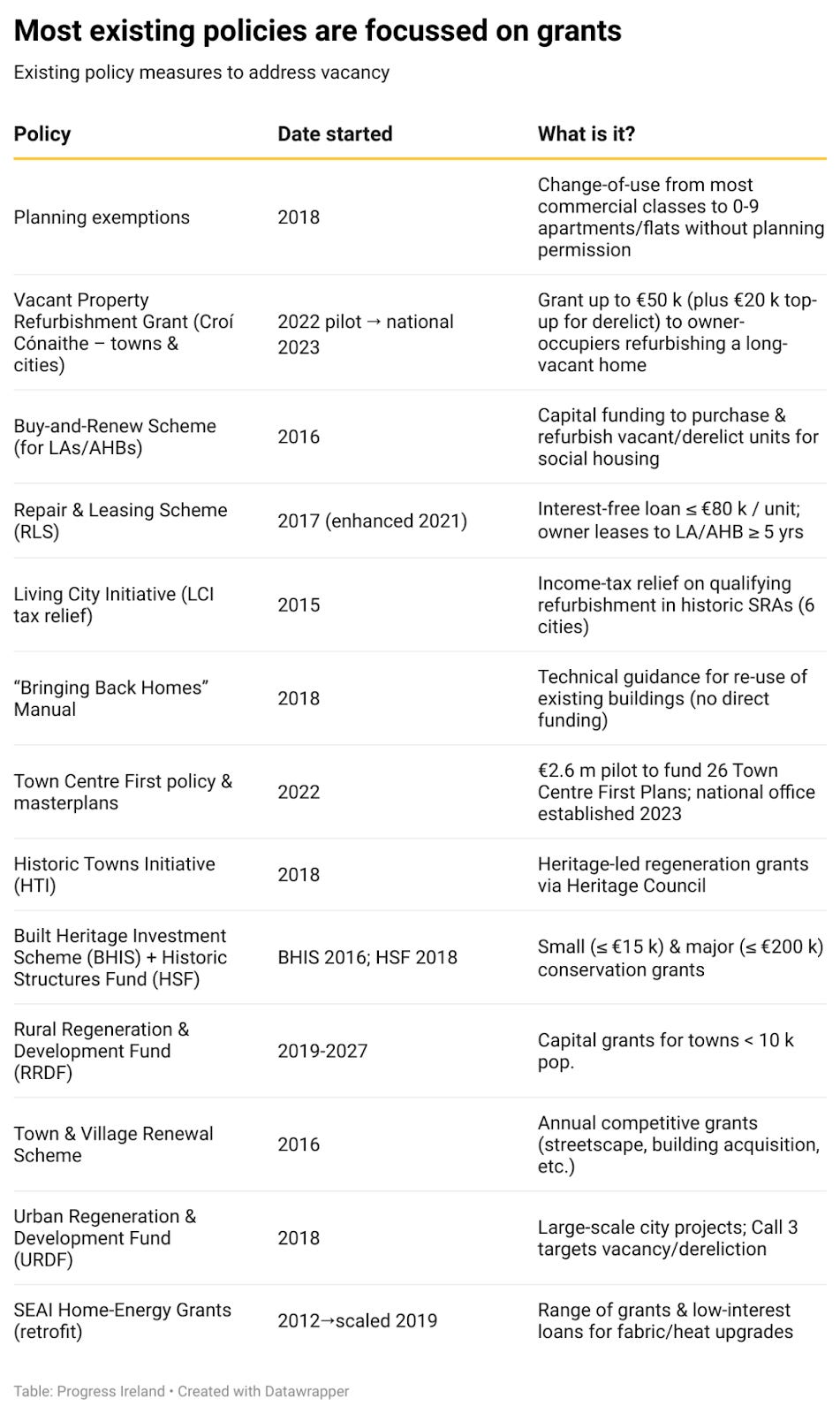
We are spending a lot of money. €77 million has been paid out of the Vacant Property Refurbishment Grant alone.
But anyone who lives in an Irish city knows progress is frustratingly slow.
One reason for the slow progress is cost. The Society of Chartered Surveyors (SCSI) did a study in 2022 measuring the cost of renovating vacant and older buildings. Their figures exclude VAT and financing costs. According to the study, one building on Henry St was renovated for €573,700. This created three new one bed homes. Four new homes could be created on Grafton St, for about €750,000. That’s less than 200k per unit.
But costs depend a lot on the initial condition of the building. One building in Cavan cost nearly €1 million to renovate delivering just two new homes.
What was clear from that report was that grants alone won’t be enough. The report evaluated the viability of investment in renovation schemes. It found that, of the sample studied, 0 additional case studies became viable with Croí Cónaithe (Towns) grant of €30,000. Likewise for the €50,000 grant available under the same scheme. When two schemes were combined, the Croí Cónaithe (Towns) and SEAI grant of €21,500, one additional scheme became viable. However, when the Croí Cónaithe (Towns) scheme was bumped to €100,000, three additional schemes became viable.
What should be clear from the SCSI study is that money alone won’t solve this problem. But of course, it won’t hurt.
How regulations stop older buildings becoming new homes
Another reason for slow progress are regulations.
Right now, old buildings have to follow new rules. When a building changes use, say from commercial to residential, it will trigger modern rules. Buildings must be as accessible as new builds under Technical Guidance Document M which provides guidance for how to follow the building regulations. They must be as fire proof as new builds under Technical Guidance Document B (TGDB). TGDB is the government’s guidebook on how to follow the Building Regulations for fire safety. They must have similar amenities under the apartment standards.
The problem with this approach is straightforward. Older buildings were not built to modern standards. Forcing them into the mould of modern standards drives up costs. And high costs means few properties will get refurbished.
Even when it makes financial sense to convert an older building, regulations still make it impossible. The SCSI report discussed gave an example of one such building. The conversion of a three-storey building on Grafton St in Dublin into four new apartments above-the-shop was found to be viable. However, the authors note, “the secondary means of fire escape requirement and no available option to make such a provision means that this project is unlikely to be renovated for residential use, and instead remains as a storage space for the foreseeable future.”
It isn’t just that regulations drive up costs. They also make investment highly uncertain. This is because the rules are ambiguous when it comes to older buildings. To see what I mean, take a look at TGDB.
In the case of an existing building there may be constraints that would not exist with a new building and some variation of the provisions set out in this Document may be appropriate. Alternative solutions whether applied to all or part of the building or to specific provisions, may be employed in these situations. Also note that exceptions are allowed in 1.3.8 in relation to existing internal stairways.
Now, take a look at the apartment standards.
Planning authorities are requested to practically and flexibly apply the general requirements of these Guidelines in relation to refurbishment schemes, particularly in historic buildings, some urban townscapes and ‘over the shop’ type or other existing building conversion or refurbishment projects, where property owners must work with existing building fabric and dimensions. Ultimately, Building Regulations must be complied with and planning authorities must prioritise the objective of more effective usage of existing underutilised accommodation, including empty buildings and vacant upper floors.
In both cases, the guidance admits that new rules and old buildings do not work well together. But in both cases, the solution is to ask for flexibility.
This doesn’t sound like a bad thing. It is simpler to ask for flexibility than to write new rules. After all, the rules that would suit Georgian buildings will be different from a 1950s creation.
But flexibility breeds conservatism. Take fire officers as an example (though the same would apply for planning and other officers). When confronted with an older building, a fire officer in the council does not have clear guidance. The officer must use his own judgement (and the guidance) to produce a bespoke solution. The officer knows that if he makes a mistake, he may be questioned (though he is not legally liable). He has every incentive to be conservative and only offer the most stringent requirements. After all, it is his job to minimise fire risk, not to enable the conversion of older buildings into new homes.
(To be sure, the updated TGDB (Volume 1) does contain more explicit guidance for older buildings. But this new volume is an exception.)
Misaligned incentives and flexible rules together will prevent refurbishments. To fix this, the rules will have to get clearer.
A 2022 Joint Oireachtas Committee report made the same point. The committee noted that, to unlock the roughly 4,000 vacant above the shop units between Dublin’s canals, regulations would have to be simplified and clarified.
As Hugh Wallace once said in the Irish Times, the alternative is that
… we do nothing and simply let these buildings fall into such disrepair and dereliction to the point where some of them will ultimately have to be demolished. In an era where sustainability is so important to our collective future, it’s a no-brainer that we acknowledge that the most sustainable building is the one that’s repurposed, not knocked down and rebuilt.
A new golden age for Irish cities
I started by discussing Dublin’s fall from grandeur in the 19th century. But that wasn’t supposed to be depressing. It should be exciting. With simple regulatory changes, Irish cities could continue to undo their decline and bring in a new golden age for Irish cities.
Ireland needs its historical buildings. But to breathe life back into them, we must change how we regulate them. As Jane Jacobs said, “cities need old buildings so badly it is probably impossible for vigorous streets and districts to grow without them.”