Progress Ireland’s monthly happy hour takes place on the last Wednesday of the month (tonight!). It’s happening from 5:30 to 7:30 at The Duke, Duke Street, Dublin.
The Irish government currently spends around €1 billion a year on scientific research. Is that number too high, or too low?
The academic literature relevant to this topic is surprisingly thin. Larry Summers and Ben Jones have come up with remarkable – almost implausibly large – estimates for the social value of scientific research. They have estimated that research funding generates a social rate of return of 67 per cent per year. For context, the greatest hedge fund in the history of financial markets generated roughly the same returns.
If their estimate is even close to correct, it means that research spending should be dramatically higher than its current level. Let’s unpack this:
Jones and Summers’s model predicts that, on average, every dollar of research and development (R&D) translates into several dollars of long-term benefits. The exact number depends a lot on your social discount rate. But even under the most conservative assumptions, there was no way the authors were able to get their model to output long-run benefits of less than $4 per $1 spent.1
It’s common for economists to convert investments with a stream of future payouts into an annual rate. This answers the question: At what rate would an investor be indifferent between getting the stream in question, and a hypothetical investment with a fixed annual rate of return? When you do this for the Jones-Summers model, the annualised rate of return is a whopping 67 per cent. Other research has found similar numbers.
The fundamental intuition for why this number could be so large is that the benefits we get from new knowledge and technologies are often permanent, while the investment that was required to create it was a one-off cost. In some cases of early state patronage of research, the benefits have lasted for centuries.
This figure has many caveats. Jones and Summers bundle together both government and non-government spending on research; we don’t know from first principles which of the two has a higher rate of social return. And while the theoretical points are intended to be general, their model is calibrated on American data.
Research about Europe is more spotty. While there have been attempts to work out the return on research in the UK and EU, I’m not aware of any that attempt to do serious causal inference. It could be that common factors cause countries both to spend a lot on research, and to be healthy and productive. No country has ever done a randomised control trial on increasing its budget for science. But there have now been a few ‘quasi-experiments’ in cases where we have near-random variation in research funding. These have been generally very favourable regarding the direct and spillover benefits of publicly-funded research.
If you take these numbers seriously, few, if any, government interventions even come close to the return on funding basic research. Standard estimates for the rate of return on public infrastructure are in the range of 10–20 per cent. As a result, there is a strong consensus among economists that almost every country underspends on research. A canonical paper in this field, by Chad Jones and John Williams, famously concluded that R&D spending should be between two and four times higher than it currently is. I’ve been unable to find any papers that concluded that the current level of funding is too high.
If the returns are so enormous, why don’t private individuals and companies gobble them up? The basic idea is that research creates large spillovers that are not captured by the original inventor or company. As a result, firms will substantially underinvest in research relative to what would be socially optimal. That is why the Jones-Williams result is generally interpreted as saying that the state needs to pick up the slack by directly subsidising research. In the long run, we should expect more R&D spending to make almost everybody richer.
But all of this is somewhat theoretical. What does Ireland currently spend on research, and how does it compare to other countries?
How Ireland compares
Here’s a rule of thumb: In rich countries, about two per cent of all economic activity goes toward research and development. Of that two per cent, about one-third comes from the public sector, and two-thirds from the private.
In terms of GNI*, around two per cent of Ireland’s economy is spent on R&D. That compares to around 2.25 per cent for the EU as a whole – not much of a difference.2 For OECD countries in general, on average 2.2 per cent of GDP has gone to R&D since 2000.3
Where Ireland falls down is in how much of that research is publicly funded. By some measures, just 13 per cent of Irish R&D is funded by the state. That is one of the lowest shares in the EU.
That means that when it comes to public spending as a share of GDP, Ireland is well behind its peers. Across the European Union as a whole, 0.55 per cent of GDP is spent on public research. The number is similar for the UK, and for the US, it’s 0.65 per cent.45
The comparable figure for Ireland is just 0.37 per cent.
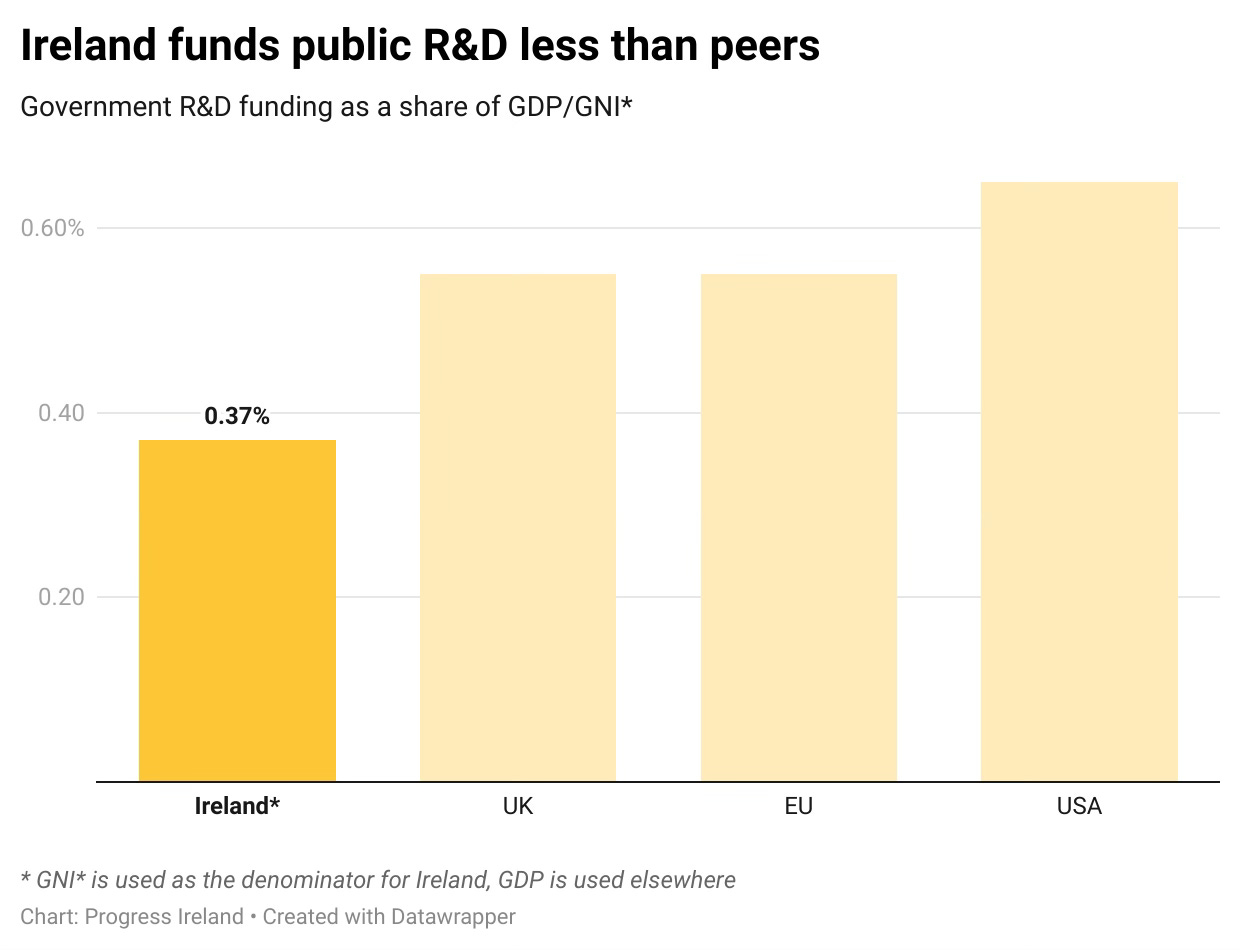
When you put this in absolute terms, the State spends €199 per person on research, compared to an EU average of €274. And it was only two years ago that the Irish government spent over €1 billion on research for the first time. Ireland is a small country, but even so – that is not a lot of money.
Ireland’s primary national research and innovation strategy document is Impact 2030, which was published in May of 2022. Impact 2030 has certain key metrics which they are aiming for by 2030.6 The most widely publicised target, also mentioned in Oireachtas debates, is to raise R&D spending (public & private combined) to 2.5 per cent of GNI*.
I have two problems with this.
First, metrics which include public and private spending are more easily gamed. I don’t particularly begrudge them for it, but companies have an incentive to classify as many expenses as possible as R&D for the purposes of claiming tax credits.
Second, the state has less direct control over an aggregate public & private measure. The state is but one large player in the complex system of the economy. Fundamentally, private and public R&D are different mechanisms. Private R&D is driven by the firm’s incentive to increase its profits. Among other goals, public R&D is to correct for market failures which lead to systematic underinvestment. Arguably, bundling them together misses the point.
Completely absent from Impact 2030 is a target for the actual amount of money to spend on research. The State has lots of goals for metrics which it has only partial control over, and none for a metric which, almost by definition, it has complete control over.
Ibec has proposed public research spending should more than double, to one per cent of GNI*. This would make Ireland one of the most research-intensive economies in the world.
This would be a big departure from the current strategy. The only country which has consistently spent more than one per cent of GDP on the public funding of research in recent years is South Korea.7 It’s not crazy to think that a country as educated and rich as Ireland can support research as much as Korea does.
Two further points about Irish science spending
While my own preferred policy would involve a big increase in spending, I think it’s generally under-appreciated how you can vastly increase the total amount of spending in many fields with a relatively small amount of money. It’s difficult to get granular accounting, but there are many important subfields which receive only a few million euros per year in funding globally. Ireland could become the global dominant funder in them practically overnight.
European research funding has been of particular interest recently because of the Trump Administration’s cuts to basic science funding. Much ink has been spilled on apocalyptic predictions of the end of American research dominance.
But context is needed. The American Association for the Advancement of Science has estimated that, if Trump’s favoured plan is enacted, it would represent a 22 per cent overall cut in science funding. Under the most naive possible extrapolation, that would bring public R&D as a share of GDP to 0.51 per cent.8 That is still significantly higher than Ireland’s 0.37 per cent.9
What fraction of Irish people even realise that their government currently financially supports science less than the most pessimistic projections of Trump might do? It’s not even close.
There have been various efforts to recruit American academics to decamp to Europe amid the funding cuts and other chaos. For example, in May, the E.U. created a €500 million ‘Choose Europe’ recruitment programme. The New York Times recently ran a newsletter about how little take-up there has been of such programmes: ‘Even with a recruiting war chest, many universities lack the flexibility or means to make serious offers.’ It’s, of course, too soon to really say, but I am not optimistic about such efforts.
There are certainly better and worse ways to target this money. For example, it may be more promising to target postdoctoral scholars and incoming PhD students, rather than trying to convince senior scientists and their labs to move to Ireland. While I support such efforts in principle, at a certain point, one needs to accept that there is no way for the Irish government to induce important research to take place in Ireland without spending a lot more.
One country that I think illustrates the benefits of such an approach is Denmark.
The case of Denmark
By some measures, public research is 0.9 per cent of Danish GDP.10 One example of something that money paid for was a large share of the foundational research on GLP-1 receptor agonists. The most famous of these, semaglutide, is the active ingredient in Ozempic and Wegovy, the ‘miracle’ weight-loss drugs produced by Novo Nordisk. You don’t need me to tell you how spectacularly successful these have been. This has made Novo Nordisk, depending on the day, into Europe’s most valuable company by market capitalisation.11
We are now in the stunning situation in which the Danish economy is not growing at all before you account for weight-loss drugs, and is one of the best-performing economies in the European Union after you account for weight-loss drugs.
This should inspire pause: One of the most important biomedical innovations of the 21st century was a commercialisation of publicly-funded R&D in an EU country with a similar size and population to Ireland. This has created a world-leading company that is, for once, a genuine peer with the largest American multinationals. That could, and should, have been us.
Maybe you don’t buy that public funding was essential to semaglutide in particular, but I think it’s difficult to tell a story about these drugs in which academic labs don’t play a major part.
The power of arbitrary targets
I reject the idea that the current level of public R&D expenditure is due to high economic theory or deliberate design. No specific individual chose the current number, nor has a detailed model in which 0.37 per cent of GNI* is the optimal response to the current tradeoffs. Why defend a specific number that arose from political contingency?
I think the economics literature has given us a pretty good indication in which direction we should go with science funding (‘more!’), but not when we should stop. I am extremely sceptical of anyone who claims to know that a specific level is best.
An example of the power of spending targets is the celebrated commitment that developed countries should spend 0.7 per cent of their national income on foreign aid. That target was generated by a specific model with many actively mistaken and misleading assumptions, as Michael Clemens and Todd Moss have shown. And yet, the target did seem to achieve its goal in raising the quantity and quality of foreign aid spending.
The UK first hit this target in 2013, and for the following eight years, the British were widely commended as having among the best systems of foreign aid in the world. That commitment slipped during COVID-19. Now it’s at 0.5 per cent, and (probably not unrelatedly) many activities previously not considered aid have been reclassified, which has been necessary to meet the new, lower, target.
The point is this: completely arbitrary numbers have sticking power. If a future Irish government were only interested in a much more modest increase in research than I favour, my advice would still be: pick a rate which is higher than the current one, and then stick to it.
What about the National Development Plan?
In July of this year, the Minister for Further and Higher Education, Research, Innovation and Science James Lawless announced that there would be a €4.55 billion additional capital allocation for his department. This was under a revised version of the National Development Plan (NDP), which originally covered the period from 2021 to 2030.
If this money were entirely spent on research by 2030, then it would represent not far off a doubling in the amount which is sloshing around the funding ecosystem. So: victory?
Alas, these allocations are often misunderstood by the general public as being a funding commitment. But, as I understand it, the NDP provides capital ceilings. This means that the Department for Higher Education, Research, Innovation and Science can spend up to €4.55 billion before it has to ask for permission again. That money may or may not ever be spent.
The additional funding secured by Minister Lawless is partly earmarked for student accommodation and other expensive goals. We await further details on how much will be spent on research.
The NDP claims that the public spending investment of €165 billion over the 2021–2030 period will bring public investment to 5 per cent of GNI*. If this were to occur, it would put us well above the recent EU average of 3 per cent of GDP. We are now halfway through the relevant period, and are nowhere close. Unlike Impact 2030, the NDP takes my preferred approach of targeting a public measure, rather than an aggregate public & private measure.
The new funding from the NDP, however it shakes out, appears to be a step forward. We’re getting closer to the optimal amount of funding, whatever that number is. But it’s safe to say we’re still far short.
Sam Enright is the Innovation Policy Lead at Progress Ireland, and editor-in-chief of The Fitzwilliam. If you have thoughts about this piece, you can email sam@progressireland.org. You can follow him on Twitter here.
Jones and Summers 2021, p. 34.
The precise number fluctuates from year to year, and is subject to various methodological complexities, so I would advise against reading too much into it.
Jones and Summers 2021, p. 26
See the OECD’s Main Science and Technology Indicators dataset. In the case of the UK, I averaged across the three most recent available figures. Not every country reports data each year to the OECD, which makes the comparison somewhat messy. American R&D figures come from surveys run by the National Science Foundation of government and businesses with at least 5 employees (see Jones and Summers, p. 11).
For some reason, European policy circles have come to prefer the acronym R&I (Research and Innovation), but as far as I can tell, it means the same thing. There are two related concepts here. The first is Gross Expenditure on Research and Development (GERD). That is the amount of government-funded research that gets conducted within a country’s borders. Notably, if Ireland funds a research project that is conducted entirely abroad, it won’t show up in Irish GERD. The second is the Government Budget Allocation for Research and Development (GBARD). GBARD is more or less always higher than GERD. There are many legitimate reasons why funds initially allocated for research would not be spent on research in that country, including that they may flow out to multinational research projects. Ultimately, GBARD and GERD are both interesting in different ways. You might think of GBARD as a measure of how much a country currently supports science politically, and GERD as a measure of how much research is actually taking place. While I like the principle of Ireland supporting science that doesn’t happen within our borders, I think that whether the 1 per cent GNI* commitment should be stated in terms of GERD or GBARD depends on various political factors about how reliable budgetary commitments are. This helpful blog post from Eurostat explained the state of GBARD in the EU. The figures above are all government-financed GERD divided by nominal GDP.
These are summarised in Appendix B.
Whether other countries qualify gets a bit technical and depends on your definitions. For Korea, see the MSTI database, navigate to ‘GERD financed by government, percentage of GDP’. More countries reach 1 per cent by the GBARD measure.
With 2023 numbers: take €1,075 million from the budgetary allocations, and divide by the CSO’s 2023 GNI* estimate for that year (€291 billion) to get 0.37 per cent. For 2020: take the raw research spending from page 6 of Impact 2030 (€867 million) and divide it by the CSO’s figures for GNI* in that year (€198 billion) to get 0.44 per cent. The numbers between countries are not trivial to compare, because, while the GNI* figures are more meaningful for Ireland, other countries’ data is usually reported in terms of GDP. For almost all countries in the EU, GNI ≈ GNI* ≈ GDP. Because of Leprechaun economics, Ireland looks worse than it is in terms of the fraction of GDP spent on research.
If you’re wondering why the numbers in the linked post are different than the ones I reported earlier, it’s because they are adjusted for PPP, which in general will increase the share of GDP spent on public R&D in expensive countries.
In the essay I published when I originally started this job, I contrasted us negatively with Denmark’s pharmaceutical policies in a different way: even though we have a larger pharma sector, Denmark runs four times as many clinical trials.