The exempted development regulations are open for public consultation. We encourage all of our readers to submit their views here.
Dear Ministers Browne and Cummins,
You are currently considering how to implement the regulations for exempted developments. Your decision will determine how many categories of new building don’t need to apply for planning permission.
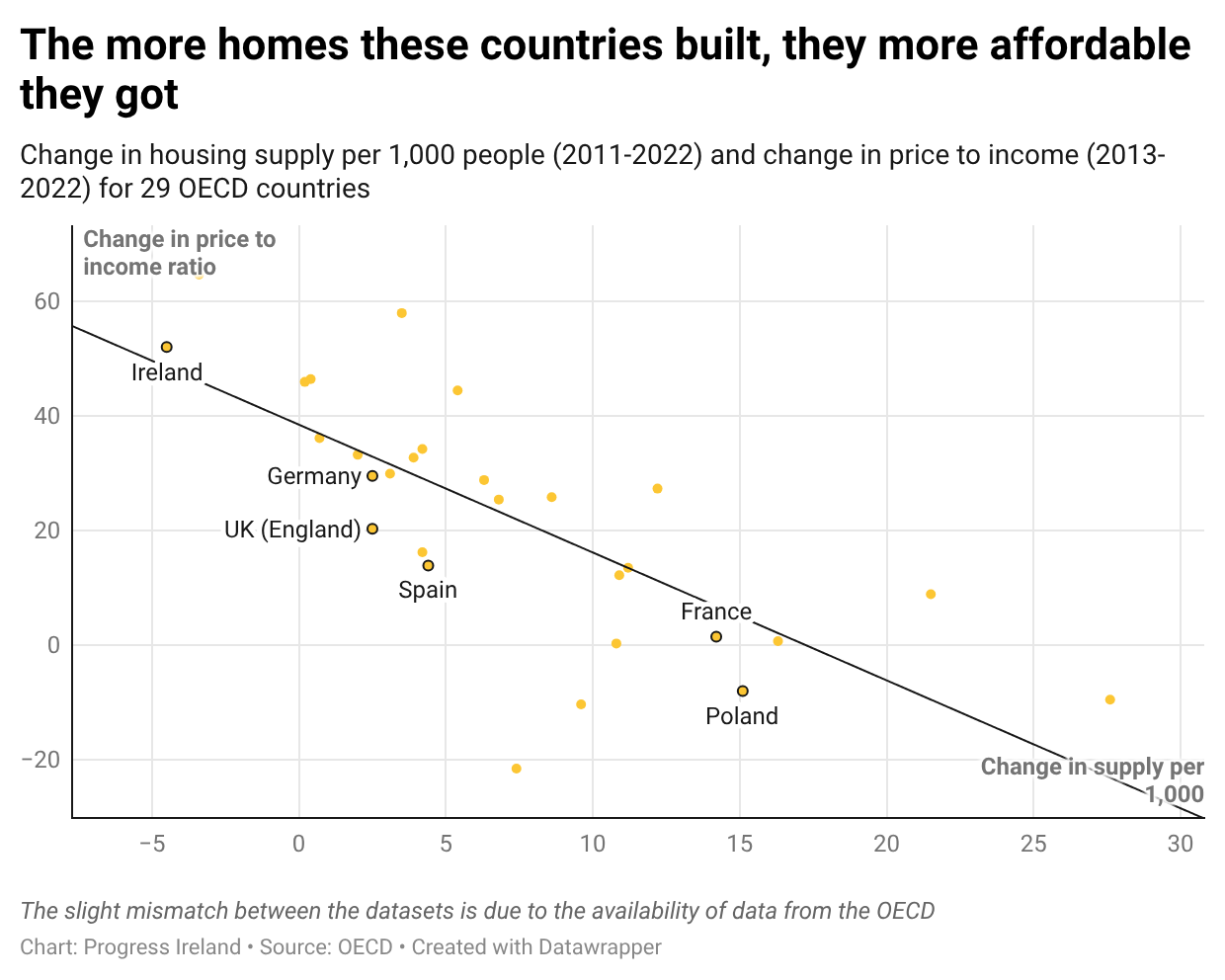
To get more homes built, half-measures won’t work. Many of the recent reforms have been in the right direction but arguably not far enough. The government claimed that changes to the apartment standards would cut ~€100k off the cost of building an apartment. Instead, they will likely only save about €35k per unit. New and ambitious housing growth requirements were announced with a headline figure of 83,000. But the fine print suggests this figure is optional.
Like with all policies, there are choices to be made.The new exempted development regulations offer a chance to correct this trend and help address the most serious parts of the housing shortage. The regulations offer a chance to choose more housing instead of further scarcity. Where other parts of the system say No or, at best, Maybe to new homes, this part can say yes in advance to thousands of new homes.
Saying yes to development
Exempted development isn’t about the absence of planning rules. It is about giving certainty. It is about saying yes in advance to certain kinds of development.
The Planning and Development Act (and its predecessor of the same name) gives the Minister powers to catalog types of development that are pre-approved. The regulation sets out the rules of development in advance. Once those rules are followed, anyone can build the types of development set out in regulation. Exempted development is the part of the system whose purpose is to say yes to development.
Right now, there is a public consultation on exempted development. With the new Act will come new regulations. And with that, comes an opportunity to make a dent, if only a small one, in the shortage.
In February, Minister Cummins brought the welcome announcement that the government will exempt “detached dwellings” to the rear of homes. We called these seomraí. Our modelling suggests that there are 350,000 suitable gardens for these homes.
Since the announcement, the proposal has been widely popular. An Irish Independent poll showed overwhelming support for the proposal and significant interest in both living in and building a seomra. 85 per cent of those polled support the government’s proposal to relax “planning rules around building additional homes on people’s own land.” 39 per cent said they themselves would live in a seomra, while 22 per cent said they have a family member who would live in one. 48 per cent said they would consider building one in their garden.
A Business Post poll showed a 63 per cent majority support the proposal and that a majority of both young (18-34) and older voters (>55) support the policy. Overwhelming support in the wake of the announcement was also on display in the media. Joe Duffy said on Liveline “the sooner [this policy is implemented] the better, according to most of our listeners.” A similar point was made by the Tonight Show’s Gavan Reilly. The Irish Times Editorial board also came out in favour of the policy.
But there remain questions. The answer you give to these questions, Ministers, will determine whether the policy is successful or another half-measure.
The first is about access. The building regulations mandate that homes have sufficient access for fire services. At present, this means that the property must be within 45 metres of a vehicle access point. When Progress Ireland modelled this requirement (along with other conservative estimates), we found that 56 per cent of homes in our sample had big enough gardens with enough access.
Second is about who gets to use them and for what. There has been some ambiguity from the government about whether a seomra should be allowed to be rented. The current rules say no one gets to live there unless you get express permission from the planning authority.
The new rules will see that a seomra is part of the main house. It may follow naturally that these homes will be allowed to be rented in the same way bedrooms in the main dwelling are allowed to be rented, not as unique homes but as part of the main dwelling.
But there have been some calls to restrict it. This, Ministers, I think would be a mistake for two reasons. As before, half-measures will not address the shortage. There is a right way and a wrong way to implement this policy.
The wrong way
The kinds of restrictions that have been tried in other jurisdictions provide a template of what not to do.
In Seattle and California, owner-occupancy requirements were placed on accessory-dwelling-units or ADUs (an American term for what we call seomraí). In Ireland, an equivalent restriction would see the use of seomraí artificially restricted to members of the family or household.
By removing some barriers such as owner-occupancy requirements, Seattle increased ADU permits by 253 per cent in just three years. In six years, California’s ADU approvals went up by 15,334 per cent. As of 2022, 19 per cent of all housing units produced in California – or nearly one in five homes – was an ADU.
Another restriction would be to impose car space restrictions. In fact, car space restrictions were cited by Dublin City Council in a report arguing for the restriction of seomraí five years ago.
Where car parking provisions were removed, in California, Portland, and Seattle, greater numbers of ADUs were delivered. Advocates for ADU policy in the United States frequently refer to minimum parking requirements as a ‘poison pill’ regulation, meaning that it inhibits supply. Ireland should learn from their success and follow their example.
If the plan is to place restrictions on seomraí, then I would predict the policy will not help those that need it most.
The right way
First, as before, there is a critical shortage of rental accommodation in Ireland’s towns and cities. Listed on DAFT at the time of writing there are six one bedroom properties for rent in Limerick city. The same is true of Cork. In Galway city, there are just three.
Allowing high quality seomraí to be rented could dramatically improve the supply of rental accommodation in these cities. What began as a means to provide accommodation to a family member could then become a home for a young person studying in Galway or Waterford or beginning work in Cork or Limerick.
There are some complications built into this. A new seomra that is rented out may constitute a “change of use.” Change of use is a term used by planners to describe when a property, well, changes its use. For example, if I convert my home into a factory, I need planning permission for this change of use.
It is important, then, that any exemption includes allowances for changes of use to ensure that high-quality homes are not underused. The risk of not including a change of use provision is that homeowners would face planning enforcement action if they rented out a seomraí outside of the occupants of the household.
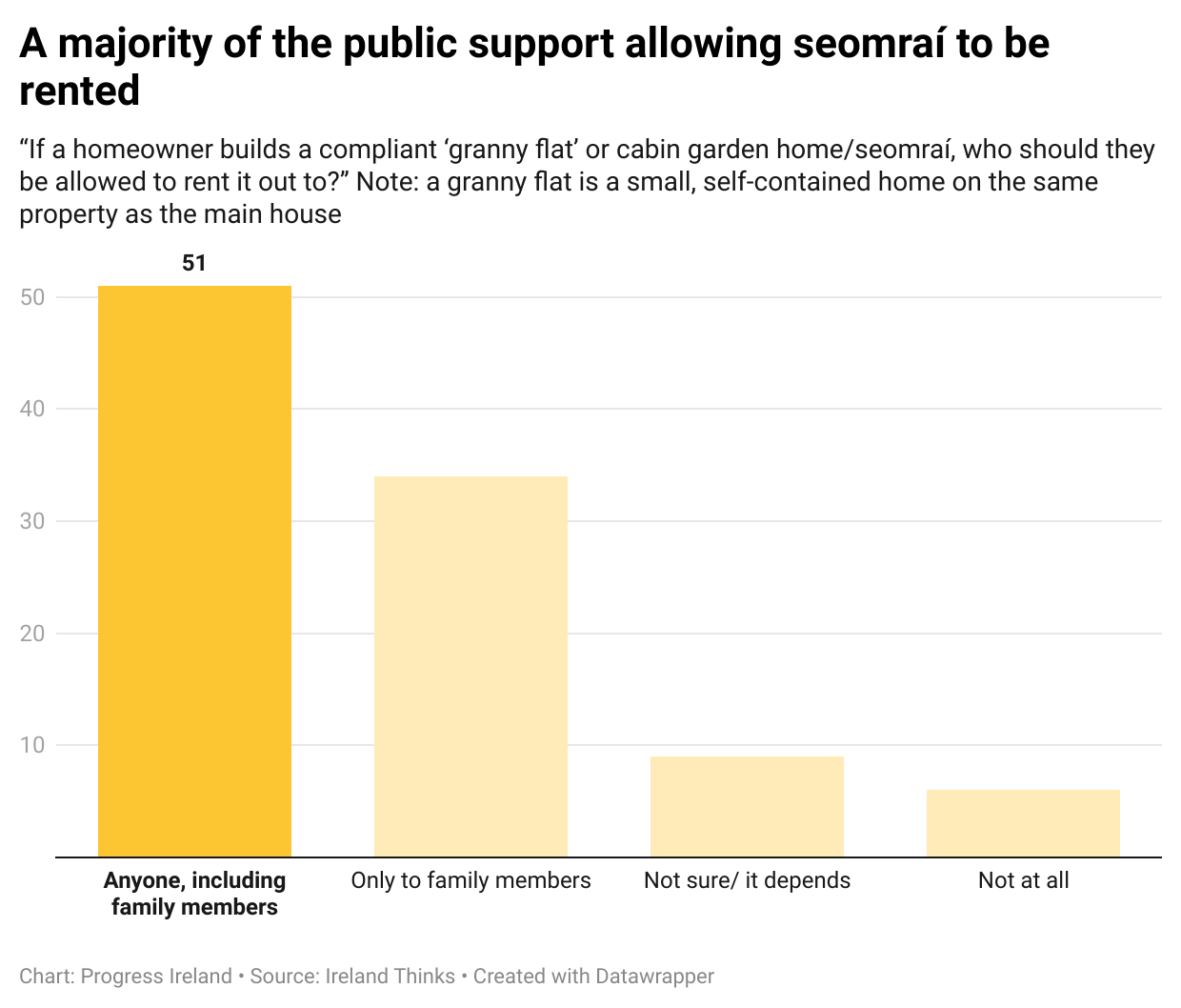
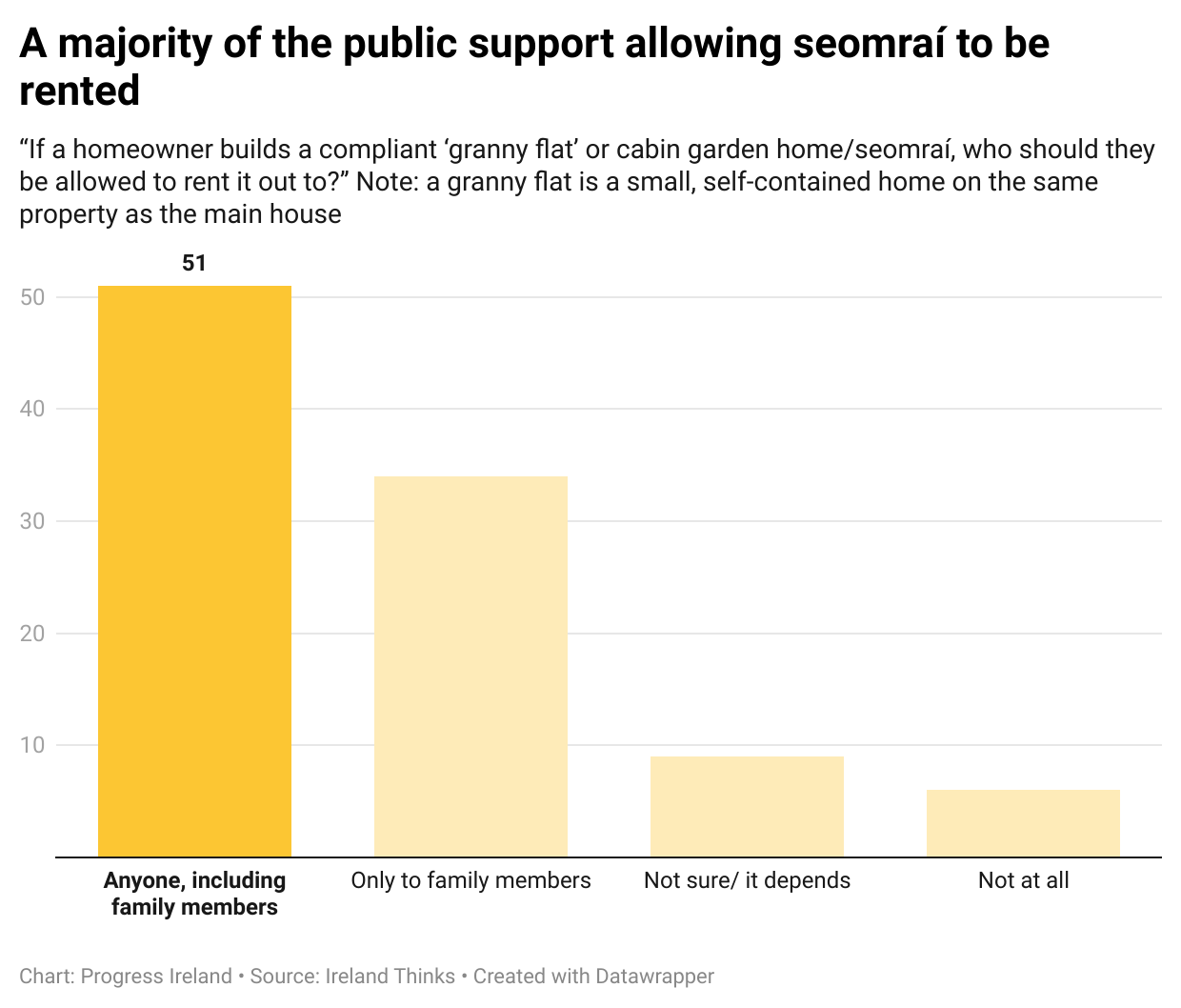
Second, it is popular. Most people assumed the policy would permit seomraí to be rented. And nevertheless, they supported the policy. To check this, Progress Ireland commissioned our own polling. 51 per cent of the sample supported allowing seomraí to be rented to anyone.
Why do all of this?
The main reason to do it the right way is because the policy addresses the three most important facts about Ireland’s housing shortage at once. These are its magnitude, the locations of scarcity, and the types of homes missing. In other words, how many, where, and of what type?
First, how many. The shortage stands somewhere around 300,000 homes. The Housing Commission completed extensive research to get to this figure (they got to a lower figure but poor housing delivery since means the real figure is now about 50k higher). The basic idea is that you take an estimate of underlying household size and compare that with observed household size. The gap between these figures is the best estimate of unmet demand.
Second, where. Where we put new homes matters because housing markets work locally. Those that want to live in Dublin will not have their needs met by a bungalow in Sligo and vice versa. Adding homes in low-demand places does not cut rents or expand job access in high-demand cities. This is why it is a mistake to believe that Ireland built too much during the Celtic Tiger. In urban areas, there has never been an oversupply of homes in Ireland.
The shortage in Ireland’s city and town centres is most acute. In Waterford city, with a population of 60,000 and its own university, there are five 1-bedroom properties available to rent.
Third, what type. Most new homes will have to be small, one or two bed homes. According to the Housing Commission, by 2050 Ireland needs somewhere between 615,00 and 1.1 million additional 1 and 2 bedroom homes. If we take the average of the Commission’s scenarios, Ireland will have to more than double its stock of small homes in the next 25 years.
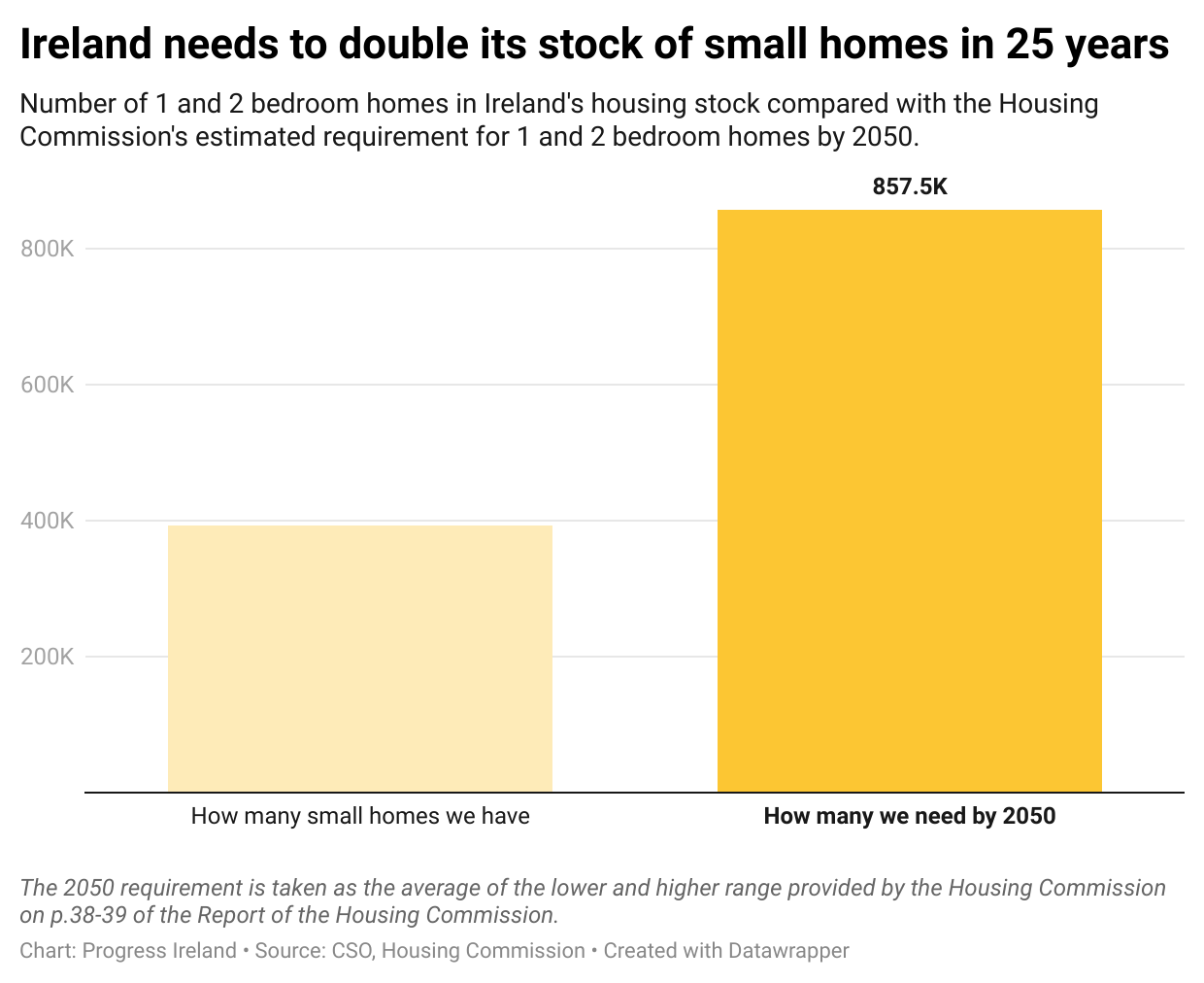
Put these three facts together and it is clear that Ireland needs to build more 1 and 2 bedroom homes in town, village, and city centres. How is Ireland doing on delivering these?
Too few, too big, too spread out
The existing data is limited. As a proportion of development, compact growth is high at just over 60 per cent. Compact growth means building within the existing footprint of a village, town, or city. High levels of compact growth should indicate that Ireland is building in the right places. But that would be too quick.
This is because “compact growth” statistics are misleading. They don’t tell us whether we are building in the right places. The reason is that compact growth takes into account “sequential” growth. That means, building on the fringes of any existing settlements constitutes compact growth.
It does not tell us if we are building in areas with the highest demand. As we have seen, building on the fringes of rural towns does not help people access urban labour markets in places like Dublin. Building in compact settlements in Portlaoise does nothing to prevent sprawl if the town functions as a commuter base for the Dublin labour market. But, the government still counts it as “compact.” So, what is the government doing to promote new homes in Ireland’s cities?
At present, the government basically has zero means of promoting infill projects at pace. Infill projects are those that happen “the gaps” within cities: think laneways, underused gardens, and derelict properties. There are grants and subsidies, such as the Croí Cónaithe cities scheme or the Urban Development and Regeneration Fund. There are planning measures such as Urban Development Zones. But uptake on the former has been slow. And the latter reforms have yet to be implemented in full. In short: we have a long way to go.
Will you say yes to more homes, where they are needed most?
Ministers, you’re faced with options here. You can choose to say yes to more homes, giving people an option that they currently don’t have.
The evidence from international cases shows what not to do. It says: do not artificially restrict the supply of new homes.
Politics is not, in this case, a reason for half-measures. Every poll available shows the public supports you in this policy.
I wish you every best wish in reforming the exempted regulations.
Best wishes,
Seán