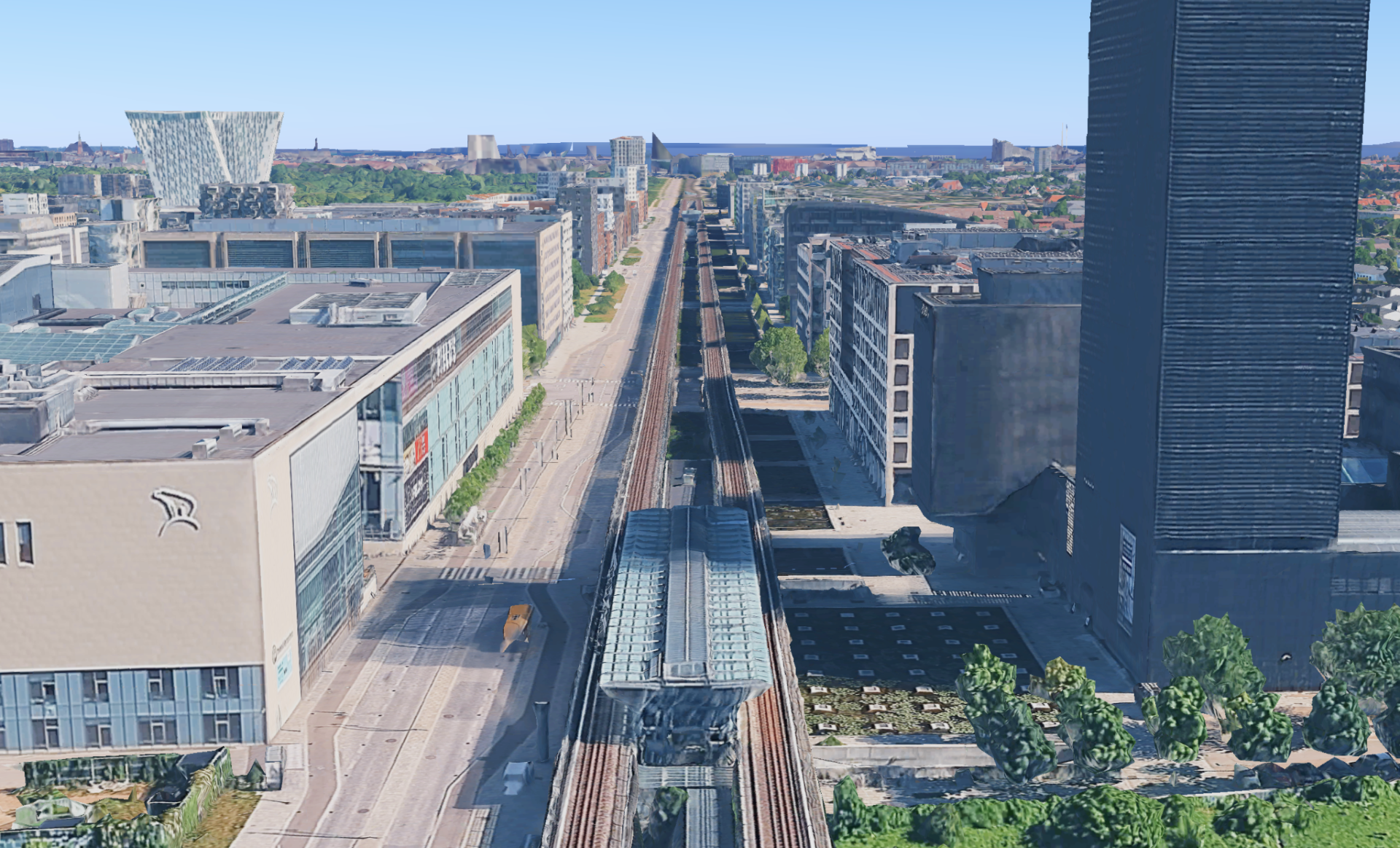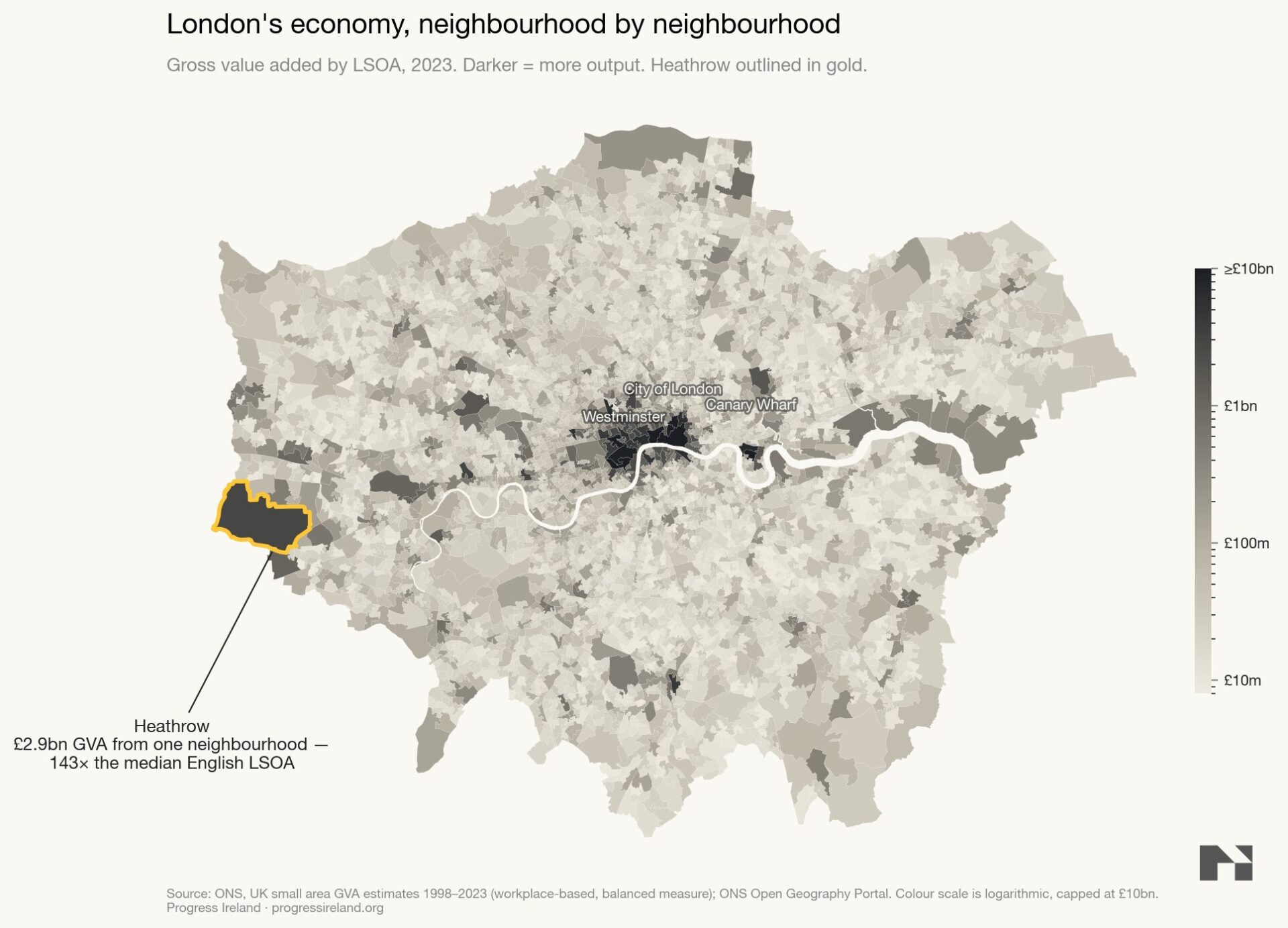
There is a brainworm that says it’s futile to build new roads, because new roads do not relieve traffic congestion.
There is a germ of truth in this. In the long run, new roads do not relieve traffic congestion. When new roads get built, they relieve congestion for a while; eventually, new homes and workplaces get built alongside them and congestion settles back to normal. The process might take five to ten years.
The problem with this brainworm is that it views roads from the individual drivers’ perspective. The driver only cares about how long their journey takes. They don’t care how many other lanes of traffic there are alongside them. Their employer, by contrast, cares a lot about how many lanes of motorway there are. Employers want to recruit from the biggest possible pool of workers. For employers, an eight lane motorway will be more useful than a four lane one – even if their traffic speeds are identical – because it will let them access more potential workers. This is why Dublin’s M50, Galway’s M6 and Limerick’s M7 are lined with office and industrial parks.
Even if you don’t care about the recruiting pools of large employers on the M50, traffic speed is not all that matters to you. The width of Ireland’s transport pipes matters at least as much as the speed of traffic. The number of people that can be processed through Dublin’s transport system at 8.30am on a Wednesday morning determines everything from incomes to housing costs.
None of this means every new road is worth building. Extra traffic brings emissions, noise and sprawl, and the trips a new road induces are, by definition, the ones that weren’t worth making when the road was busier. But ‘it will just fill up again’ is not, by itself, an argument against building anything – a road or a railway or a hospital. Filling up is the point.
At 8.30am on a Wednesday morning, the main routes into and around Dublin are full. This is a severe problem in a city that needs to add 15-25,000 homes per year for the next 30 years.
Let’s take account of things.
The theory and practice of ring roads
Reuben Smeed was an influential British transport statistician. Among other contributions, he chaired the 1964 government panel that first set out a practical scheme for congestion charging in the UK.
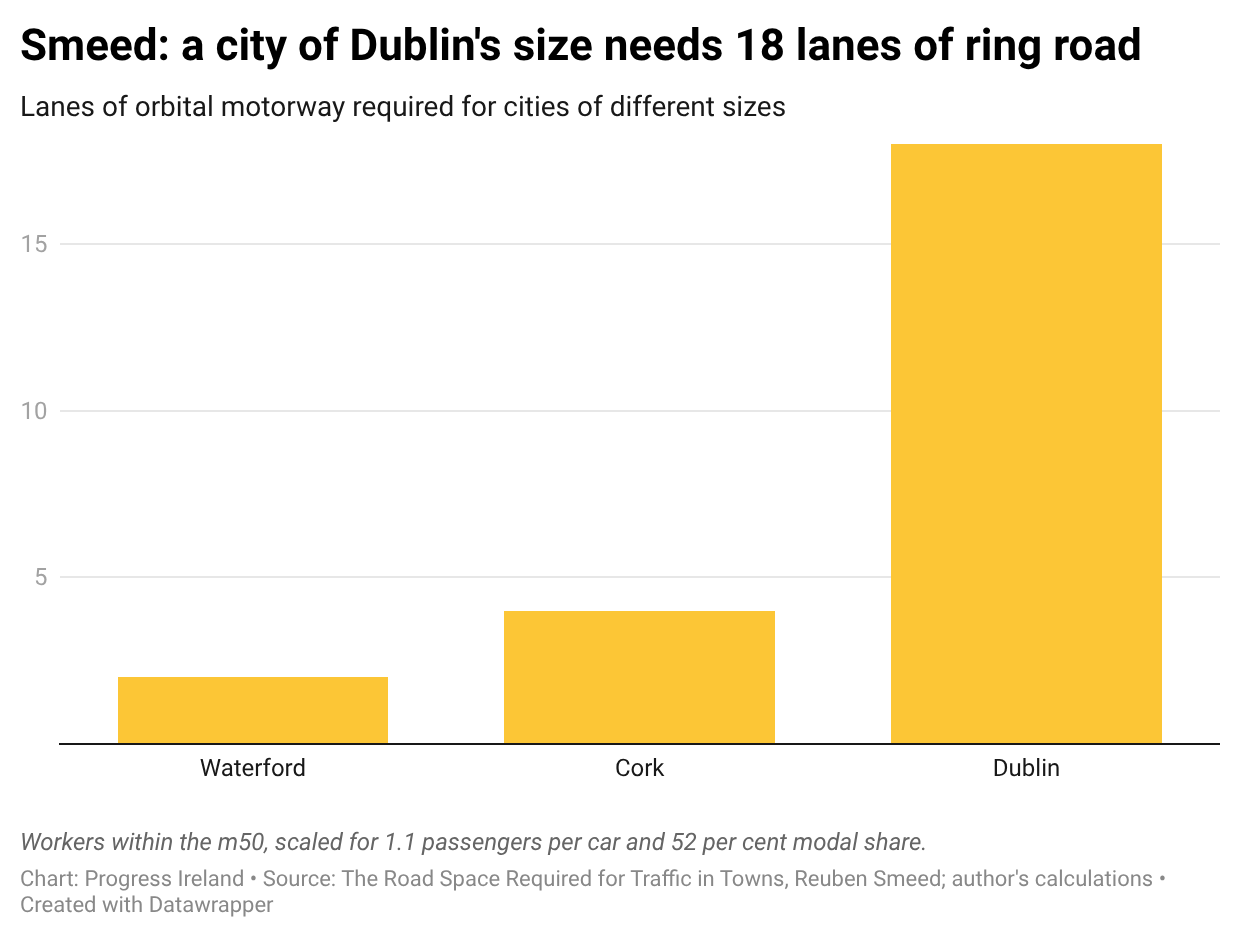
In 1963, Smeed wrote The Road Space Required for Traffic in Towns. The paper has a couple of striking findings. One finding is that orbital roads are more space and time efficient than radial ones. Smeed calculated that one lane of ring road is needed for every 25,000 or so workers driving into the city centre. Applying Smeed’s method to Dublin – with 1.1 people per car and 52 per cent of commuters driving – gives 18 lanes of ring road.
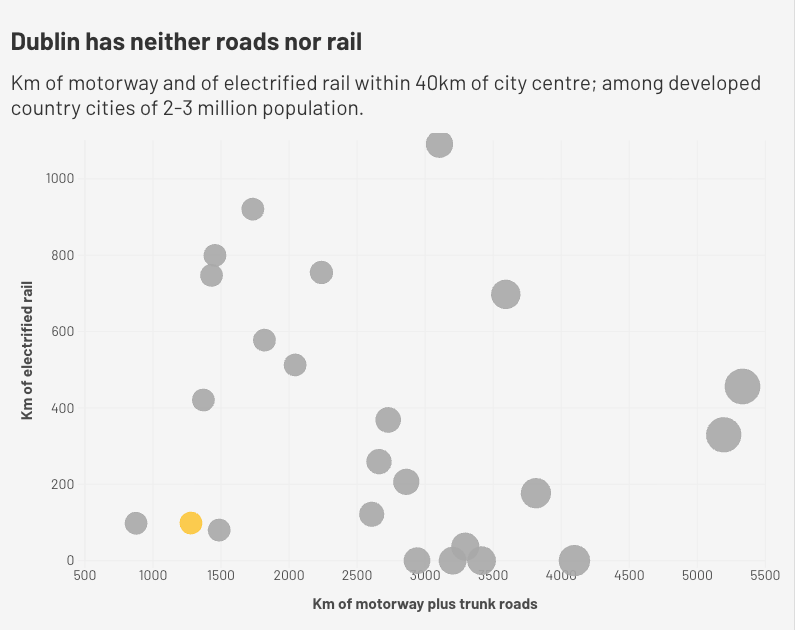
I wrote a few weeks ago about the amount of trunk road and electrified rail Dublin has, relative to peer cities. How does it compare to peers in its length of orbital road?
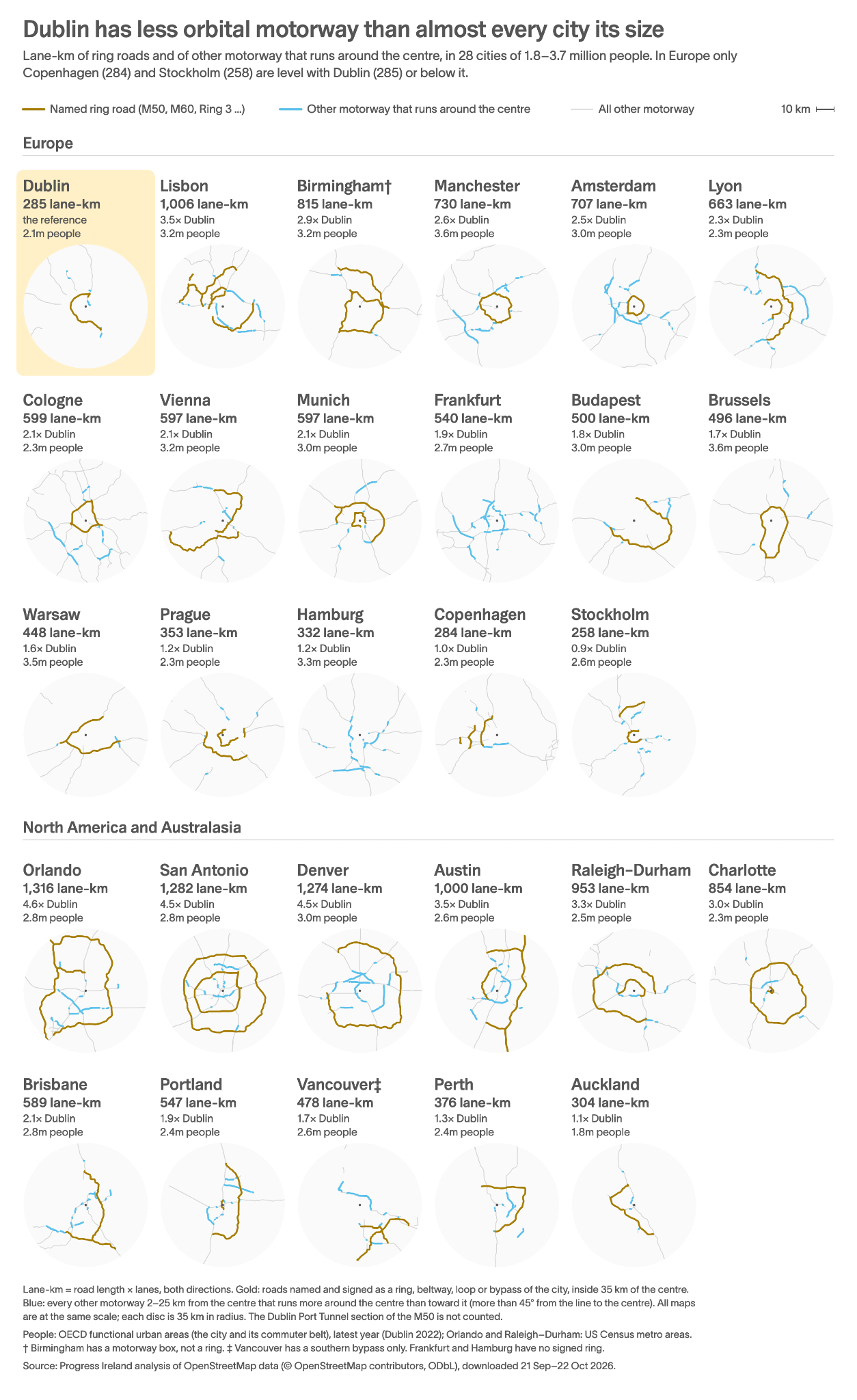
The following graphic compares Dublin to peer cities with a metro area population of 1.8-3.7 million people. Dublin is among the smallest of these cities, but it’s growing at one of the fastest rates. It’s on track for a population of three million in the 2050s.
The first group of peers are European. They tend to have more orbital motorways, as you’ll see. But most of them also have lots of electrified rail. I found last time that the average European peer city had five times as much electrified rail as Dublin.
The second peer group, from North America and Australasia, is arguably a fairer benchmark, since those cities have around as much passenger rail as Dublin. The typical one has three times Dublin’s ring road.
The M50 in numbers
Going by theory (Smeed) and by the peer cities, Dublin has far less orbital motorway than a city its size usually has. The typical peer has twice Dublin’s total. Even per head of population, the typical European peer has 40 per cent more, and the typical North American or Australasian peer nearly three times as much. How does that manifest in practice?
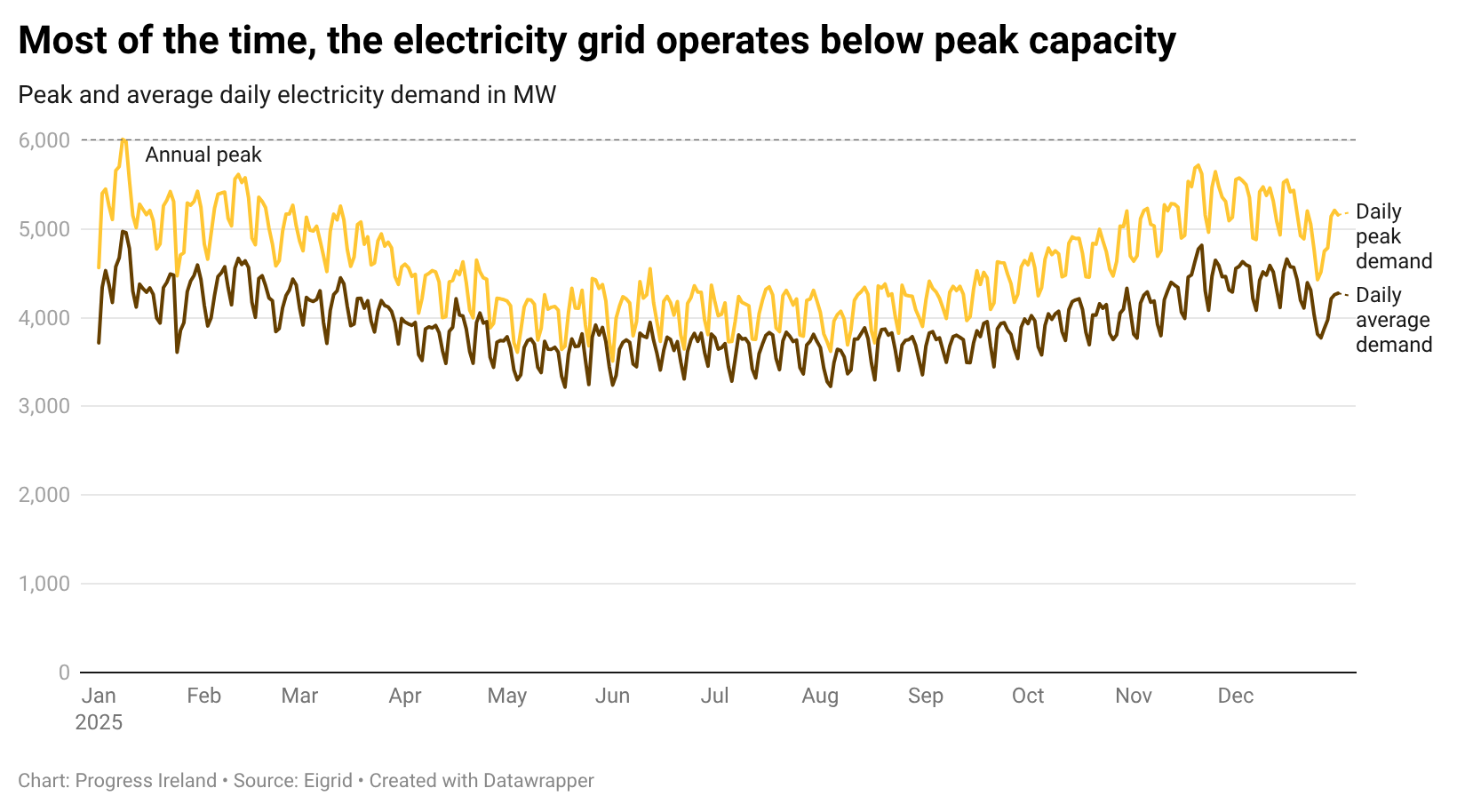
The test for any transport system is supply and demand at peak hours. Does it have the capacity to carry the required number of people to work at 8.30am on a Wednesday in winter?
On its busiest stretch, between the N4 and the N7, the M50 carries at most about 6,100 vehicles an hour southbound. What we’re seeing is that it hits that limit earlier and earlier each year. Drivers are getting up earlier to beat the rush. Morning rush now starts 46 minutes earlier than in 2014.
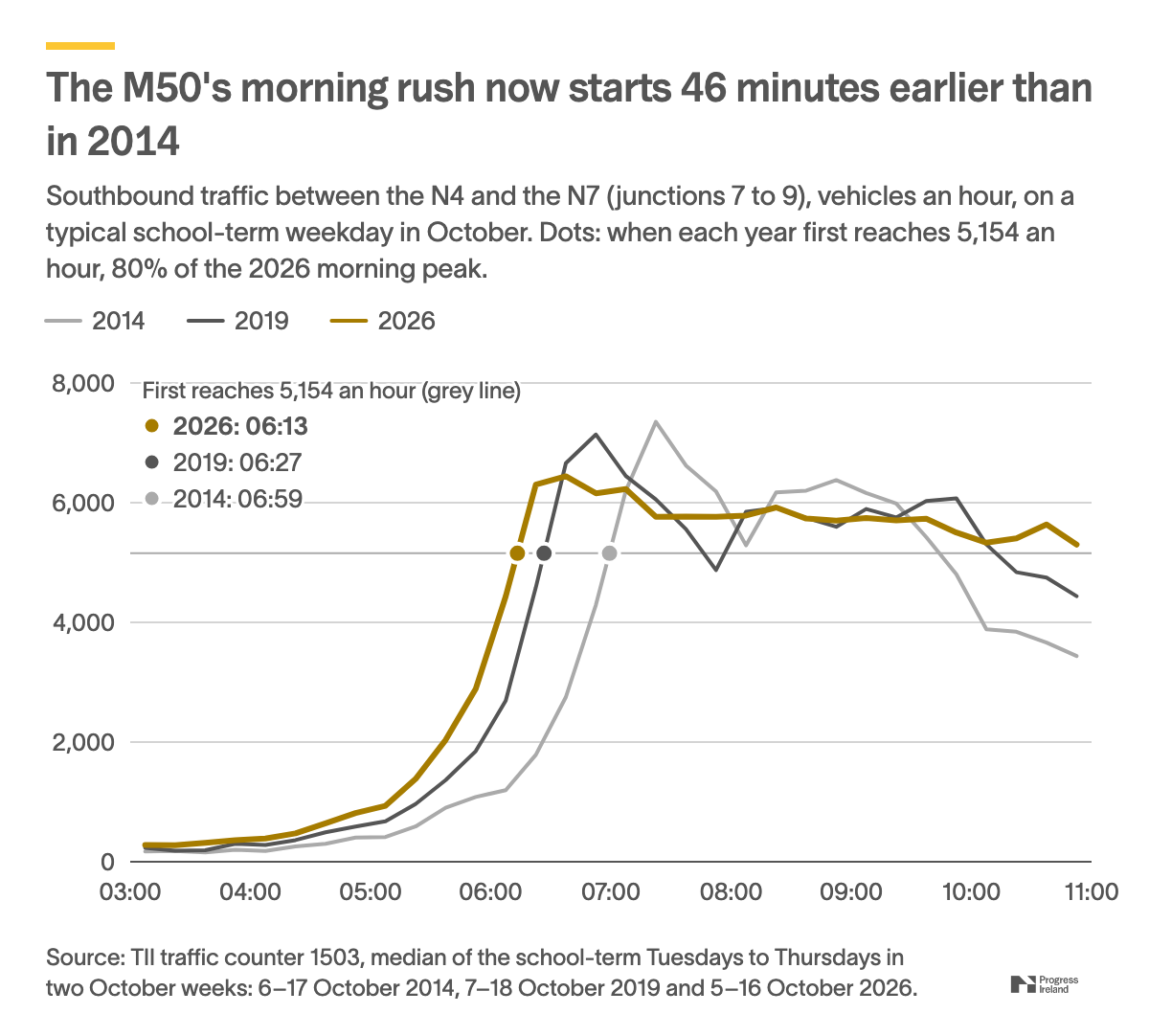
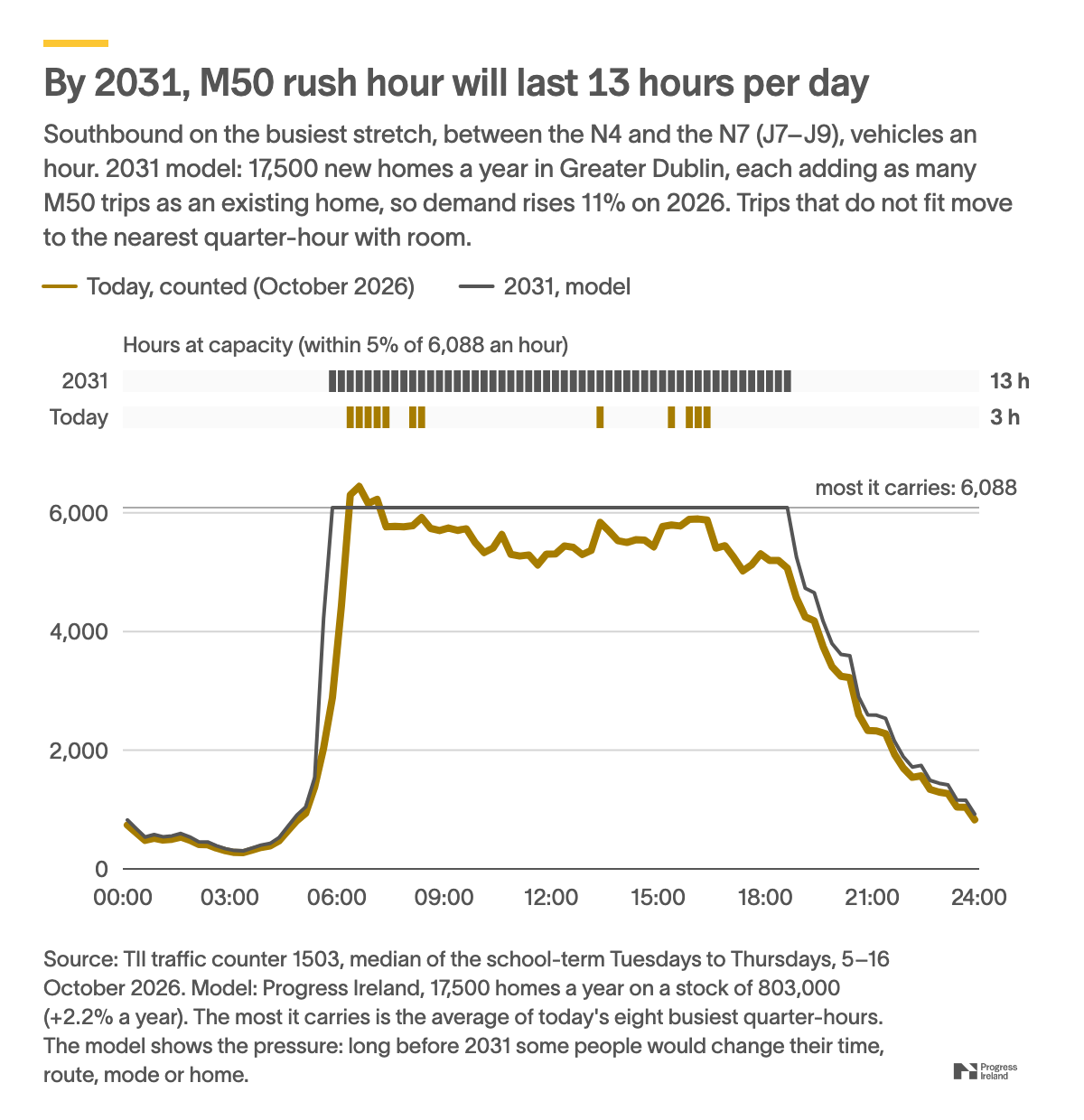
The M50 already runs close to that limit for most of the working day. If Greater Dublin keeps adding about 17,500 homes a year and nothing else changes, then within five years rush hour on its busiest stretch will run from before 6am to about 7pm1.
Another problem with a longer rush hour is the airport. Dublin airport is busiest in the early morning. This has never been a problem since the airport’s rush hour preceded the commuter rush hour. But in recent years year, the commuter rush hour starts an average of two minutes earlier, each year. Within seven or eight years, the commuter rush hour will start to overlap with that of the airport.
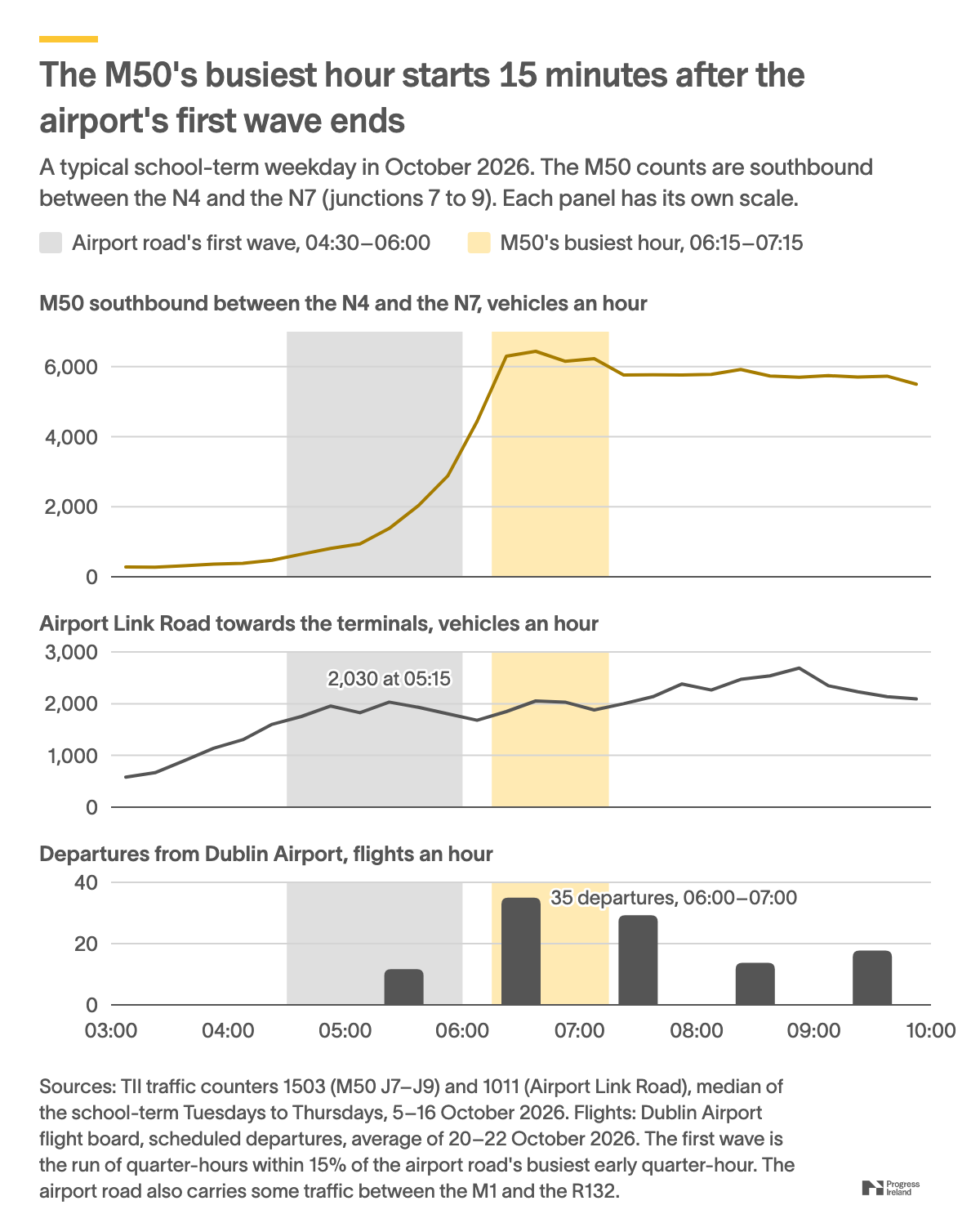
Why does it matter if the airport’s rush hour and commuters’ rush hours start to overlap? It matters because journey speeds to the airport will start to drop. Adding demand to roads drops throughput by about ten per cut, ands lowers average speed by 50 per cent or more.
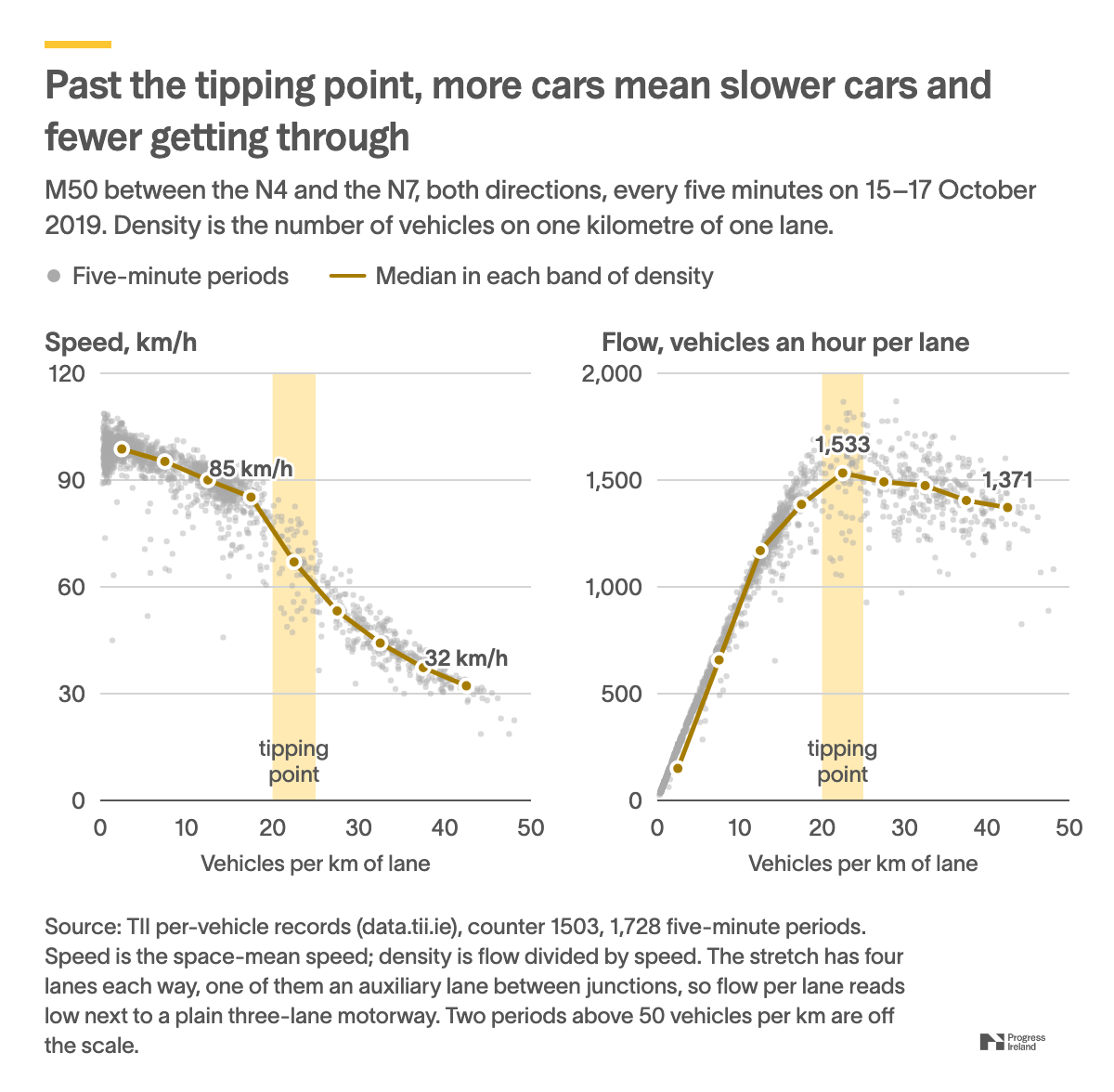
By how much might journey times rise at the busiest part of the M50 in coming years? By my back of the envelope calculation2, 17,500 new homes in greater Dublin translates to an extra 4-5 minutes on a one-way rush hour commute through the Red Cow. That’s every year.
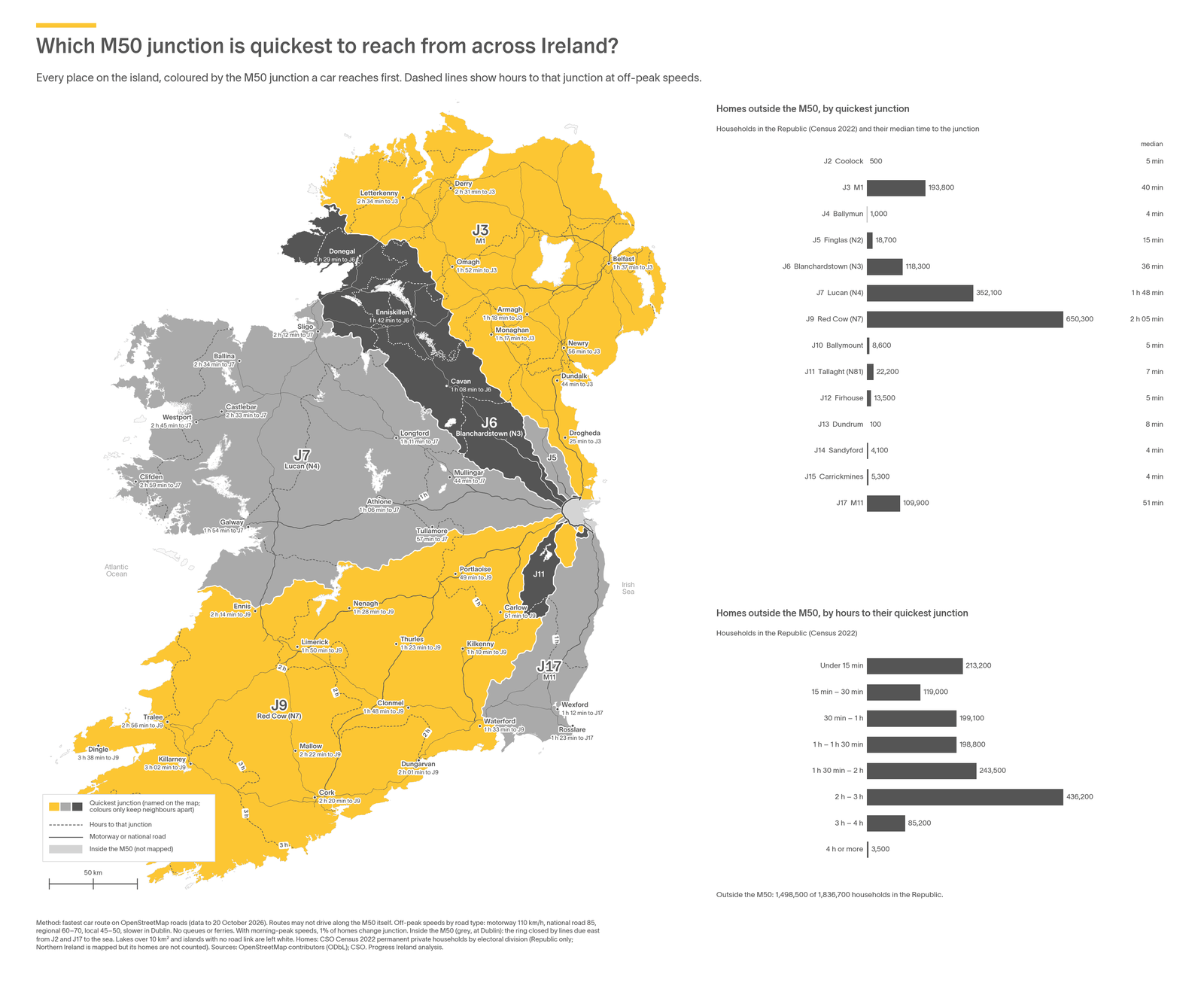
The Red Cow is the bottleneck because it’s the crossroads of Ireland. It’s where the most populous regions of Ireland connect to the capital. It’s hard to build new housing in Greater Dublin, and Ireland. without putting more pressure on the Red Cow.
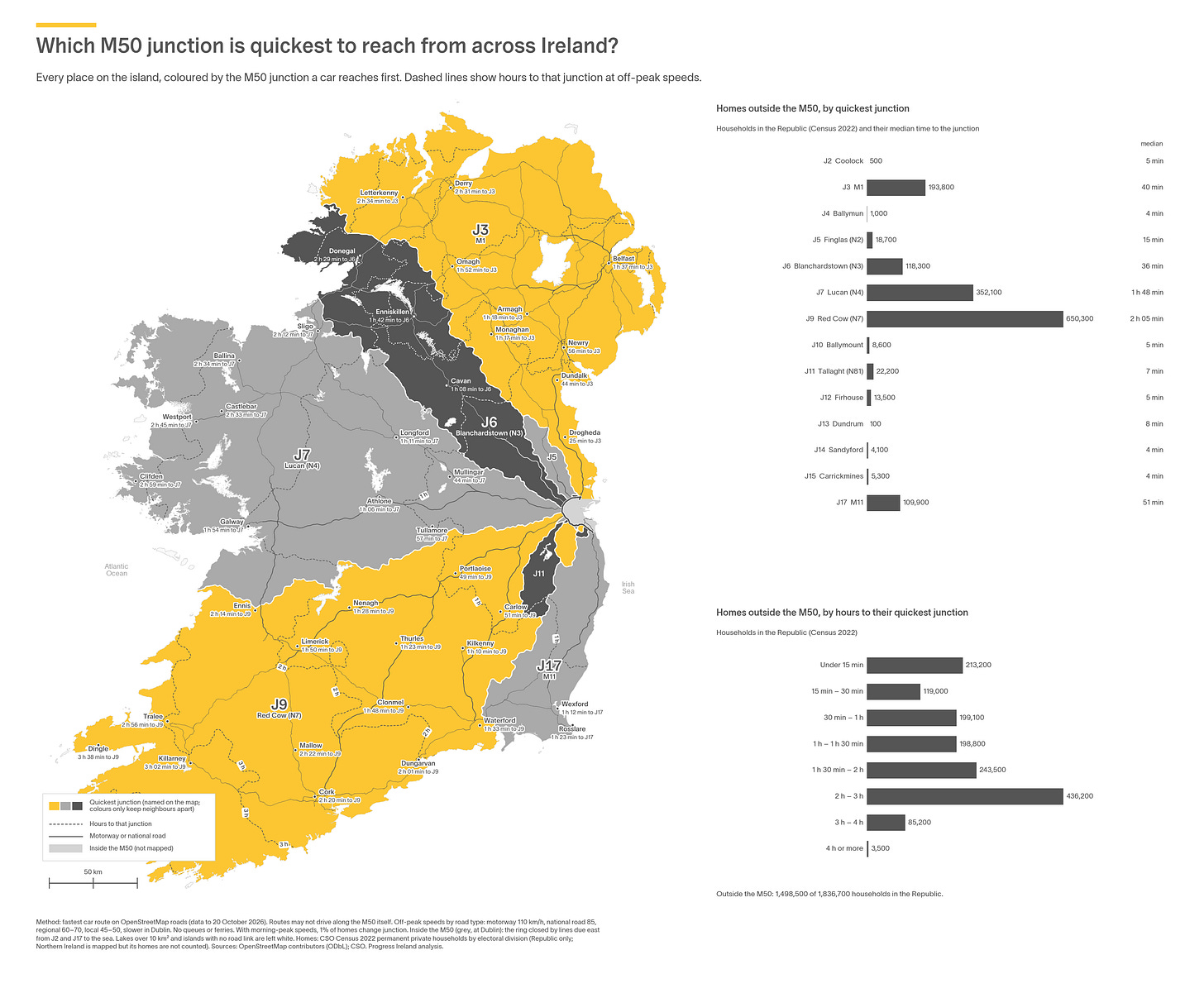
It’s a difficult situation. Greater Dublin needs something like 700,000 more homes by the 2050s. The M50 is full. It’s hemmed in and can’t be widened. There’s little appetite for a new ring road on either the east or west of the city. Congestion charging could get rid of wasteful queues, and raise road speeds. By keeping traffic below the tipping point, it could even win back the tenth or so of throughput the M50 loses when it jams – roughly five years’ worth of growth in demand3. But it can’t add new capacity, which is what’s needed in a city growing as quickly as Dublin.
Given the traffic, why is there so little call for new roads? Part of it might be the brainworm. Another might be an intuition that more sprawl is not the best way to grow.
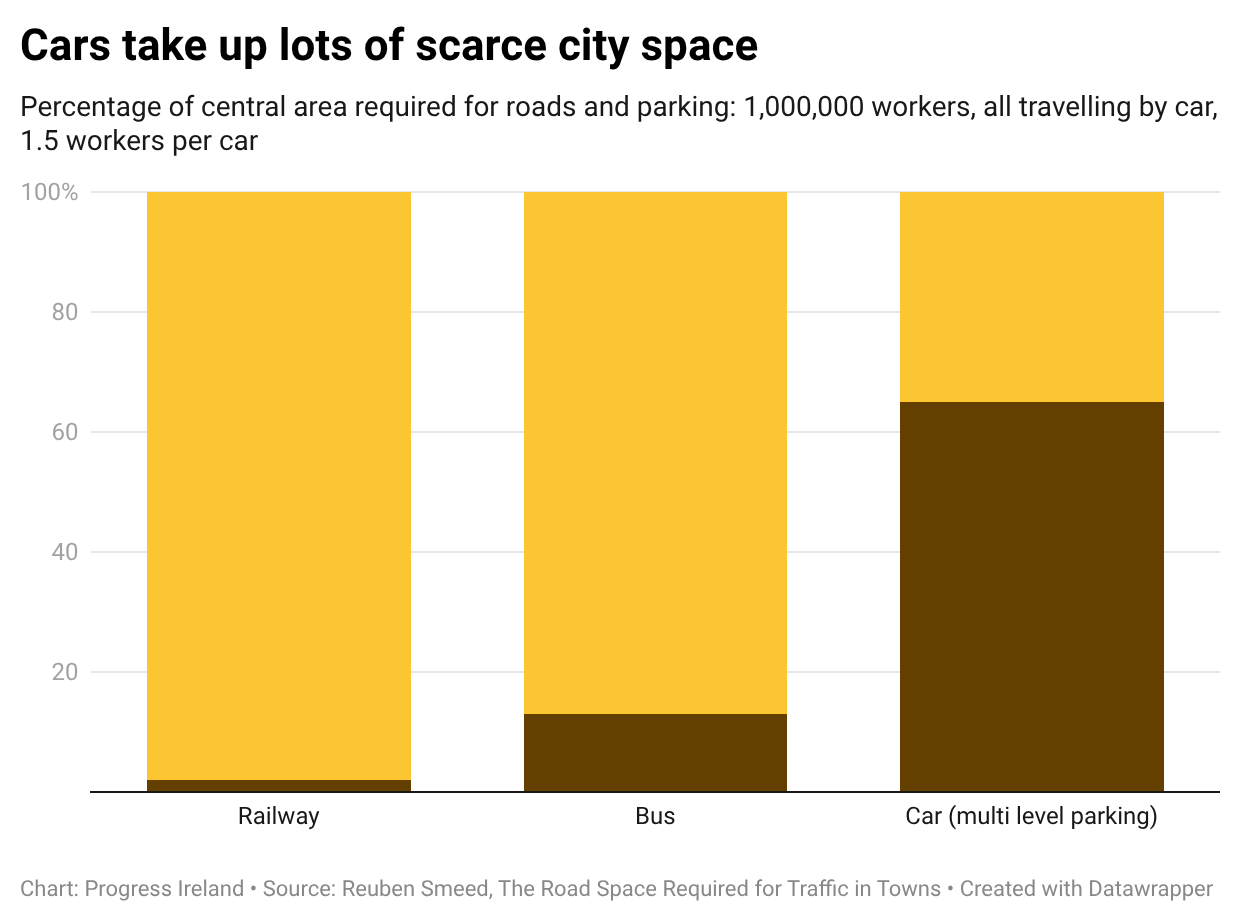
Another calculation in Reuben Smeed’s The Road Space Required for Traffic in Towns concerns the percentage of city centre land required for each form of transport. The calculation below concerns a city about twice the size of Dublin. But it gives a sense of how hard it is to move big numbers of people around using cars alone.
Dublin needs more roads, for sure. But roads alone won’t do it.
1 This would be ameliorated in practice by people changing departure time, route, mode or home before it came to that. This is its own cost.
2 Assume the Greater Dublin Area builds 17,000 houses per year. Assume the average household in one of those houses makes 0.7 journeys by car during the three hour morning peak. These houses will generate 11,900 morning peak journeys. If we assume, based on where we think the houses might be built and where people might be going, that 10 per cent of those journeys are between the Red Cow and the N4 on the M50, then we have 1,250 journeys in the morning peak period and 1,400 in the evening peak. If we assume 60 per cent of the evening peak journeys are in the congested direction, we get 840 vehicles that need to get through the queue. If the queue discharges at 5,500 vehicles per hour, we need nine minutes of road to let them through. But, as the queue is always present, they are likely to arrive evenly through the queue, and so will on average delay themselves by half that time, four and half minutes So, a journey that takes 30 minutes now, will, if all of these assumptions are correct, take 35 minutes next year and 53 minutes in five years. Note, we have assumed that all of these journeys are extra, i.e. that people are not making these journeys already. We have also assumed that there is no change in road capacity, journey routes, journey times or travel choices.
3 Tolls can increase throughput by five or six per cent. In the October 2019 school mid-term, the southbound M50 carried 6.2 per cent more vehicle-km between 07:00 and 09:00 than in term week. The average speed was 59 km/h, against 39 km/h in term week.
Last updated: