My kid’s teacher quit her post this summer. She had been 12 years in the job, and she loved the school. But she had a problem: the M50. Her commute from west Dublin to the school in Fairview, which once took 45 minutes, now took her an hour and twenty. It was too much.
When she started in the job, Ireland’s transport system was in reasonably good nick. In 2016 Ireland had a newly built motorway network and new light rail. The system was busy but not overwhelmed.
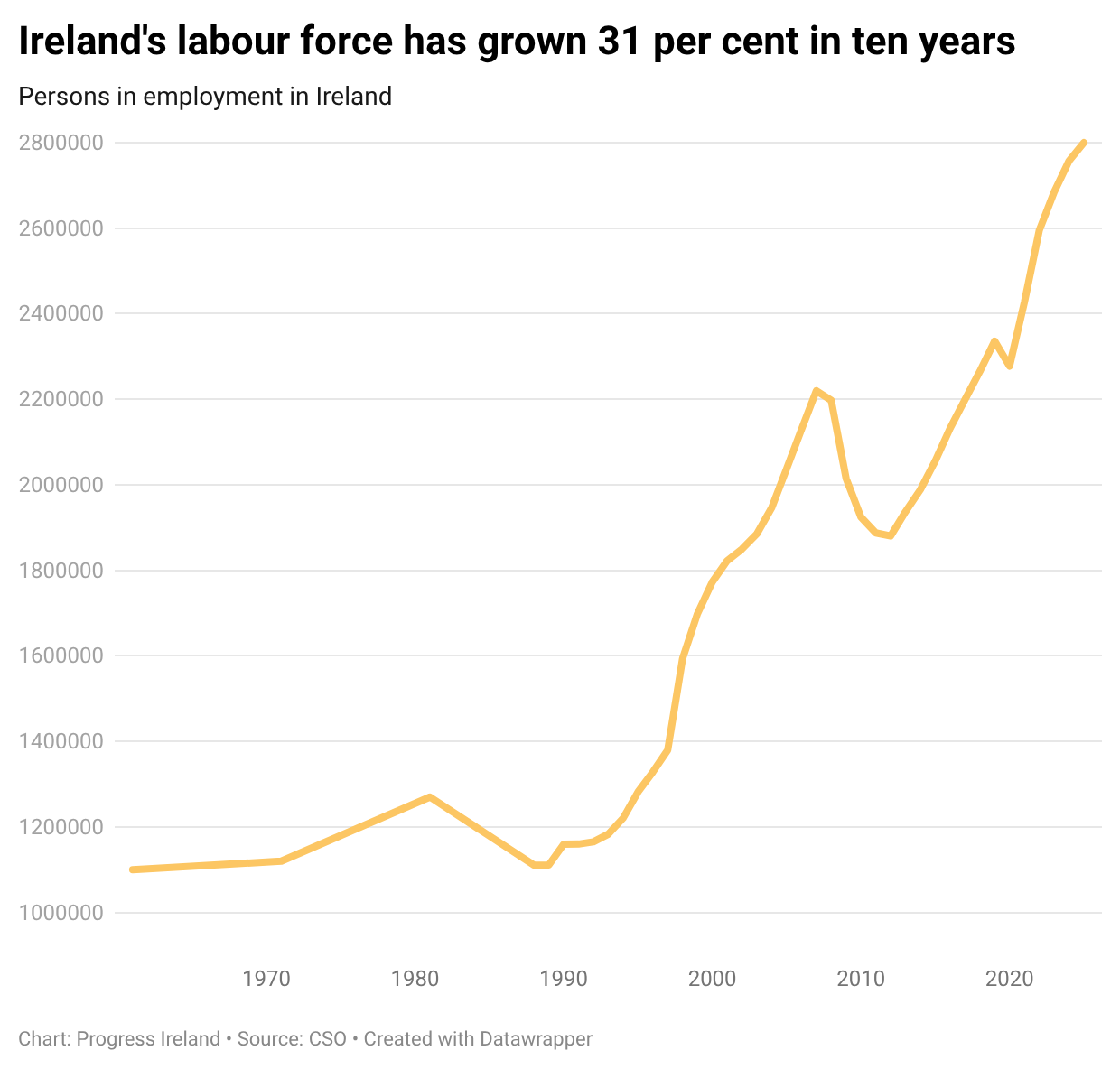
What has happened since is that Ireland has gotten much more prosperous and more populous. In ten years, greater Dublin’s labour force has grown by 28 per cent. The transport system hasn’t kept pace.
How big is this problem?
Transport quality
Before I get started: what follows are charts making the case that Dublin and Ireland has outgrown its transport infrastructure. The charts compare Ireland to other places. One caveat is that we’re talking about diverse countries with diverse transport systems and diverse accounting standards, so precise comparisons sometimes don’t work. But the overall picture is clear.
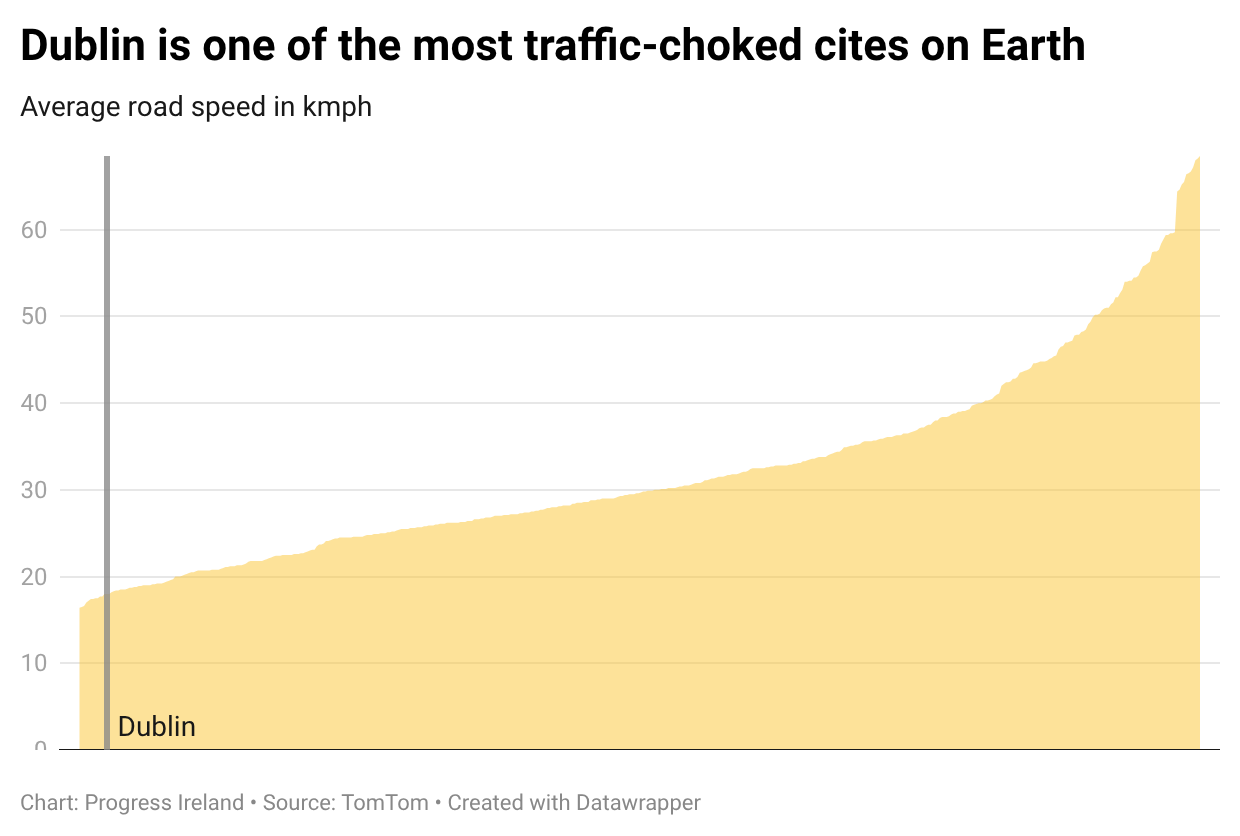
We know Dublin’s public transport is bad. What might be under-appreciated is how bad its roads are. Of the 492 cities from which satnav maker TomTom collects data, road speeds in central Dublin are the seventh-slowest (17.4 kmph). Traffic moves more quickly in Hanoi.
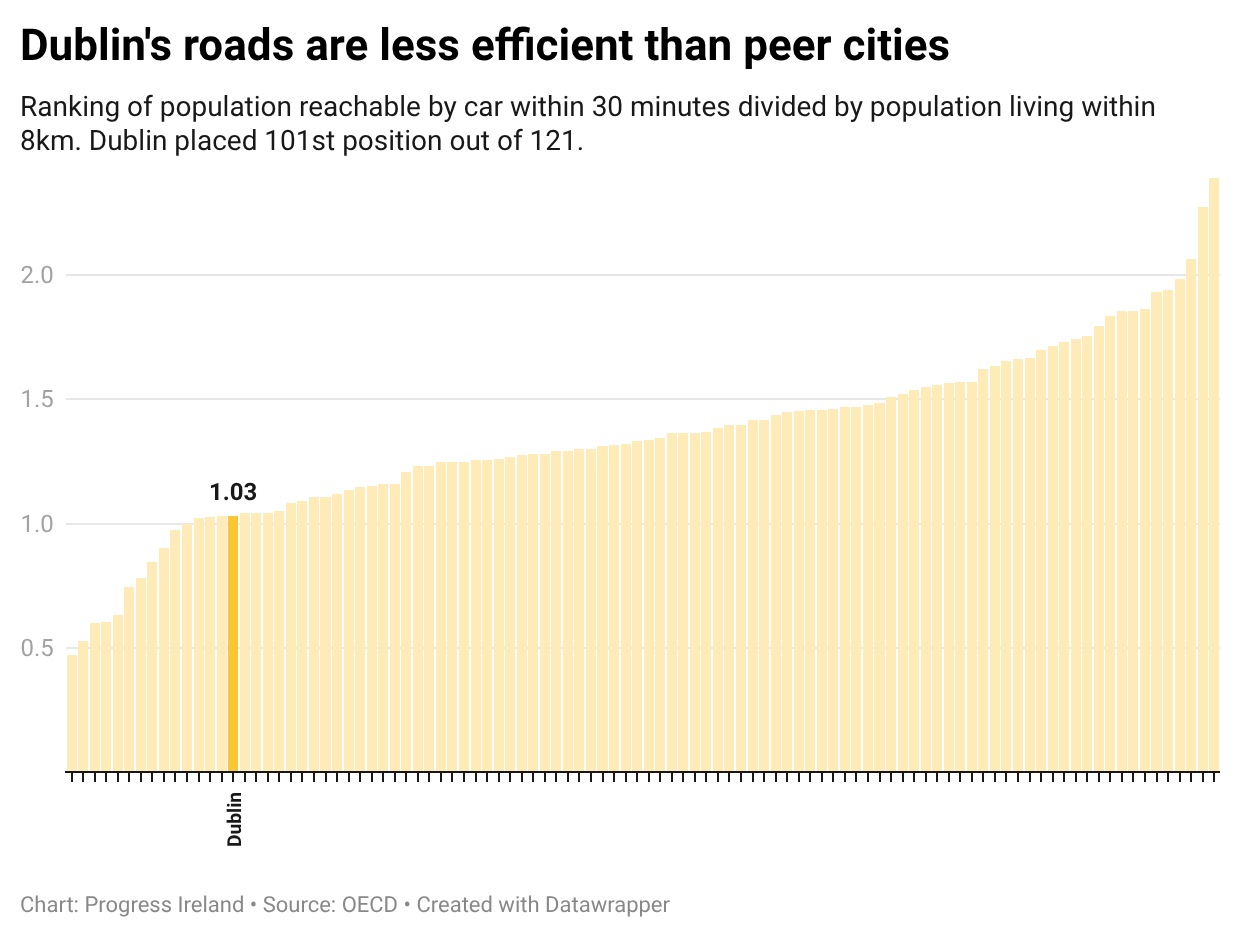
The OECD’s measure of road performance is the city’s population that’s reachable by car from a given point within 30 minutes, divided by the population living within eight kilometres of the point. Of the 121 cities measured by the OECD, Dublin ranked 102nd.
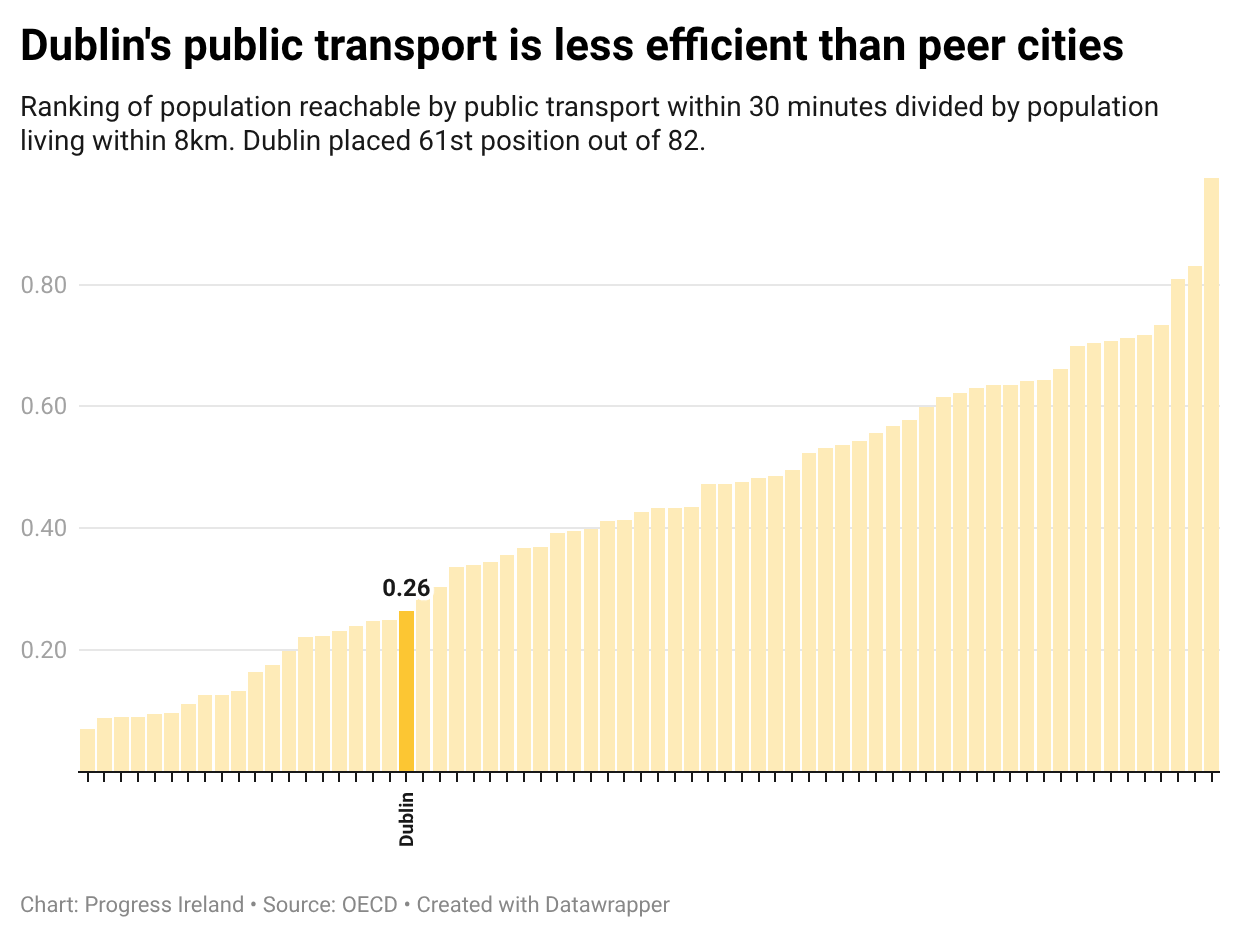
Dublin’s public transport ranking would probably surprise you less. By the same OECD metric (population reachable divided by population within eight kilometres), Dublin’s public transport ranked 61st out of 82.
Transport quantity
There is a perception that Dublin is short on public transport but blessed with plenty of roads. That’s not right.
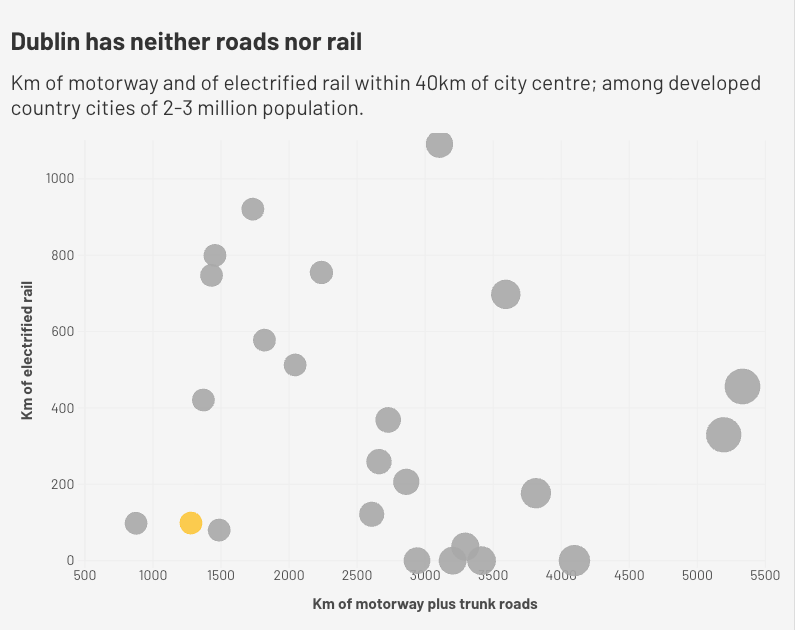
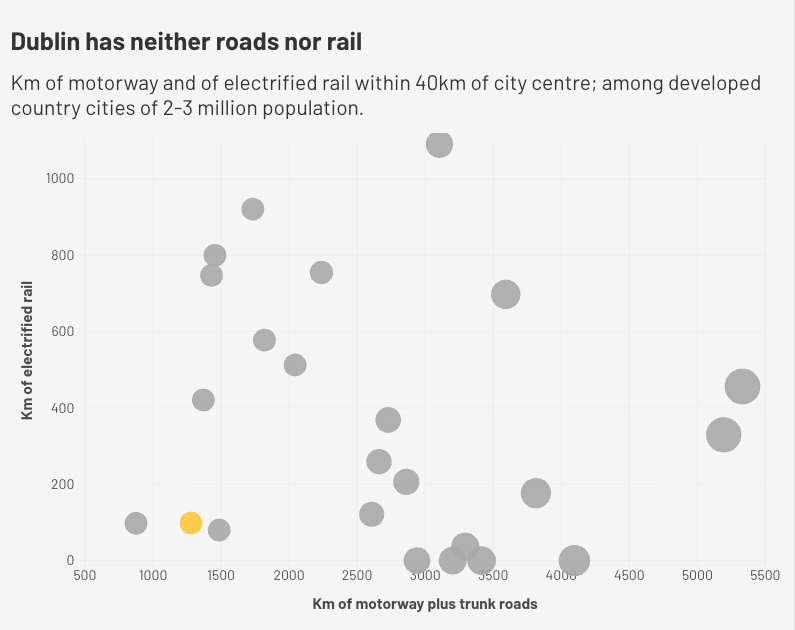
While it’s true that Dublin is short of public transport, it’s also badly short of roads for a city of its size. The following chart surprised me. It shows how Dublin compares to peer cities — developed country cities with a metro area population of 2-3 million — in terms of road and rail infrastructure. The specific measure is kilometres of electrified rail (Y axis) and motorway (x axis), within 40 kilometres of the city centre, per million of population.
Dublin is near the bottom left corner. It hasn’t got the motorways of American peers like Raleigh-Durham, Charlotte or Austin; or the electrified rail of European peers like Copenhagen, Manchester or Stockholm.
The median European city has 1.4 to 1.6 times Dublin’s roads and 5.6 times Dublin’s electrified rail. Ireland is 12th of 27 in the EU for motorway per person, and last of 24 for electrified rail.
Another point to note is that the places we associate with great public transport like Vienna, Munich and Amsterdam have lots of road as well as lots of rail. The fact of the matter is that roads are the workhorse of every transport system in the world, from Switzerland to Japan. Public transport infrastructure is a great idea but at its best it complements roads. It can’t replace them.
You might argue that Dublin is smaller than those places. It’s true that Dublin’s at the bottom end of the 2-3 million metro area range I identified. But it’s also growing very quickly. On its current trajectory Dublin’s metro area population will surpass 3 million in the next 20 years. So we need to get building!
Traffic: even worse than you think
The badness of transport congestion is, if anything, underrated.
First, traffic drives up rents and house prices. The amount of housing that can be built is directly related to the availability of transport. In order for housing to be useful, people have to be able to get to work from it, which means that what we are really short of in Ireland is land within commuting distance of work.
Transport functionally creates land. By allowing more people from a given patch of land to reach their jobs and amenities, better transport enables more homes at greater density. This is recognised in our national guidelines for development density in 2024. As an example, a hectare of land in a suburb of Dublin would be expected to provide between 40-80 houses. In contrast, a hectare within one kilometre of a DART, Luas or MetroLink station in the city can accommodate up to 250 homes.
Second, traffic reduces our wages. We all live up to our earning potential by finding a job that’s a good fit for our quirky strengths and weaknesses. The bigger the city, the more jobs are available within commuting distance of our home, the better fit we’ll find for our talents, and the higher will be our productivity.
In a hamlet in the year 1741 we had a choice of three jobs: farmer, miller or blacksmith. Today we can work as chefs specialising in Japanese food, compliance consultants for airline industry recruiters, or childcare providers for kids under two.
A bigger city results in better matching and higher wages. The same is true for a better transport network for a given city size. The more efficient the transport network, the more jobs will be commutable. As urban economist Alain Bertaud said, a city is a labor market and the size of this labor market is the number of jobs that can be reached within one hour.
Congestion reduces the effective size of the labour market by making it harder for people to commute to work. Bertaud cited research that found a 10 per cent increase in commuting speed increases the effective size of the labour market by 15-18 per cent, implying that a 10 per cent slowdown reduces it by the same amount. Using mainstream estimates of the impact of the size of the labour market on productivity, this would imply that a 10 per cent increase in traffic congestion reduces our wages by around €250-500 per year on average. If a long commute stands between you and your dream job, you’ll be less likely to take it.
Third, traffic wastes our time and makes us miserable. According to TomTom, the average driver in Dublin lost 191 hours in 2025 in rush hour traffic – more than in Mexico City. The 2022 census found that over 107,000 people in Dublin, Meath, Kildare and Wicklow have a commute of an hour or more to work. Compared to a more typical half an hour, this represents a loss of at least 21 million hours per year. Alois Stutzer and Bruno Frey found, using data from Germany, that people who commute an hour each way require about 40 per cent more income to be as happy as people who do not commute.
What’s next
To be sure, work is underway on these problems. BusConnects, its forecast, will move 245 million people per year, a 36 per cent increase over the old network. Metrolink is forecast to move 53 million per year. Dart West and Dart South West could facilitate 15-20 million trips per year (my estimate). Four tracking the line into Connolly could facilitate an extra 10 million (my estimate).
What I’m saying is that, due to extremely rapid population growth, this problem has crept up on us. To get Ireland out of the bottom-left of that scatterplot, the system needs a major upgrade.
That will require new motorways and an even bigger vision for rail.
Last updated: