To get enough homes built, Ireland needs to build all of the stuff that comes with them. Meeting housing targets means delivering enough water, roads and electricity connections. Call all of this housing-infrastructure.
In a healthy housing system, rising demand leads to more homes rather than higher prices. For that to happen, other things have to respond to demand too, like labour and finance. Housing-infrastructure has to respond as well. But the way Ireland funds and delivers it makes homes scarcer and more expensive.
How much does infrastructure cost?
Housing-infrastructure is expensive. How expensive depends on what you count and where you build. For an apartment on a serviced site in Dublin, development contributions and utility connection charges come to about €24,000 per home, as I set out in my last piece. For a three-bed semi on a greenfield estate, the developer also has to build the roads, pipes, lighting and open space that serve it. The SCSI puts those works at €25,000 to €38,000 per house. Once we had levies and connection charges and the total is roughly €35,000 to €54,000 per home, depending on the region.
Big sites need more funding on top of that. “Offsite” infrastructure, like a link road or a bridge, can need its own planning permission before any homes are built.
Who really pays?
On paper, two groups pay for housing-infrastructure: developers and the State. Developers pay development contributions and connection charges, build infrastructure themselves (think of the road outside your house), and provide parks or pay the council to provide them.
How does this show up in house prices? The natural answer is that if infrastructure costs a developer €10,000 per home, the home costs €10,000 more.
The natural answer, though intuitive, is mistaken. The standard way economists think about this question is to ask which part of the process is the least elastic. A charge usually falls on whoever is least able to respond to it. For example, if a government taxes cigarette companies, the company will raise prices. This is because demand for cigarettes is relatively inelastic. Some price increases don’t decrease the number of cigarettes demanded (you can guess why). In the case of infrastructure charges like development contributions, economists’ answer would be that their cost is capitalised in land prices: developers pay less for land since they know they will be charged a development contribution.
It is easy to take this line of thought too far and conclude that higher contributions cost buyers nothing. High infrastructure costs can, and in Ireland’s case do, raise the price of housing. They do it by reducing supply.
Costs decide what gets built
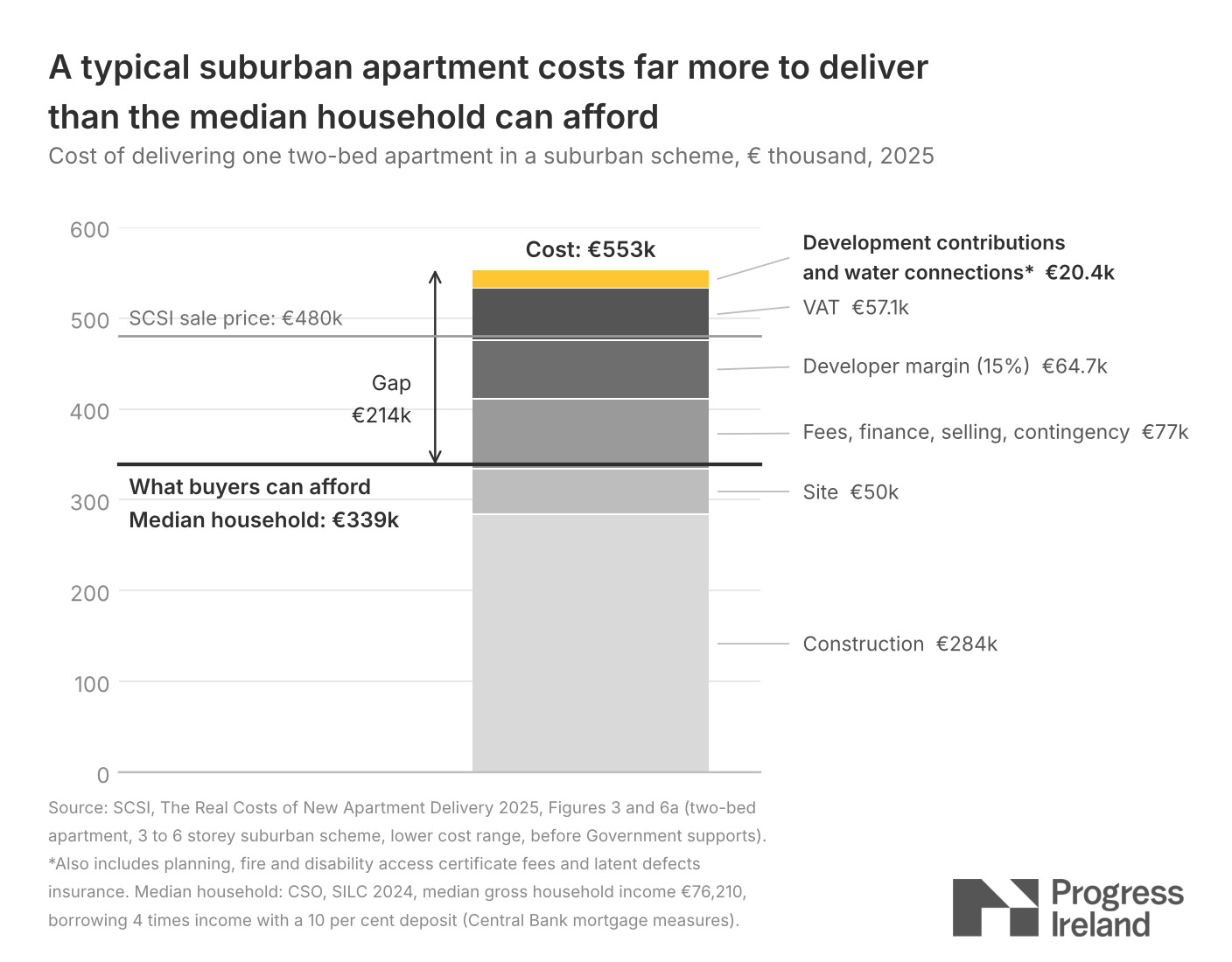
If it costs more to build something than people will pay for it, it won’t get built. Infrastructure charges are one of the costs every development has to cover. A typical two-bed apartment in a suburban scheme costs about €553,000 to deliver, including a normal margin and VAT. It sells for about €480,000. A household on the median income, borrowing the most the Central Bank’s rules allow with a 10 per cent deposit, could afford about €339,000. Development contributions are not the only cost pressure and removing them won’t “solve” the viability issue. But schemes sit at different points and for some, a €20,000 per home saving could push it over the line into viability.
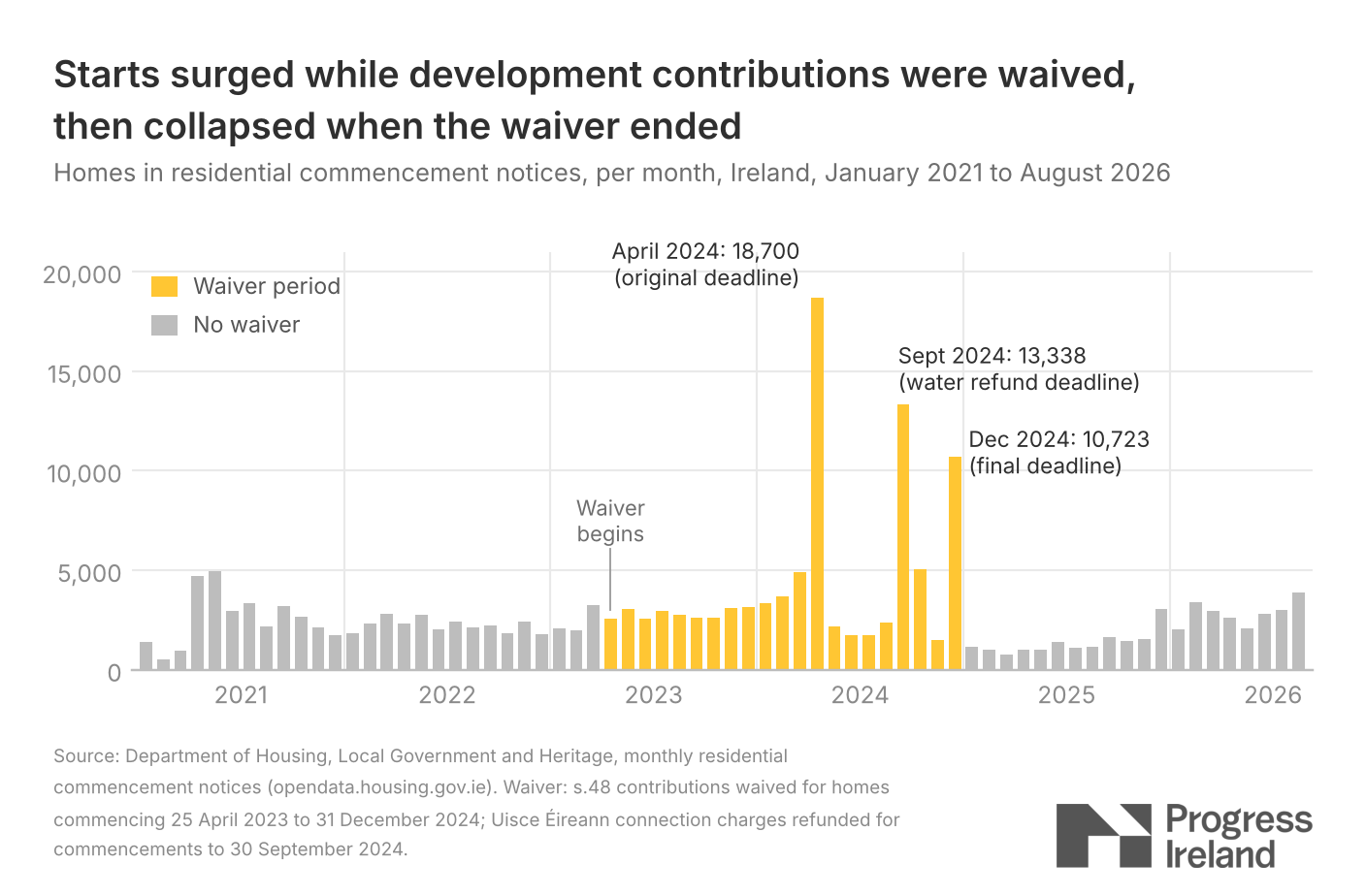
When development contributions and water connection charges were waived for homes started between April 2023 and the end of 2024, commencements more than doubled, from 32,801 homes in 2023 to 69,311 in 2024, with big spikes before each deadline (Department of Housing).
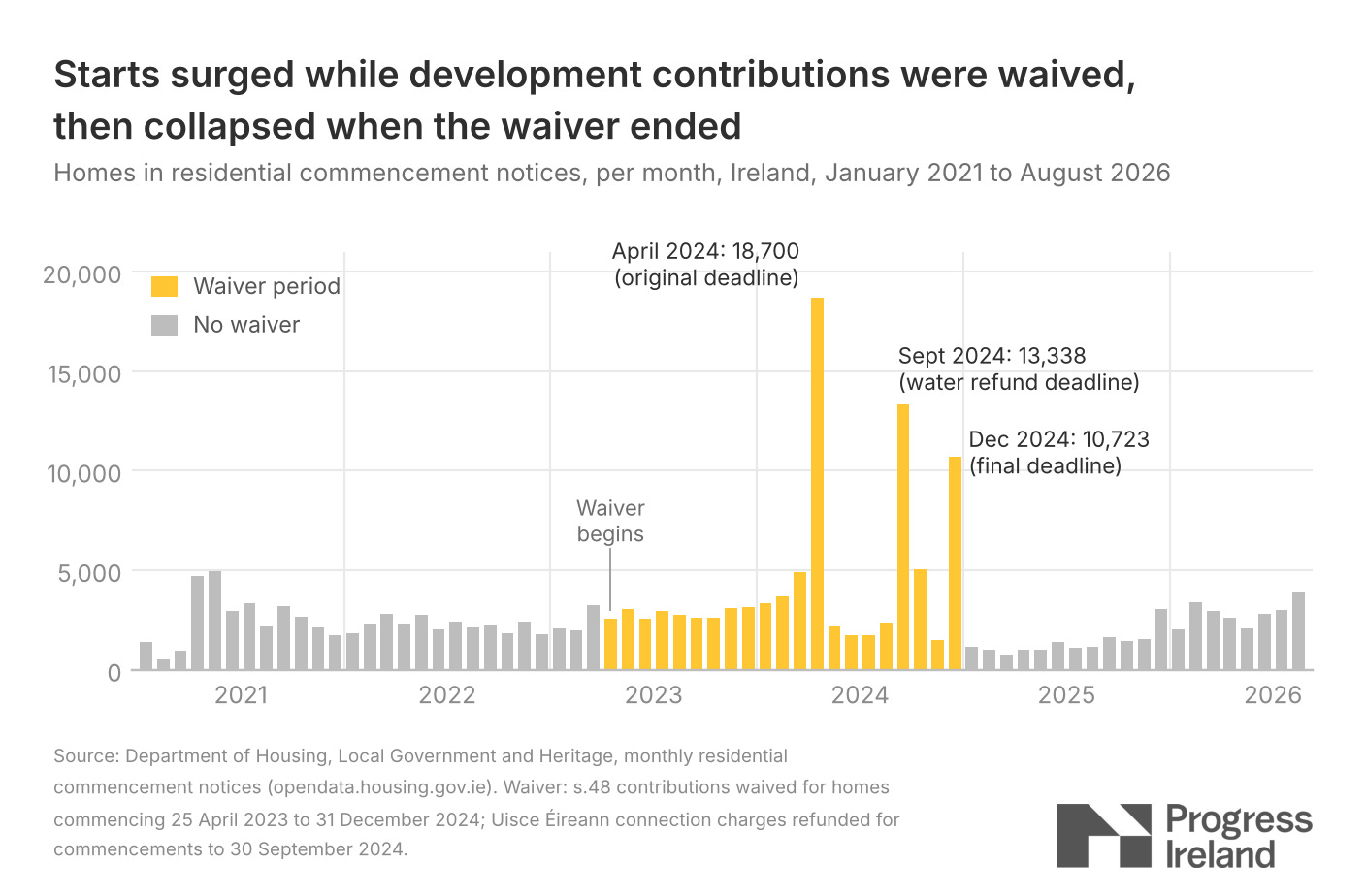
The size of the response suggests that many projects were sitting just under the threshold of viability, even if some of them were just paperwork changes to the timing of commencements. Even counting the collapse that followed, starts averaged about 39,500 a year over 2023 to 2025, against about 28,800 in 2021 and 2022. Lower costs mean more supply, so this is not surprising. For Ireland, this paper estimates that a 1 per cent rise in costs cuts supply by about 1.9 per cent.
By making homes scarcer, development contributions make housing more expensive.
The problem is the timing
To be sure, development contributions pay for something that has to be paid for, and it makes sense that councils don’t front the bill. They don’t have the money or the borrowing capacity. And if every new home cost a council money, councils would try to limit how many got built.
The problem is timing. Contributions are paid upfront, in cash, usually at commencement, which raises the peak amount a developer has to borrow. This makes the whole development more expensive. If we assume a cost of capital of 10 per cent and a scheme that sells two years after it starts, a €25,000 contribution ends up costing €30,250 by the time the homes sell. It can also put investors off by increasing the amount of money developers need to borrow.
The State’s bill
The State is the other payer. In Progress Ireland’s pre-budget submission, we estimated what it will spend on housing-infrastructure if nothing changes.
In Clonburris, the State paid about €23,500 per home: €186.3 million from the Urban Regeneration and Development Fund and about €18 million from the National Transport Authority, for 8,700 homes. In Cherrywood, it will pay roughly €13,000 to €26,000 per home, depending on how many homes are finally built (not counting what developers paid on top of it).
To deliver 40,000 to 80,000 homes in Urban Development Zones, the State will spend €0.94 billion to €1.88 billion on housing-infrastructure. That leaves out the big network projects like MetroLink, DART+ and the Greater Dublin Drainage Project, buyer subsidies like Help to Buy, and schools, Garda stations and health facilities.
While spending increases on housing and infrastructure are welcome, Irish public spending is growing at one of the fastest rates in the EU. This should at least prompt the question of whether there is a more sustainable way to fund and deliver housing-infrastructure in Ireland.
What can we do instead?
In my last piece, I said a better system would pass four tests. Does it fix the timing? Does it protect viability? Does it give locals a reason to say yes? And is it fiscally sustainable?
There are two families of systems that may meet these tests. One uses land values to pay for infrastructure. The other spreads the cost over time, through charges paid by the people who use the infrastructure.
Using land values
When land is rezoned for housing, its value goes up. In Dublin in 2024, the median hectare of farmland sold for about €60,000. The median hectare of residentially zoned land sold for about €1.6 million. That is a 27-fold increase, created mostly by a public decision and public investment.
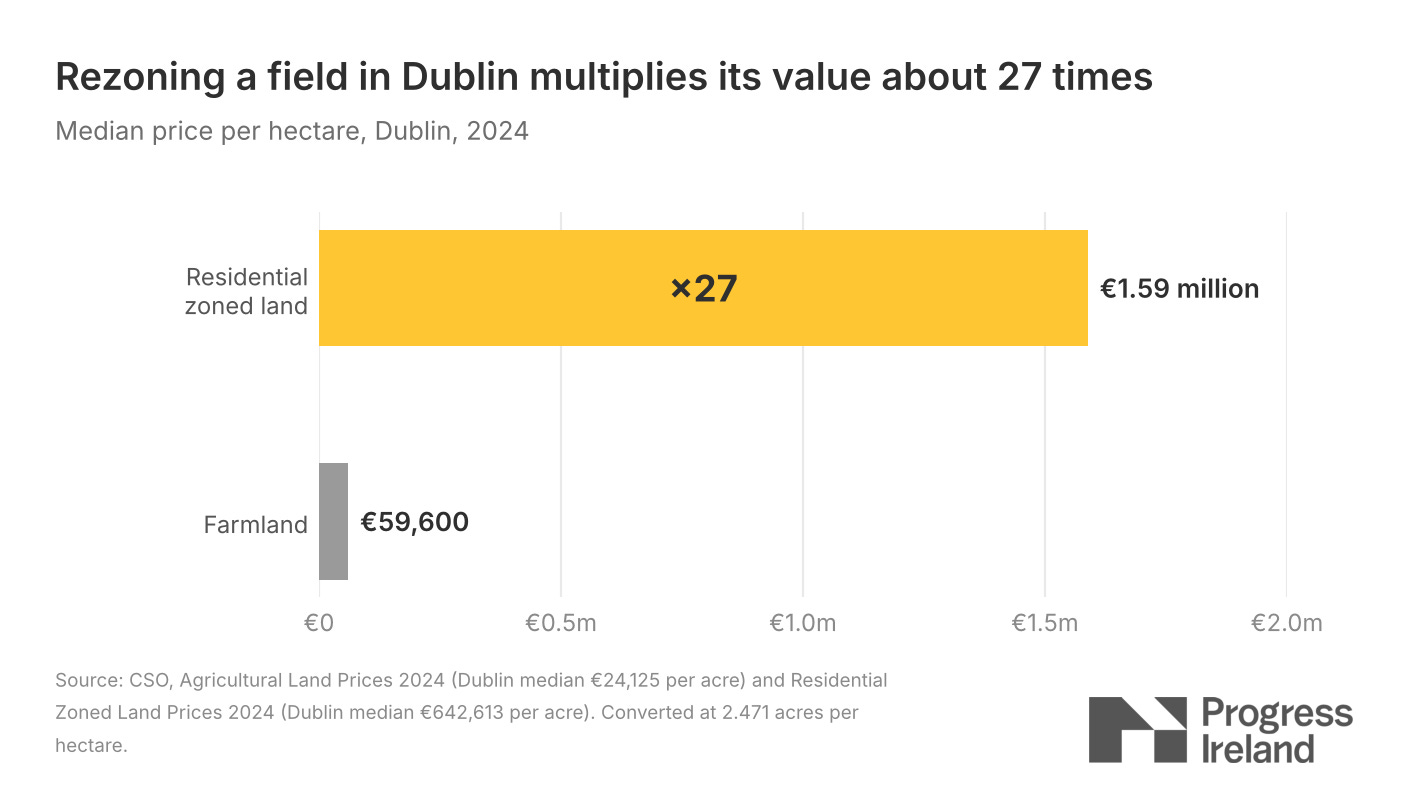
Around the world, that uplift pays for housing-infrastructure. One of the best tools for this is land readjustment, which Progress Ireland set out in a full report.
Land readjustment pools the land in a development area and replots it. Each landowner swaps their plot for a smaller one that is worth more, because it now comes with roads, pipes and planning permission. The body delivering the scheme, a special purpose vehicle, keeps some of the land, called reserve land, and sells it to pay for the infrastructure.
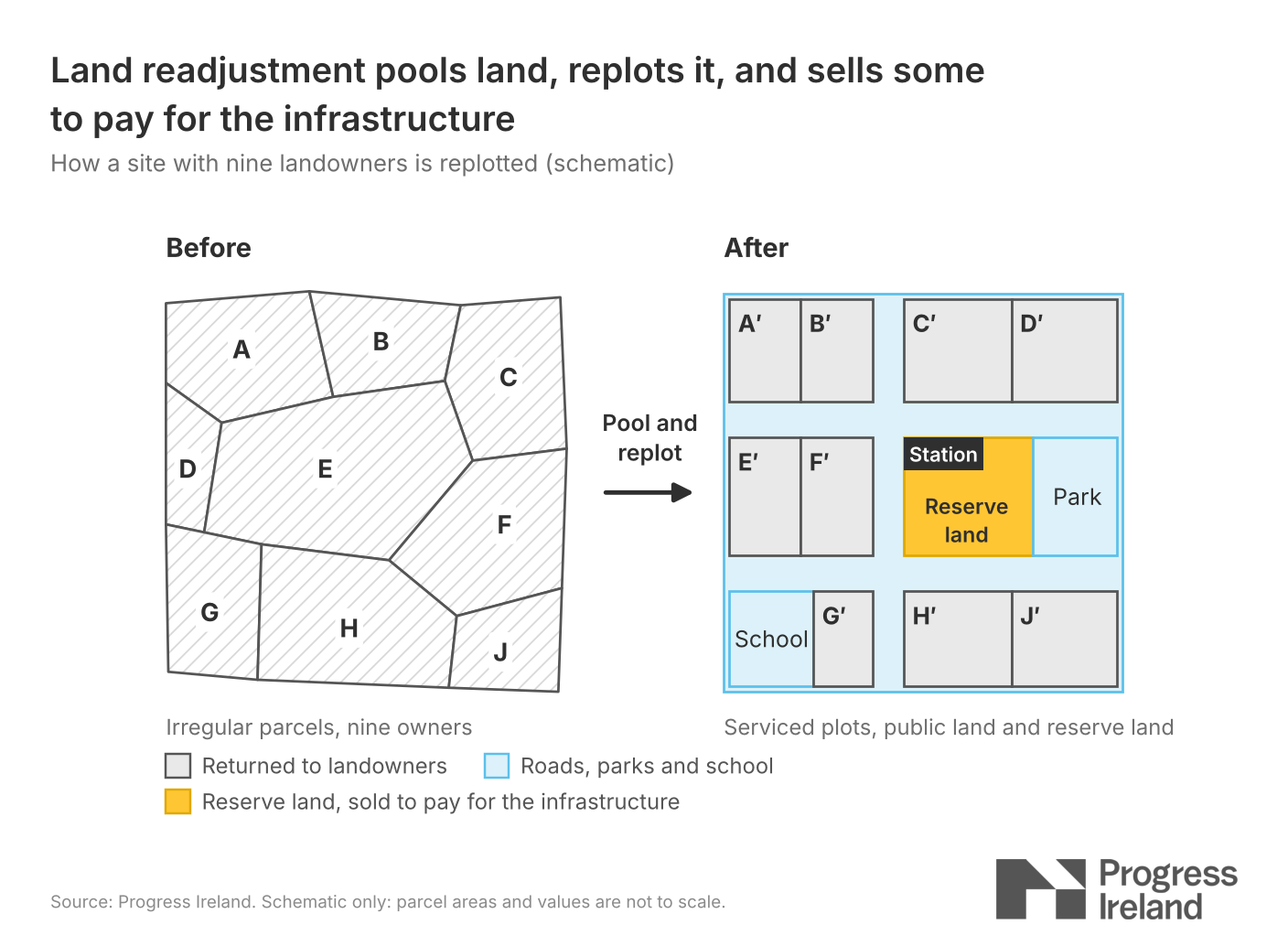
Land readjustment systems around the world routinely fund 60 to 100 per cent of the infrastructure for large schemes. In UDZs, we estimate it could save the State about €1 billion. It also lowers the cost of development, because no charge lands on the developer, which cuts financing costs.
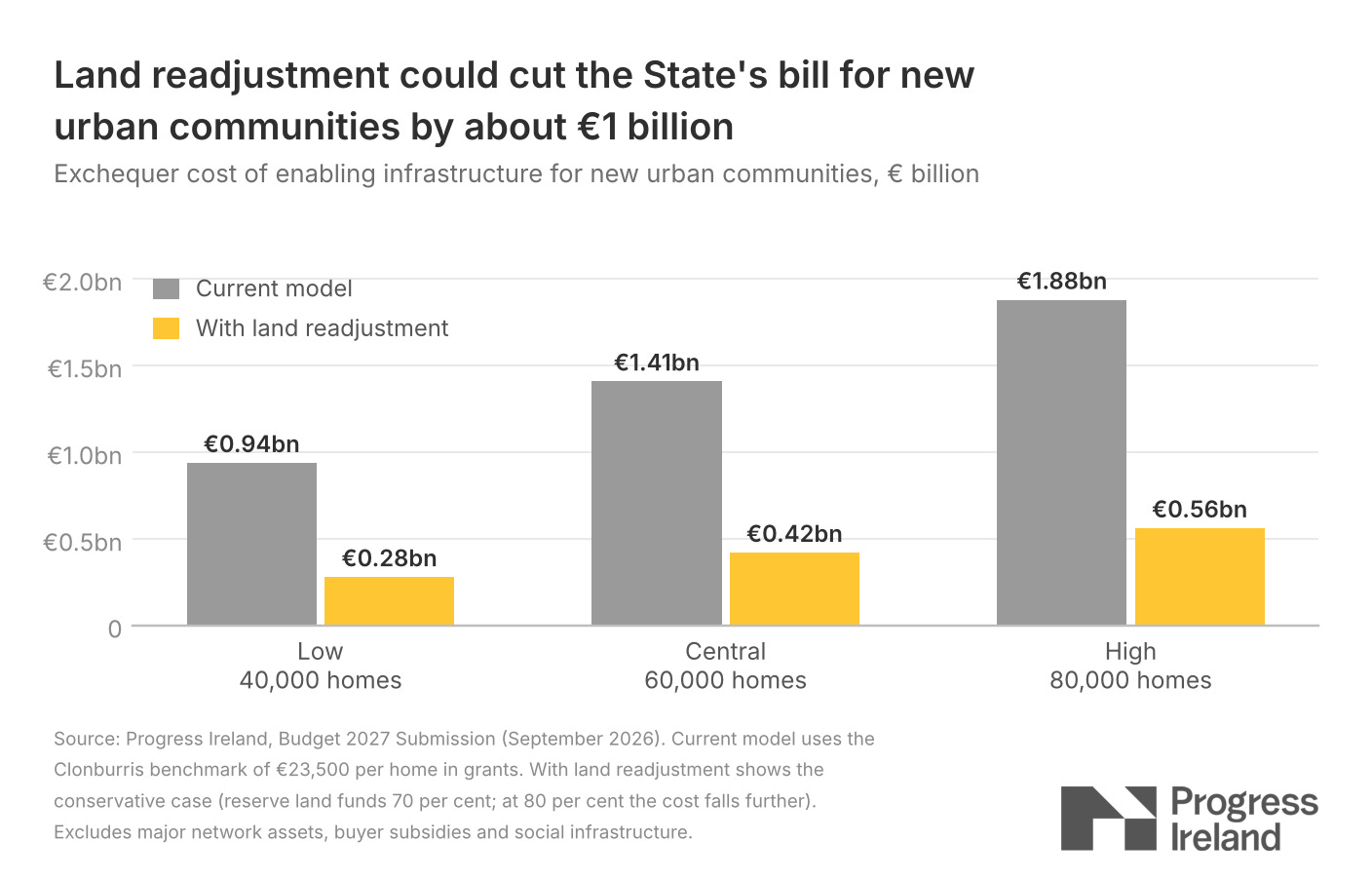
But some developments will be too small for land readjustment, and even in big ones it may not cover the whole cost. For everything else, we need a different tool.
Paying over time
Ideally, that tool would work more like HISCo, which I described in my last piece. HISCo builds the infrastructure and is repaid by a fee on each home when it sells. It doesn’t hit developer cash flow, so it solves the timing problem. It is fiscally sustainable too: HISCo makes a return for ISIF.
Viability can still be a problem, because the lump sum can end up in the price. That might change if HISCo were used widely enough for its fee to be priced into land. The other fix is to spread the charge over time.
Spreading the charge over time has a few benefits. The first is that it lowers the cost of development. The developer no longer has to borrow to pay the charge upfront, and the infrastructure can be financed over decades at lower rates than a development loan. More schemes become viable, more homes get built, and over time that puts downward pressure on prices. The households who use the infrastructure pay it, a bit at a time.
The second is that the State can pay less, if the charge pays for infrastructure that would otherwise be funded by grants.
The third is timing. Across the country, zoned land is sitting idle because nobody has paid for the roads and pipes it needs. The government set up the Housing Activation Office to deal with this. In June, the government approved 82 projects from the new €1 billion Housing Infrastructure Investment Fund, out of 138 applications. Many sites sat idle while waiting for funding. Many still do. Introducing additional means of funding housing-infrastructure could give more sites funding from the start, without waiting for government intervention.
Ireland, like many other places, used to pay for infrastructure this way. Dublin’s Vartry water scheme was built in the 1860s with a loan from the Public Works Loan Commissioners. The loan was secured on the city rates and the water income from the townships the scheme supplied, and repaid over decades.
New Zealand’s IFF
New Zealand ran a system like this until the 1990s, and is now trying to bring it back. Like Ireland, it mostly funds housing-infrastructure through development contributions. Its councils borrow far more than Irish ones, but they can hit hard debt limits and fall back on contributions.
In 2020, as part of its Urban Growth Agenda, the Labour government passed the Infrastructure Funding and Financing Act, or IFF. It lets a special purpose vehicle borrow from private investors to build infrastructure. The debt is repaid through a levy on the land that benefits from the new infrastructure. The levy is limited to up to 50 years and up to a capped total. The levy runs with the land, so whoever owns the property pays it. For households, it works a bit like council rates.
The 2020 version barely got used. Only three levies were approved in six years. One reason was veto points. A council could block a levy by declining to support it, on top of the approvals needed from Cabinet and ministers.
In July 2026, the current government passed an amendment to fix this. Councils can now hold up a levy only if it would interfere with their own charges, like water rates. The levy can pay for transport projects by NZTA and KiwiRail, water projects by the new water organisations, and the running costs of infrastructure, not just the upfront build cost. Infrastructure providers can also use one-off charges collected when a home is sold, much like HISCo. Levies still need Cabinet approval. The government also underwrites some of the risk, which for an EU country would raise the question of whose debt it is.
Texas’s municipal utility districts
In the US, the kind of system the Kiwis are trying to build is fairly common. Fast-growing American states face the same problem. New suburbs need huge investment in water and sewerage, and local government’s capacity to finance it is limited. In Texas, many big greenfield developments sit outside city limits, so cities can’t or won’t pay.
Instead, Texas lets small, special purpose units of local government form to deliver the infrastructure. These municipal utility districts, or MUDs, are now the main way new development is financed around Houston, where about 2.1 million people lived in a special district by 2010.
A MUD sells tax-exempt bonds to pay for water, sewerage and drainage, and sometimes roads and parks. It repays them through a property tax on the homes in the district, and charges utility fees to cover running costs. Usually the developer builds the infrastructure first and the MUD reimburses them from its bonds, for up to 70 per cent of the cost. The developer can then put that money into the next phase.
Where this leaves us
None of these systems is perfect. But each passes more of the four tests than Ireland’s current system does.
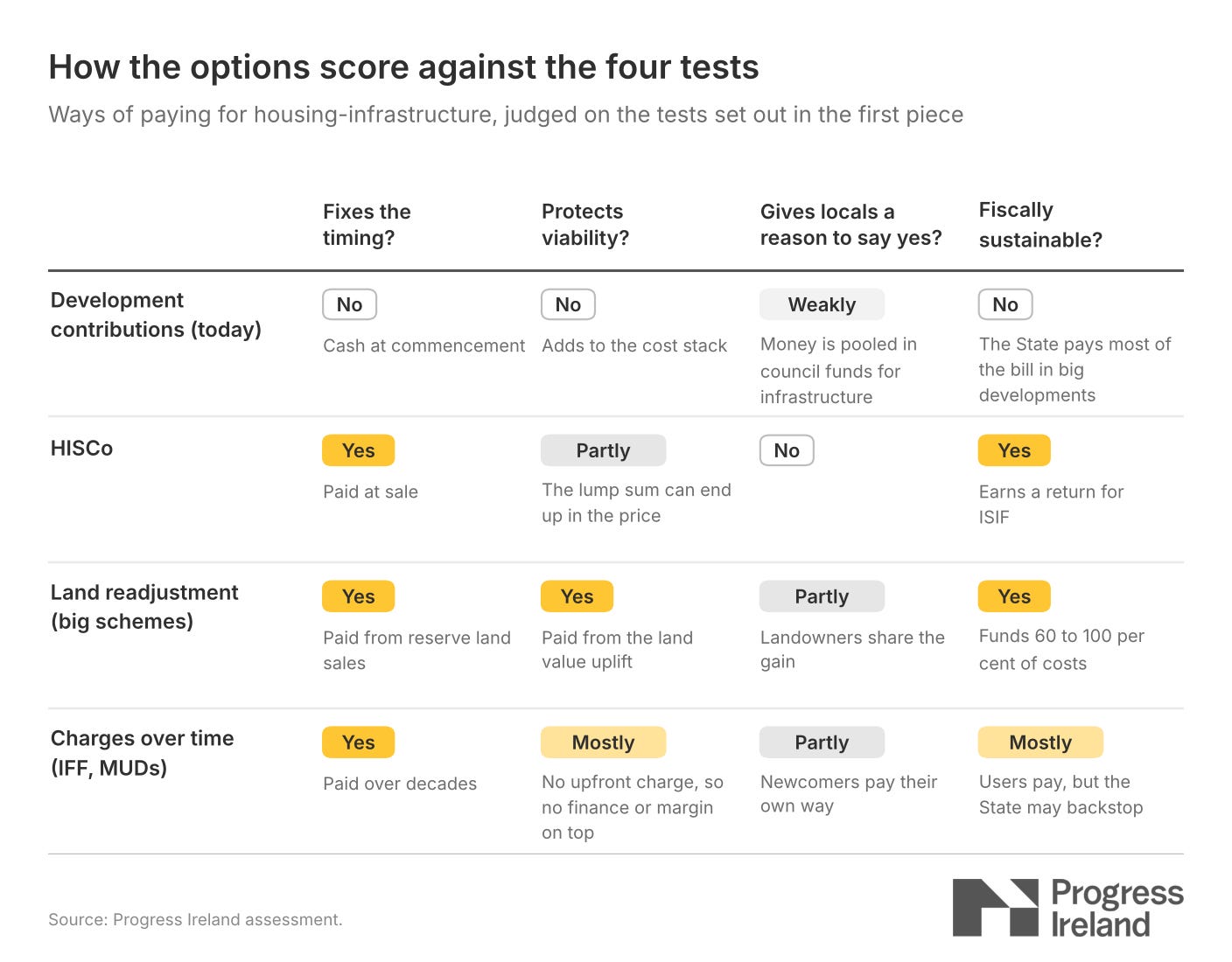
Land readjustment can pay for infrastructure in big new communities out of the value that planning creates, especially in Urban Development Zones. Outside of these, charges spread over decades and collected like a property tax could ease the cost pressures that are preventing homes from being built.
The test none of the options I mentioned passes is the third one. They make new homes pay their own way, but they don’t give the people already living nearby a reason to welcome them. That needs a different set of tools which we will write about sometime soon.
Last updated: