An investment with an uncertain and potentially large payoff.
Denmark – Ireland’s annoyingly well-governed twin – banned nuclear power in 2003. Since then it has built the world’s most extensive wind power system.
Last year, two-thirds of the Danish parliament voted to investigate the potential of nuclear power. “Denmark has no recent experience with nuclear power, which is why it is important that we start analysing the potential,” Minister for Climate, Energy and Utilities Lars Aagaard said. “Can this technology complement what will be dominant in our country: solar and wind? We all know that of course we can’t have an electricity system based on solar and wind alone. There has to be something else to support it.”
He added: “Can we say with confidence that this technology is safe? Where do we dispose of the nuclear waste? Are our authorities prepared if something goes wrong? And so on and so forth. We don’t have that knowledge, but we need it.”
At an Oireachtas Committee two weeks ago, I was asked by James O’Connor TD about nuclear power. I said small modular reactors (SMRs) were starting to come online, were a promising technology, and they could complement the electricity system we’re building. Now I want to flesh this out.
The first thing to say is that the case for small modular reactors is different to the case for lifting Ireland’s ban on nuclear power generation. One is about engineering — which system better suits our goals? The other is about governance — who should make the decision about which system to use?
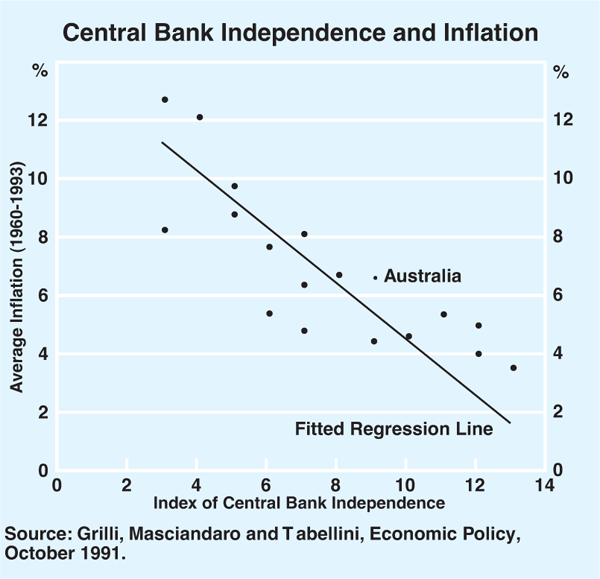
I think the nuclear ban should be lifted. It’s a bit like monetary policy – something better managed by technocrats (and markets) than politicians. Energy is complex and multidisciplinary and fast-moving. It should be implemented by scientists, economists and engineers.
The nuclear ban is not a high-level mandate; it is interference with policy implementation. The former is a legitimate democratic function. The latter is not. The democratic mandate relates to high level values and goals: that power be safe, clean, affordable, secure. Nuclear either meets, or could meet, all those goals. So why the need for a ban?
The best argument for the ban is that we already have a good plan for our energy system, and we have lots of work to do, and limited focus, and limited experts, and limited Oireachtas time, and that lifting the ban is a distraction from our goal.
I’m not sure about that. It seems to me there’s enough uncertainty about the path we’re on, and the path nuclear is on, that it’s worth not preemptively taking options off the table. Even if it does take up some bandwidth in the short term. The people operating our system have a hard enough job as it is balancing the multiple goals of a successful electricity system and we shouldn’t tie one hand behind their back.
Today I want to set out the relevant points and objections and questions. Energy being energy, I won’t bottom out on any of this. What I hope to persuade you is that the energy planning is complex and highly uncertain, which implies the Oireachtas should stay out of the way.
The path we’re on
Right now we’ve got the most expensive electricity in Europe. We’re on the path to hopefully a cleaner, cheaper, more secure system. The system we’re aiming to build will have a lot of wind, with a small bit of solar, batteries, interconnectors, and gas.
In the future we’re aspiring for, the price of offshore wind will fall over time. Ireland will generate more than 30 gigawatts of offshore wind. Solar will chip in with a few gigawatts. Some of the power gets converted to hydrogen and used to fuel a new industrial economy. Hydrogen, along with batteries and biogas, is used to store energy and smooth out intermittency. Our system is affordable, secure and sustainable.
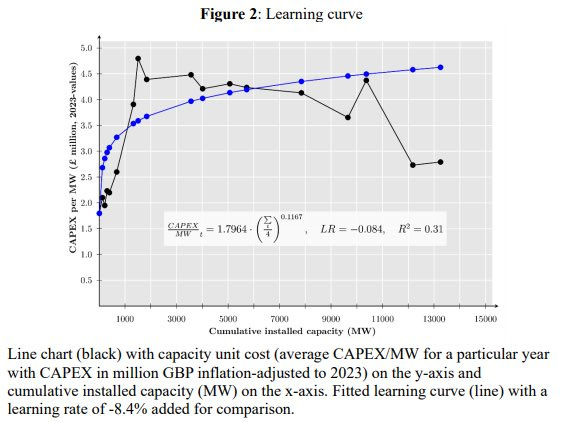
To reach the best possible future scenario, a few things will have to go our way. Offshore wind is expensive. The hope is that it’ll get much cheaper over time as we learn to deploy. But the experience isn’t encouraging so far. The evidence is contested. One study found offshore wind in the UK hadn’t gotten cheaper between 2000 and 2023. What will we do if offshore wind learning curves don’t show up?
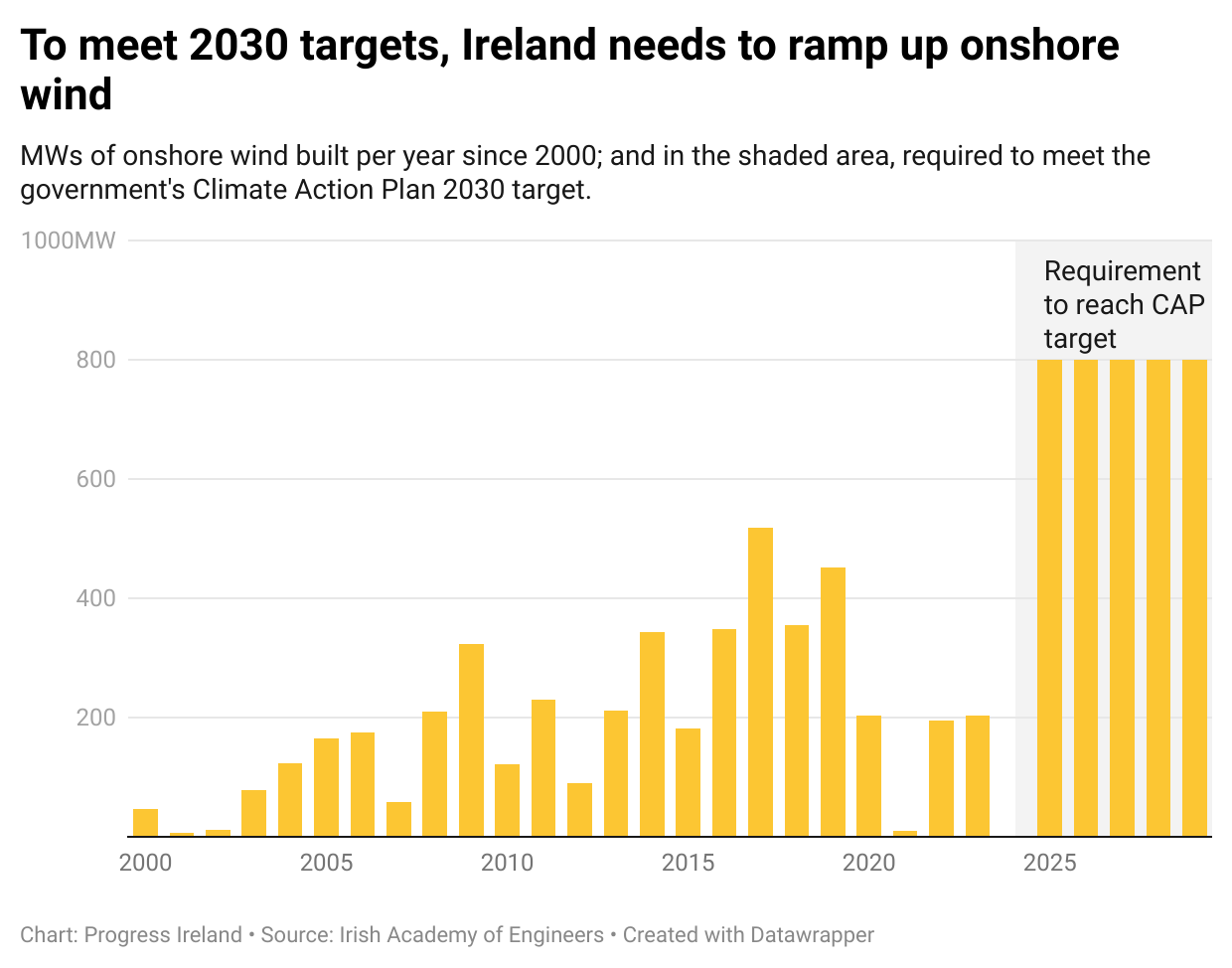
The learning curves for onshore wind are different to offshore. Onshore got about 18 per cent more efficient every year from 2010 to 2020. But since 2020, it has stopped getting more efficient.
The other problem with onshore wind is that it takes up a lot of space, which is a bad fit for Ireland’s dispersed settlement patterns. People don’t like wind turbines near them. Per capita, Ireland already has about as much onshore wind as Denmark, the world leader in wind power generation. It’s going to be hard to find suitable sites for onshore wind, and get everything through planning. The same goes for the required transmission system upgrades, which are enormous.
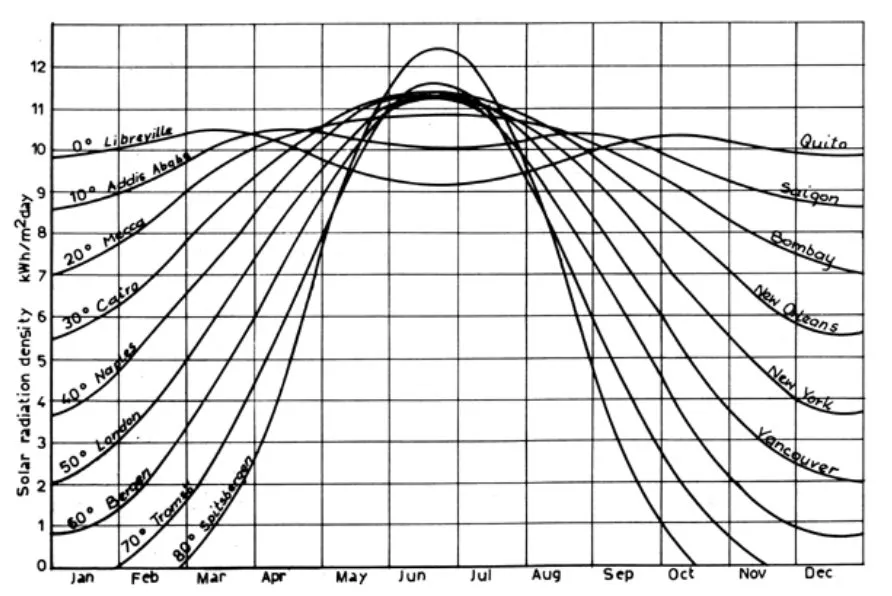
What about solar? Solar is a wonder technology. It gets about 25 per cent cheaper every year. But Ireland lives at a cursèd latitude where winter solar radiation is low on average, and sometimes very low. Compensating for this with overbuilding is prohibitively expensive.
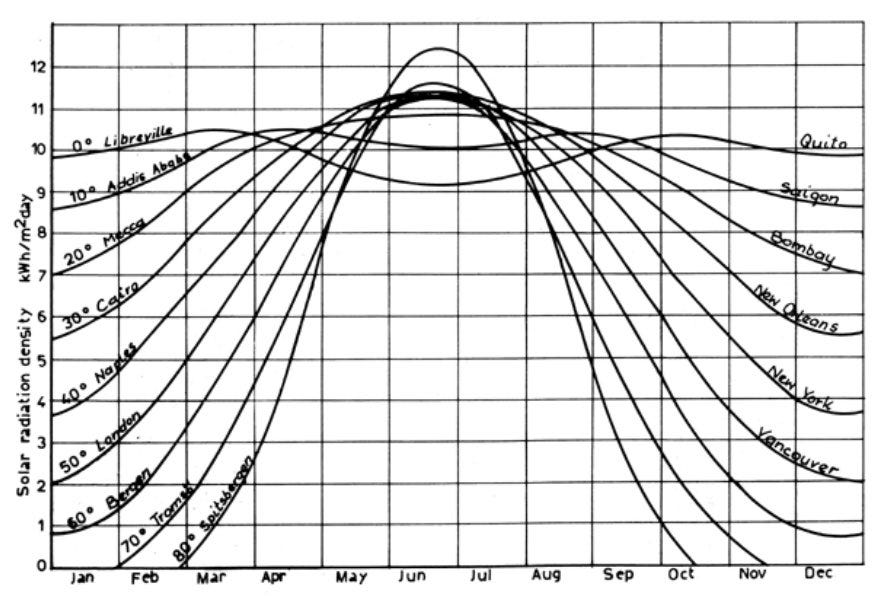
The other problem with our ideal scenario energy future is intermittency and storage. Even if we assume renewables are cheap and abundant, we need a plan for the darkest and most windless weeks. This problem gets more acute (and expensive) the more renewables you add to the system.
Batteries can’t solve the problem. Batteries can store hours’ worth of electricity, but not a week or a fortnight’s worth.
Interconnectors help – not least because they connect us to Nuclear-powered France. But the more Europe builds out renewables, the less useful are interconnectors. Sites up to 1,000 kilometres apart are still 40-80 per cent weather correlated. Even Spain is correlated 30 per cent with Ireland’s weather systems.
In an ideal world hydrolysis would be so efficient that energy could be stored as hydrogen. But hydrolysis is currently very expensive, and there’s little sign of it getting cheaper.
For windless weeks, the economical alternative to hydrogen storage is natural gas. This has the advantage of being an existing, proven technology. What we would need to do is build an entire backup gas system, and store lots of gas, only for use a couple of weeks out of every year or two.
To be sure, we can build a better system even if we don’t get all the way to the best possible one. Not all these technologies need to pan out for things to get better. But the point I’m making is that the status quo path to a new energy system isn’t without uncertainty and risk.
The SMR option
The question isn’t whether we should buy a fleet of SMRs tomorrow. The question is whether we should lift the ban and allow their consideration.
What are SMRs? SMRs are small nuclear power plants. They are built in a factory and assembled onsite. Each one can provide about 300 megawatts of power — about five per cent of Ireland’s peak power demand.
SMRs are not exactly a new technology. Ireland once used a small radioisotope generator (not a reactor) to power a remote lighthouse in the 1970s. They are used by militaries to power submarines and aircraft carriers. And Ontario is building one for commercial power generation right now.
SMRs are like normal nuclear power in that the power they produce is carbon free; they are safe; and they produce radioactive waste that needs to be managed indefinitely.
The type of power SMRs provide is relatively inflexible. They can be dialled down by about 50 per cent, but they can’t be turned off. This is relevant in a grid dominated by highly variable renewable energy.
SMRs have two unique features. The first is their size. Ordinary nuclear reactors are huge. They are a big commitment, a big technical challenge, and they cost tens of billions of euro. SMRs by contrast are small and (relatively) cheap.
The second interesting thing about them is that they’re produced in factories. Being built in the controlled environment of a factory, they should get cheaper over time. The hope for SMRs is that, with scale, producers can lower cost per unit, in the way that solar panels and (until recently) wind turbines fell in price over time.
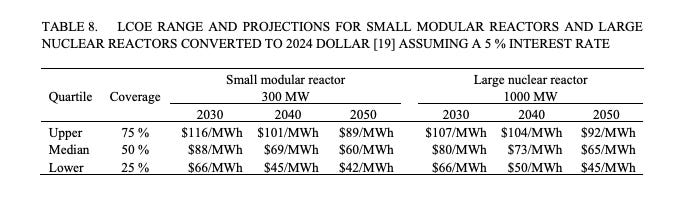
The case for SMRs hinges on their learning curves. SMRs are currently not economical. But, given a fast enough learning curve, they could be. Nobody knows whether and how quickly costs will drop. One optimistic projection from J. K. Nøland, M. Hjemeland and M. Korpås said:
”Idaho National Laboratory (INL) projects a learning rate of 15 per cent per cumulative doubling of units [5]. In such an optimistic scenario, the deployment of 32 SMR units will lead to an overnight construction cost (OCC) reduction of 55.6 %. Similarly, energy analytics firm Wood Mackenzie expects the levelised cost of electricity (LCOE) of around $180/MWh for first-of-a-kind (FOAK) SMRs but that the LCOE will reduce by 40% to $100/MWh by 2030.”
The authors estimated that by 2040, SMRs will be producing at a levelised cost of $69 per megawatt hour (in 2024 money). SMRs would, in this scenario, be cheaper than gas power today, and with less variance in price. In that scenario it might even make sense not only to augment our renewables system with SMRs, but to replace it entirely. This is the prize on offer.
What should we do about SMRs?
The first step is be to reach the IAEA’s first milestone, and make an informed decision about whether to proceed with SMRs. This would be expected to take one to three years. After that we’d be looking at investing a further five to ten years in building our own state capacity before commissioning a plant.
By that point, if SMRs hadn’t gotten much cheaper, we wouldn’t proceed. That would be an easy decision.
What if their costs had dropped gradually, such that they were similar to our renewables system? This is a tougher decision. It’s one we want made by a small number of experts.
The system needs clean, reliable and cheap power SMRs are clean, so there’s no problem there, and it’s firm. But its relative inflexibility causes problems. What happens when the wind is blowing a gale? In that scenario, we’d be generating more power than normal. So we’d either have to turn off some wind turbines, or else find a temporary home for the excess electricity. Neither option would be straightforward.
Turning off wind turbines would be operationally easy to do. But it would mess with the economics of wind power. The wind farm would charge more to compensate for their risk.
The other strategy — finding a use for excess SMR power — is not straightforward either. Not many demanders of electricity are ok with intermittent power. The demand has to be physically close to the plant, big enough to absorb hundreds of megawatts, and viable even when it is not running flat-out.
Some fraction of data centre work can be done on this basis; there’s even an idea to use SMRs to suck carbon directly out of the sky.
Open questions
Here is a list of relevant questions to which I don’t think there’s a good answer at the moment.
- When will SMRs be ready?
- How will SMR costs change over time?
- Would the economics of SMRs pencil at less than max capacity?
- Would always-on SMRs wreck the economics of renewables?
- How would we offload SMR generation in high output periods?
- Where would SMRs sit in the order of merit?
- Where would SMRs be sited? How would neighbours be brought around?
- Would SMRs be made whole through capacity payments? How would this market be designed?
- Could data centres absorb excess capacity?
- Could direct air carbon capture, powered by SMRs, pencil?
- What investment of time, money and effort would be needed to test the case for nuclear and build the state capacity?
- What would be the capitalised costs of storing the waste?
- Will offshore learning curves improve?
- Will deep water offshore ever be economical (relevant given a limited amount of shallow sea bed)?
- Will onshore learning curves return to trend?
- How will we solve the planning and siting problems onshore?
- How will we ramp up transmission system investments 5-10x?
- How will we manage intermittency at a reasonable cost?
- Will we need to invest in lots of gas storage and generation infrastructre?
- How will we mitigate the risk from renewables and correlated weather?
Last updated: