Part one: Progress Ireland
Chair, members of the committee, thank you for the invitation.
My name is Seán Keyes. I am the executive director of the independent, non-partisan think tank Progress Ireland. I’d like to start by explaining who we are, how we work, how we’re funded, and what we’re trying to achieve.
We were founded in 2023. Our board is made up of Fiona Cormican, former CEO of Cluid Housing, Jim Breslin, a former Secretary General; Donal de Buitléir chair of An Gardaí Síochána; and Brigid Laffan, Chancellor of the University of Limerick.
We work on housing, infrastructure and innovation policy. Our modus operandi is to connect Ireland to policy solutions with a proven track record from overseas.
How do we choose which policies to focus on? Policy choices are ultimately determined by our values.
We believe in building as a tool for solving policy problems. We think Ireland’s most pressing problems – from competitiveness to the cost of living, to climate, inequality and polarisation – will be solved only by building. Ireland needs to build new housing, infrastructure, companies and institutions.
We believe state capacity matters. We believe the state should be capable of following through on its priorities, whatever they might be. A government should be capable of doing the things it wants to do. In an increasingly complex world this is often not easy. We believe in reforming the state so it can follow through better on its goals.
We believe in progress. We believe the world can be much better than it is, and Ireland should aspire to be much better than it is. Ireland could have the highest living standards in the world.
The next point is about funding. We are often asked who funds us, and what influence our funders have over our policies. These are legitimate questions.
We are funded by private philanthropy. Our funders support us because they share our values and believe in our policies. Funders don’t have influence over the policies we work on. They do not benefit directly from our policy work. And we publicly disclose all material funders.
Part two: Our diagnosis
The committee is concerned with competitiveness and the cost of doing business.
Ireland is a country beset by shortages of physical things like housing, power, water, trains, and ports. Ordinary people experience these shortages as high rents and costs of living. Business owners experience them as the cost of doing business and foregone investment. They are two sides of the same coin.
Investment, on both big and small scales, is bottlenecked by our housing and infrastructure. Citing lack of housing, Global investment banks choose Amsterdam over Dublin for their post-Brexit EU headquarters. And small enterprises struggle to pay their workers a wage sufficient to cover their rent.
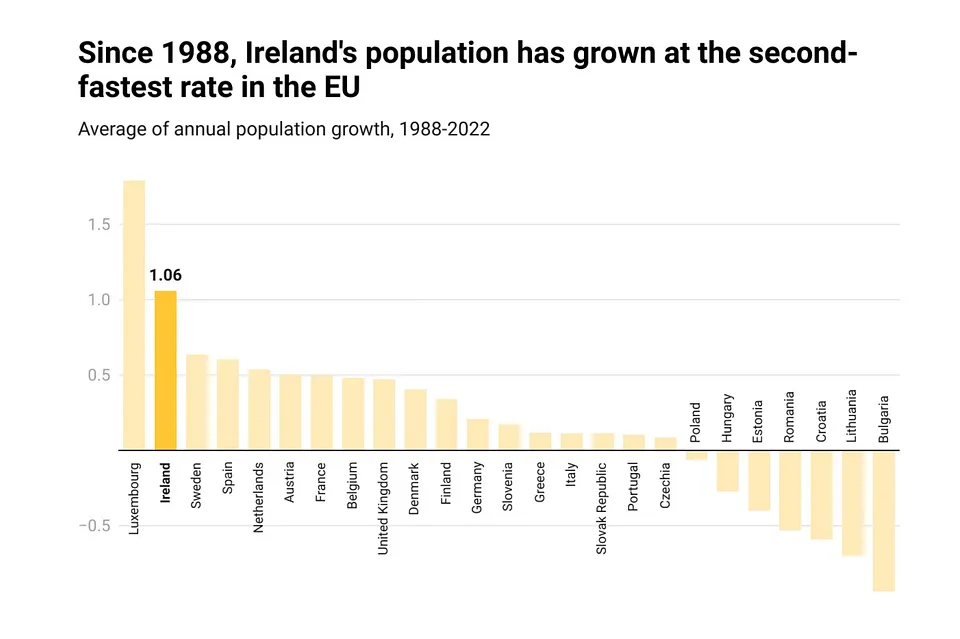
Progress Ireland’s high-level diagnosis of Ireland’s situation is that there is extraordinary demand to live and invest in Ireland, and the state is struggling to build enough to keep up. Here are four charts setting out that case.


The second point we would make is that in Ireland, money is usually not the bottleneck. Despite plenty of money, projects are slow to get started and finish. Progress Ireland sees its role as identifying and helping remove bottlenecks.
Part three: Our solutions
I will briefly describe four policies we are working on. Each one has the potential to have a big impact on the cost of doing business; each has a strong track record; and each is practical and implementable.
Land readjustment. What does Ireland need? It needs hundreds of thousands of homes near jobs; in nicely masterplanned walkable communities; without emitting lots of carbon; without bankrupting the exchequer.
Land readjustment is a tool designed to solve this problem. It is used to masterplan neighbourhoods at scale so that they are self-funding. It is used in more than 30 countries including Spain, Germany and the Netherlands. 30 per cent of urban Japan was built with it.
How it works: a qualified majority of landowners in a designated area to pool their land, cede roughly a third for roads, parks and services, and receive back smaller but much more valuable serviced plots.
This tool shows how land readjustment creates value for landowners and pays for infrastructure.
Electrified Rail. A natural complement to land readjustment is electrified rail. Rail’s superpower is its capacity: electrified rail lines can move a colossal number of people. One fully souped-up rail line can move as many people as 42 lanes of motorway. Pairing electrified rail investments with new housing can unlock enormous amounts of housing in every urban centre in Ireland.
Street votes. Most Irish jobs have been added in towns and cities. It’s in these places that it’s hardest to build new housing. The result has been higher housing costs and longer commutes. Street votes is a policy designed to gently intensify housing where it’s most needed, and nearest to jobs.
How does it work? It was first pioneered in South Korea, Israel and the UK. It lets the residents of a single street vote, by supermajority, to grant themselves permission to extend or add storeys to their homes, subject to a mutually agreed design code. It unlocks gentle density in a way that is consensual, local, and does not require top-down planning fights.
Metrolink and other complex projects. As Ireland gets bigger and richer, the state will have to deliver bigger and more complex projects. The children’s hospital was one. Metrolink is another. The DART+ Tunnel, or better government software, might be next. To deliver complex projects quickly and cheaply, the government should employ and empower more experts.
Take Metrolink. When it comes to metro construction cost per kilometre, there’s a striking difference between English-speaking countries and European ones. English speaking countries pay approximately 4x more for their metros. Why is that?

European countries tend to be better clients. Their governments employ expert builders. And those experts are empowered to make decisions.
When it comes to Metrolink, our research suggests a €52 million investment in expert staff inside Metrolink — hiring the engineers and project managers directly — could save up to €15 billion on MetroLink alone. The model is the NTMA.
I thank you for the opportunity to speak and welcome your questions.
Last updated: