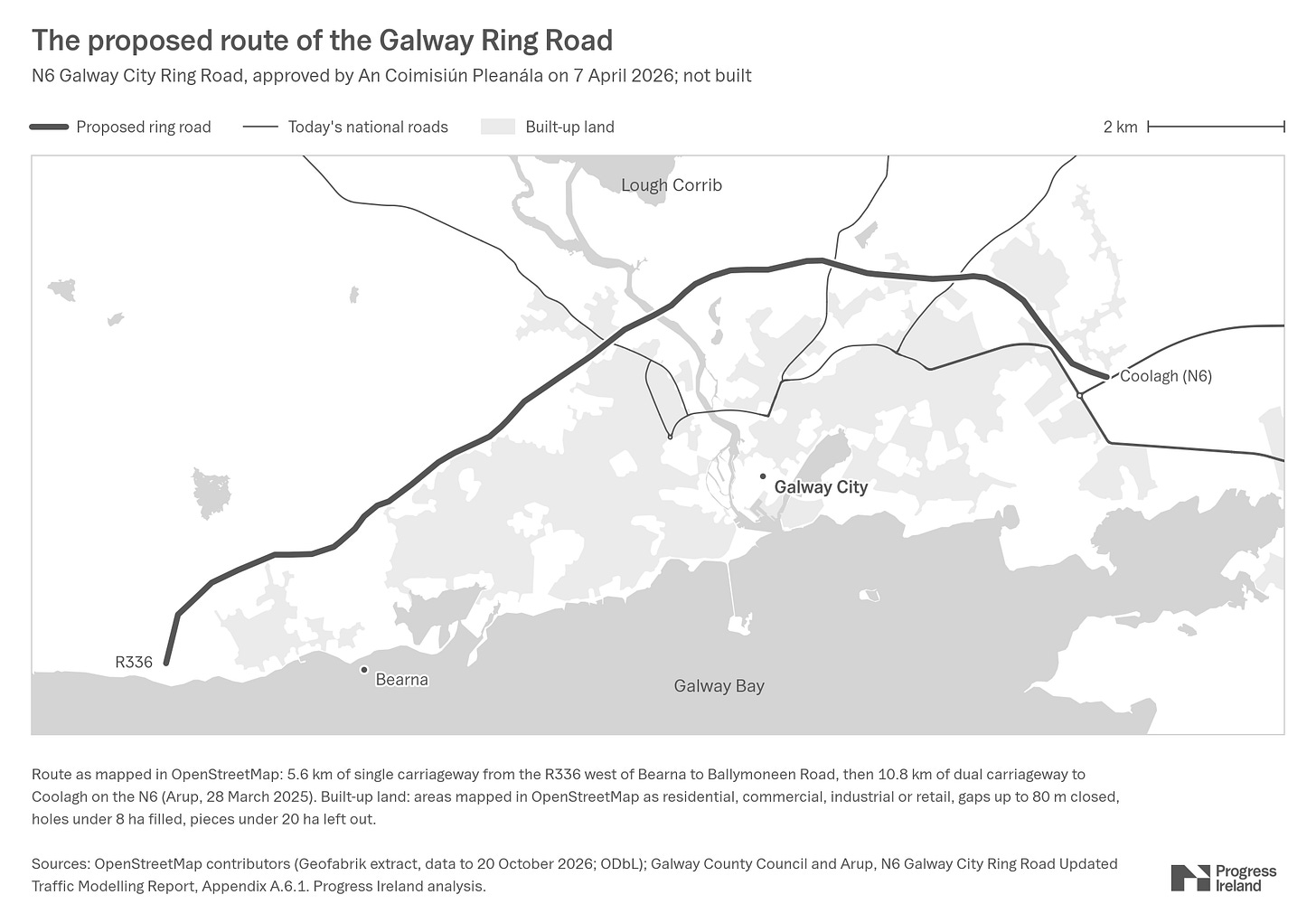
Galway looks to be getting its ring road. On Monday, the last objector seeking a judicial review of An Coimisiún Pleanála’s decision to approve the scheme withdrew his challenge.
The Galway ring road is a saga. The first feasibility study on a Galway ring road was undertaken in 1999. In 2008, An Bord Pleanála granted permission for it. In 2013, the Court of Justice of the European Union ruled that the chosen route was incompatible with the Habitats Directive. In 2016, a new route was chosen. In 2021, An Bord Pleanála approved the new route. Between 2022 and 2026, it went through rounds of judicial reviews. In April of this year, An Coimisiún Pleanála approved the scheme for the third time.
It’s said new roads don’t fix congestion. This is the view of former Minister for Transport Eamon Ryan and former Galway TD Ciarán Cannon, neither of whom supported the road. The argument goes that the new road induces new journeys, and that jobs and houses get built along the new road. Once the new settlement patterns get established, there’s no going back. Congestion returns to its pre-new road level within five to ten years. This is known as induced demand.
All of that is often true. But it doesn’t follow that new roads should never be built.
I’d add new orbital road when four conditions hold: when the city has little orbital road already; when it takes through traffic off streets and replaces them with buses, bikes and people; when a toll controls it; and when land use is controlled at each junction. The conditions come from chapter six of the World Bank’s Review of Urban Transport.
How does Galway stack up?
1. Does it have much orbital flow?
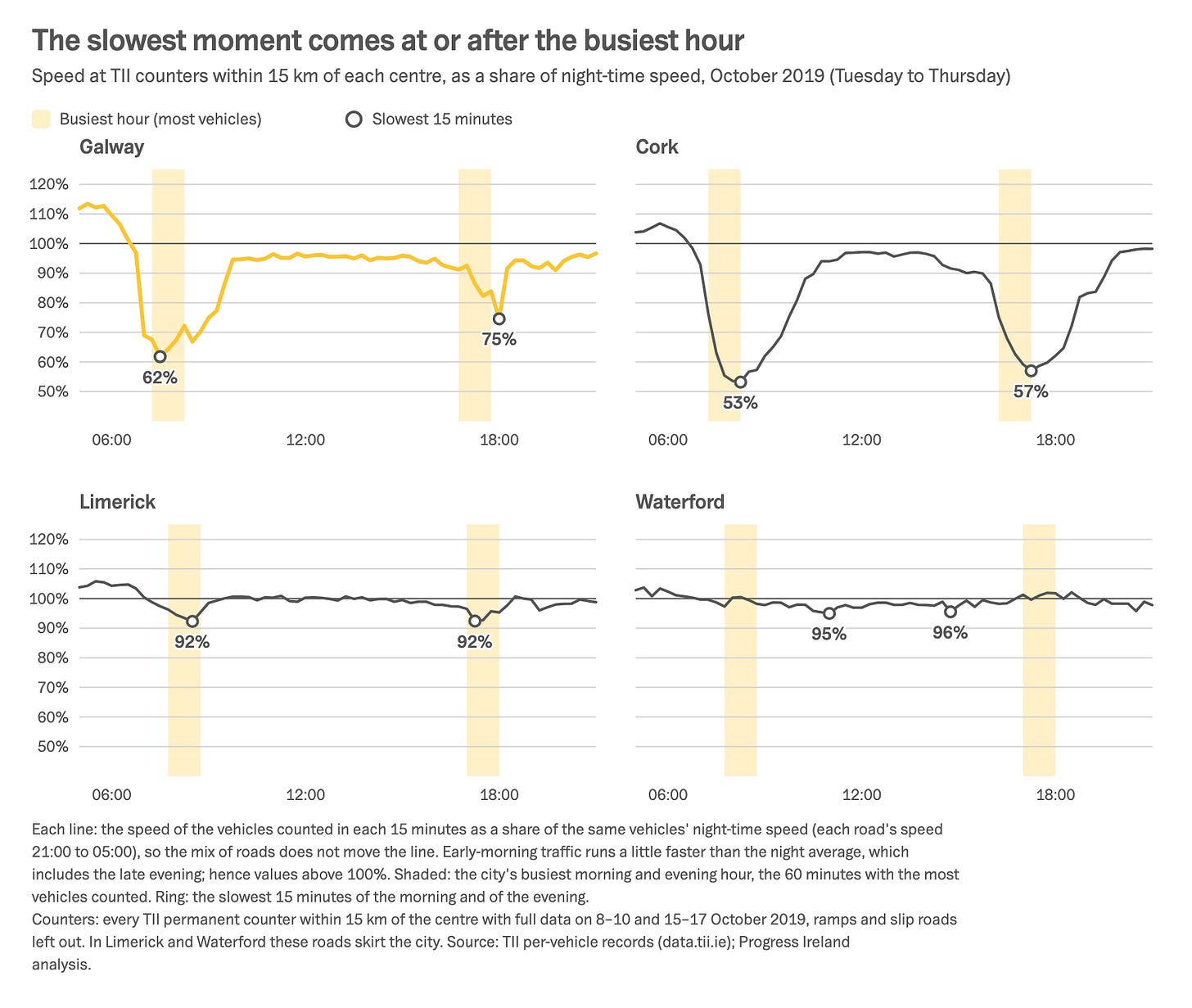
We can all agree Galway is clogged. The population of the Galway metropolitan area is a bit smaller than Limerick, about 40 per cent bigger than Waterford, and about two-fifths the size of Cork. Yet its rush hour is second only to Cork’s, in a city less than half Cork’s size, and far worse than Limerick’s or Waterford’s.
Why is Galway traffic so bad? I count three reasons. The first is the shape of the city. The other three each have at least part of a ring road (Cork’s South Ring Road, Limerick’s Southern Ring Road, and Waterford’s bypass and outer ring road) linking the radial roads into the centre. Galway is pressed flat along the coast from east to west. The River Corrib, in the city centre, runs north to south. Most of the houses are on the west side of the river; most of the jobs are on the east side. Jobs are concentrated on the N6 corridor. Any line-shaped city will find it harder to move people around (Galway: the LINE of Ireland).
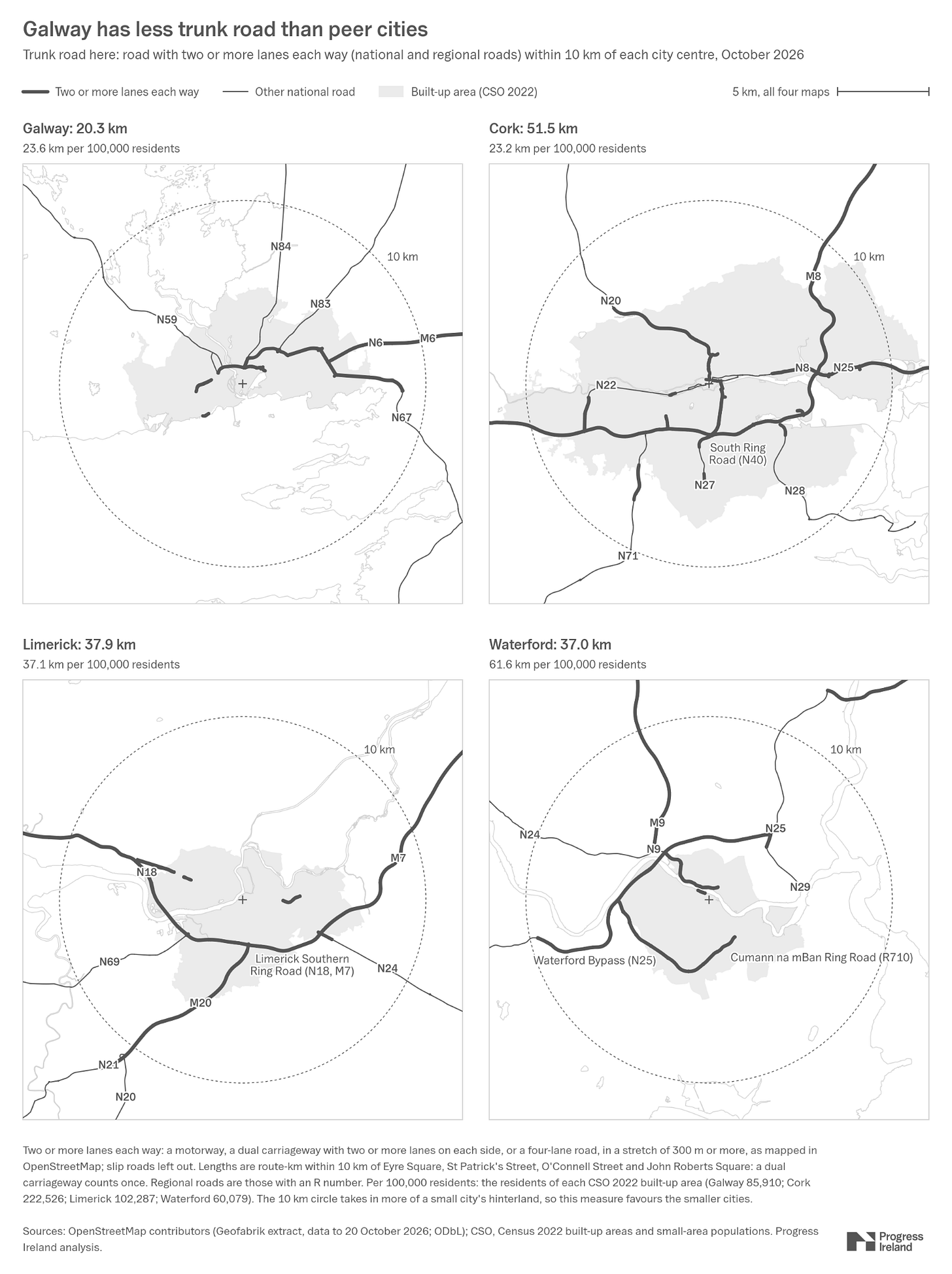
Galway’s second problem is that it simply doesn’t have many kilometres of road. The following chart compares Galway’s trunk roads to peer cities. Waterford has 161 per cent more kilometres of trunk road per resident; Limerick has 57 per cent more. Cork has about as little per resident as Galway, and an even worse rush hour.
Induced demand would say traffic should move at approximately the same speed in each place, especially since most of these roads are not new and all are growing. New roads are meant to attract drivers and trips such that congestion comes back just as strongly as pre-road. But traffic in practice moves much more easily in Limerick and Waterford than Galway.
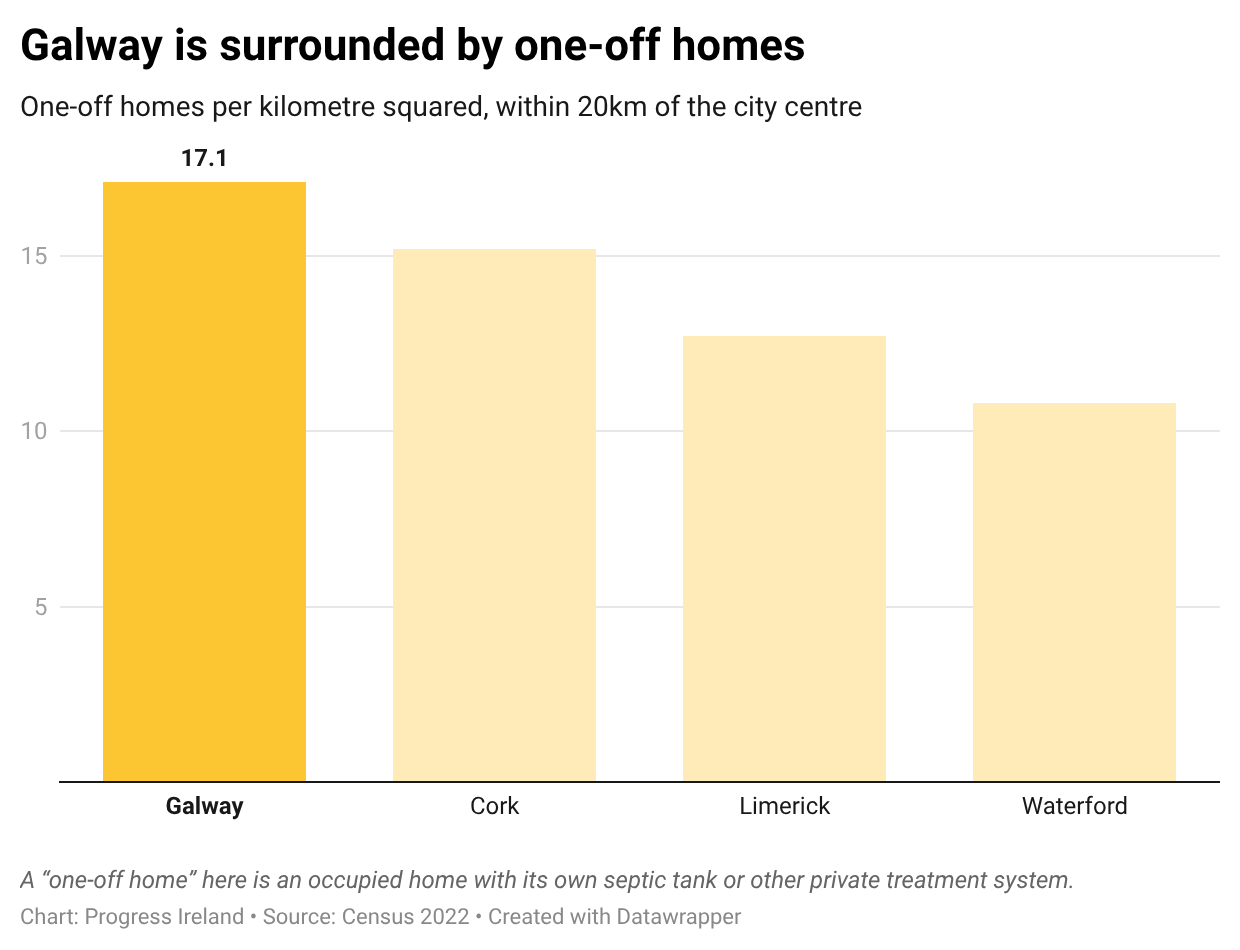
Galway’s third problem is that there’s a lot of dispersed one-off housing to the east of the city, between Galway and Athenry. It’s densely populated enough that a lot of people live there, but dispersed enough that they are impossible to serve by any other mode of transport than the car.
2. Are central streets clogged with through traffic?
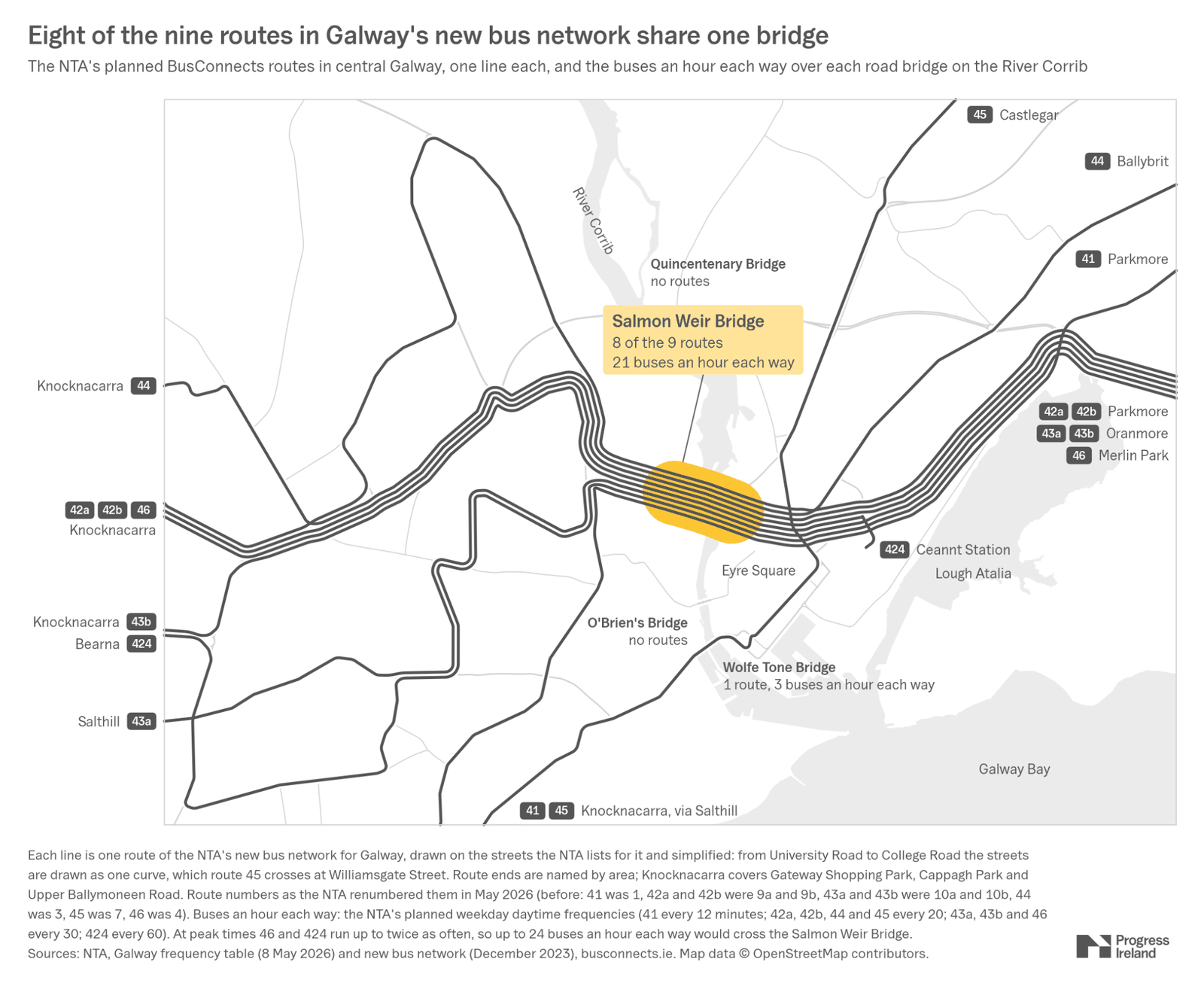
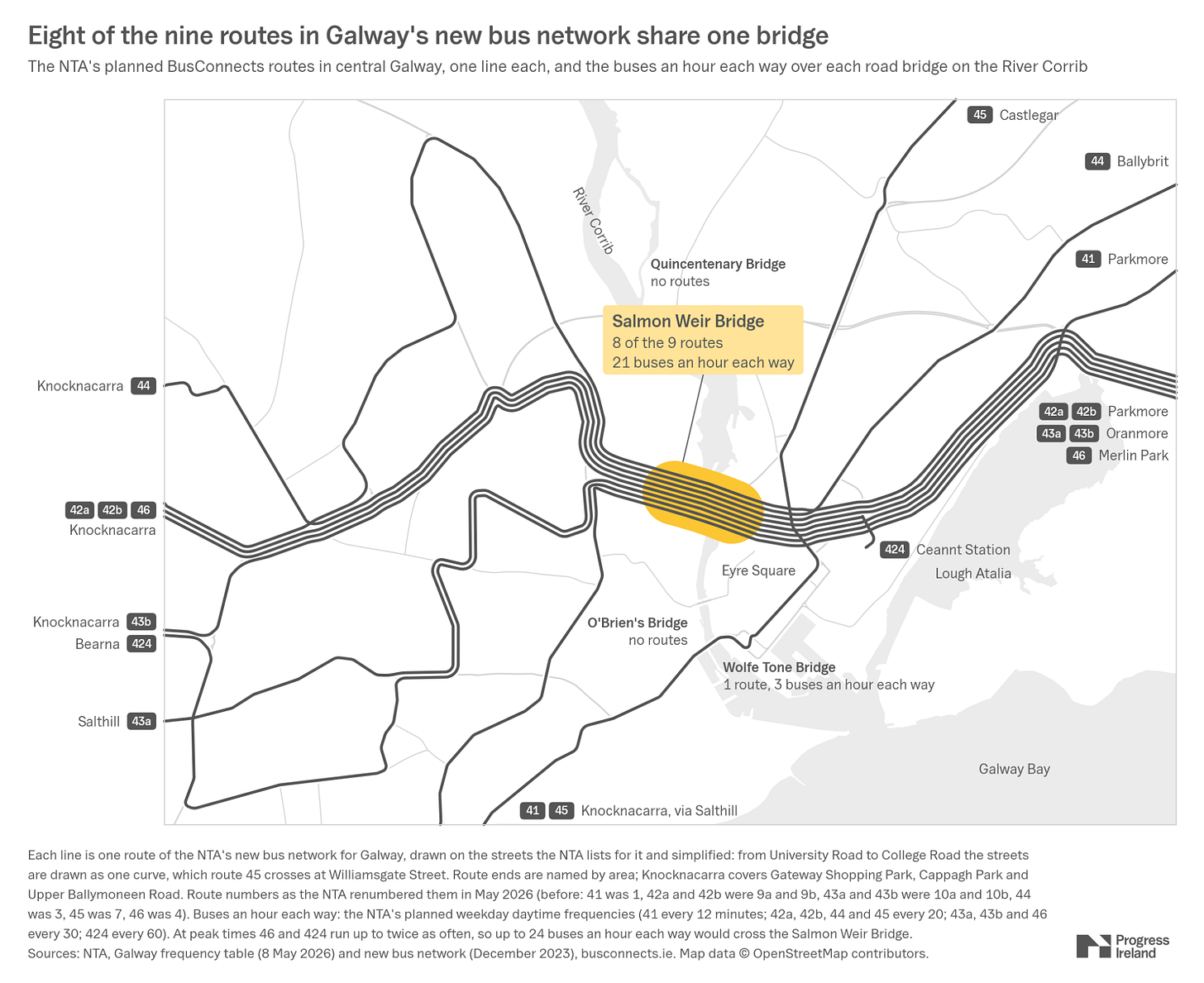
Only four bridges cross the Corrib. Three of them feed into the narrow, winding streets of Galway city centre. One of those three, the Salmon Weir Bridge, is the bottleneck of Galway bottlenecks. It has one lane in each direction, yet eight of the nine routes in the NTA’s new bus network for Galway will cross it: 21 buses an hour each way in the daytime, and up to 24 at peak.
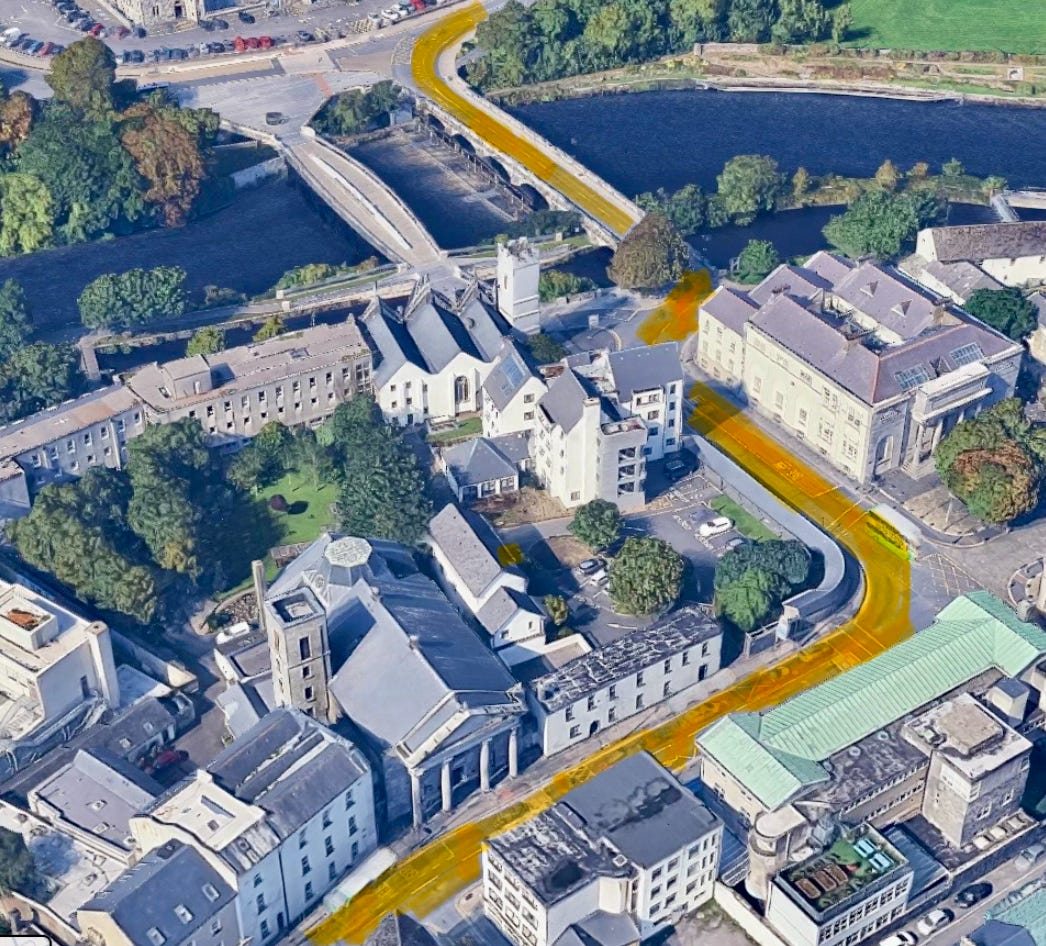
Having crossed the bridge, buses must wind their way down single-lane St Francis Street and Eglinton Street, en route to Eyre Square.
If we want more Galwegians to use the bus, bus commutes must be faster than car ones. This requires kicking cars off city centre routes like Salmon Weir Bridge and St Francis Street. Car removal could be done either with bus lanes or congestion charges. Galway is already moving that way. In October, the city council backed a trial making it bus-only.
Road space in Galway city centre is scarce and it makes a lot of sense to reserve it for buses and bikes. It would make the city centre more efficient, more pleasant and greener.
However, in dispersed Galway city, many don’t live or work near a bus route. Car commuters, displaced from the city centre crossings, will need another way to get to work. They need the ring road.
3. Is the new road controlled by a toll?
The new ring road should be tolled. All congested roads should be tolled. But new ones are especially good candidates because nobody yet feels entitled to them. Once drivers feel entitled to their route, it’s much harder to impose a toll on them. They get more cross.
4. Is land use controlled at the junctions of the new road?
The best argument against new roads is that they encourage sprawl. Sprawl is said to be bad because it results in car dependency, long commutes, poor local amenities and hollowed-out city centres. The way to avoid car-based settlement patterns, it’s said, is not to build the motorways in the first place. No motorways, no sprawl.
The point that motorways encourage sprawl hard to deny. Once a road is built, a housing-starved city will be tempted to use it for housing, offices and industry. The employment zones of Galway city, as we’ve seen, hug the N6.
It does not need to be like this. Galway can have tonnes of new housing within a short commute of jobs, and fast-flowing roads for those who need them. Galway can have it all!
It’s a two-step process. Step one: resist building new housing at the junctions of the new ring roads. Irish cities have found this hard, but it is not impossible. The Spanish are great at extending their cities in a disciplined fashion. They don’t build suburbs along exurban roads. The edges of the city of Madrid are razor sharp, with nicely planned courtyard blocks abutting empty fields and ring roads.
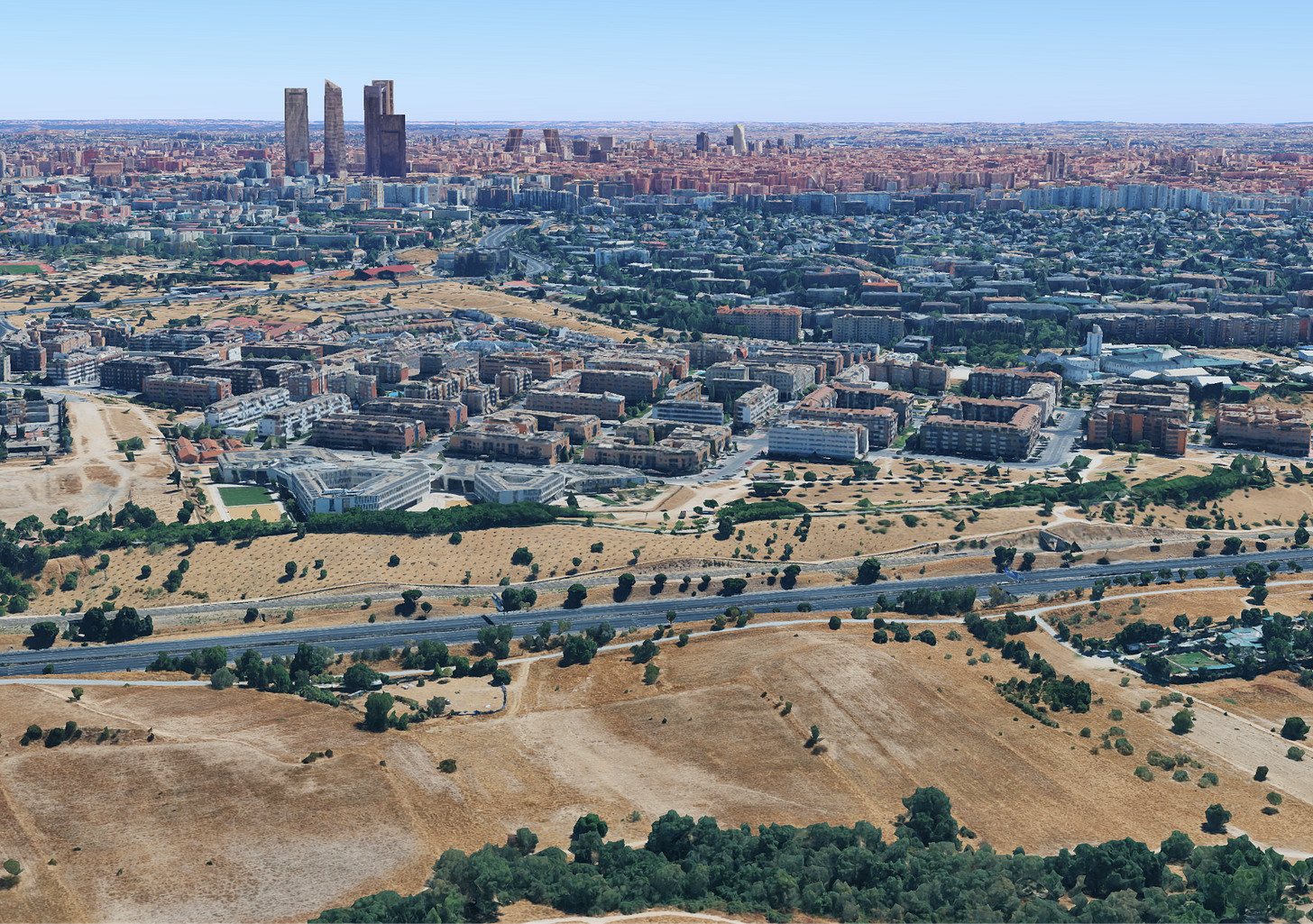
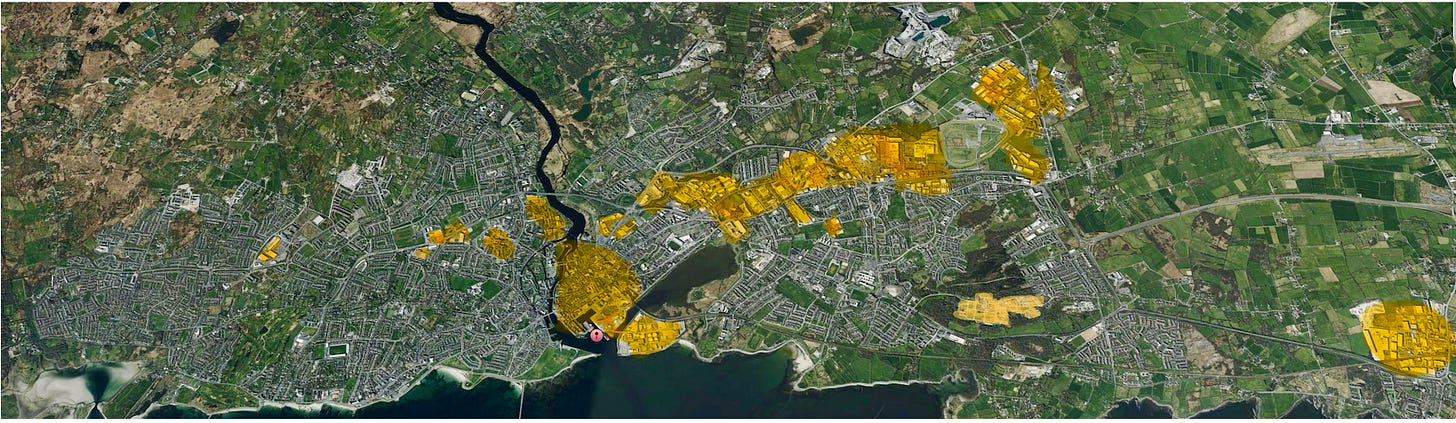
Step one is easier when there’s a relief valve for the houses. Step two: build lots of houses along the coast, between Ceannt Station and Oranmore, and on to Athenry. These lands start less than two kilometres from the station. There are hundreds of hectares of fields between Galway and Oranmore and more again between Oranmore and Athenry.
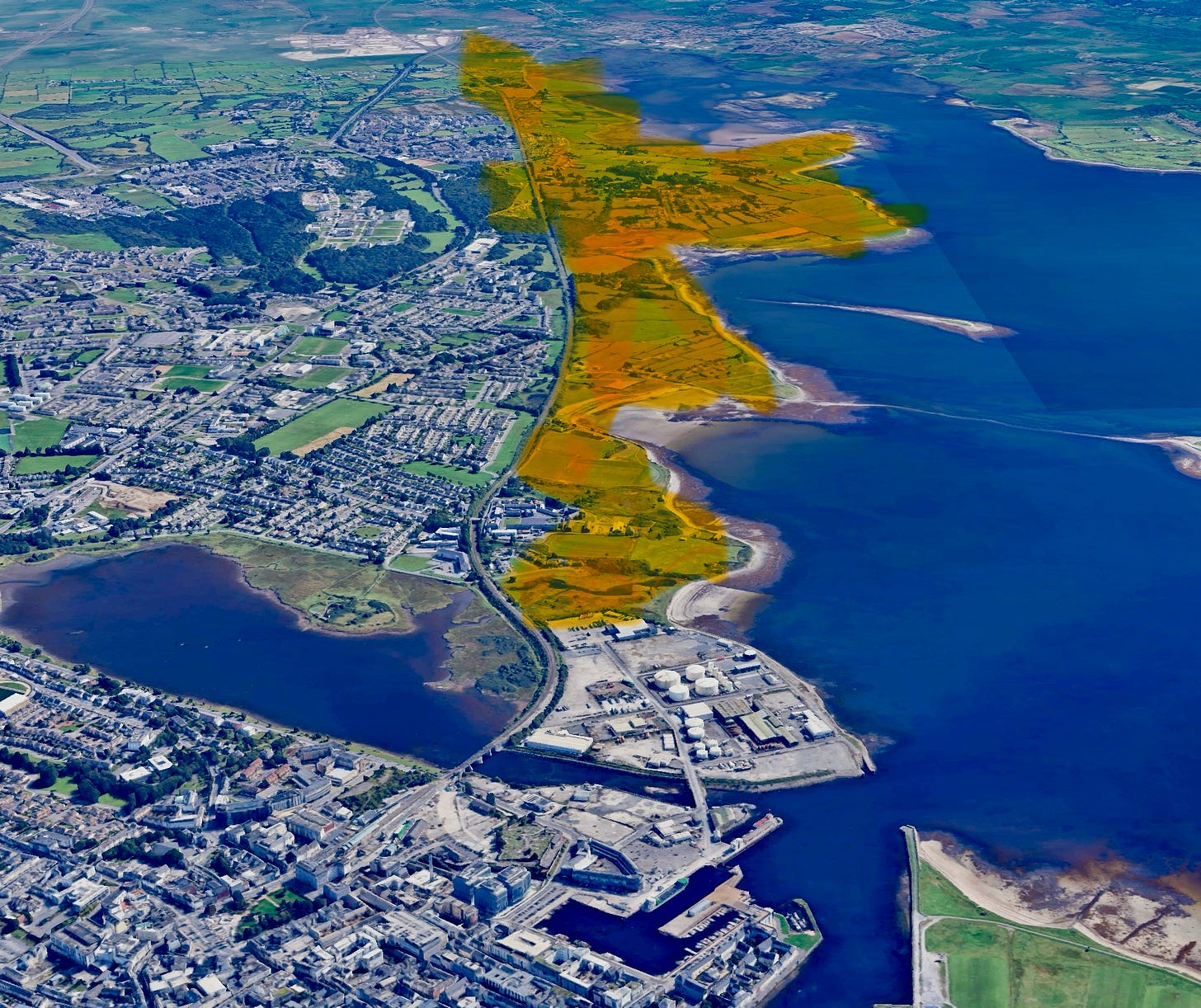
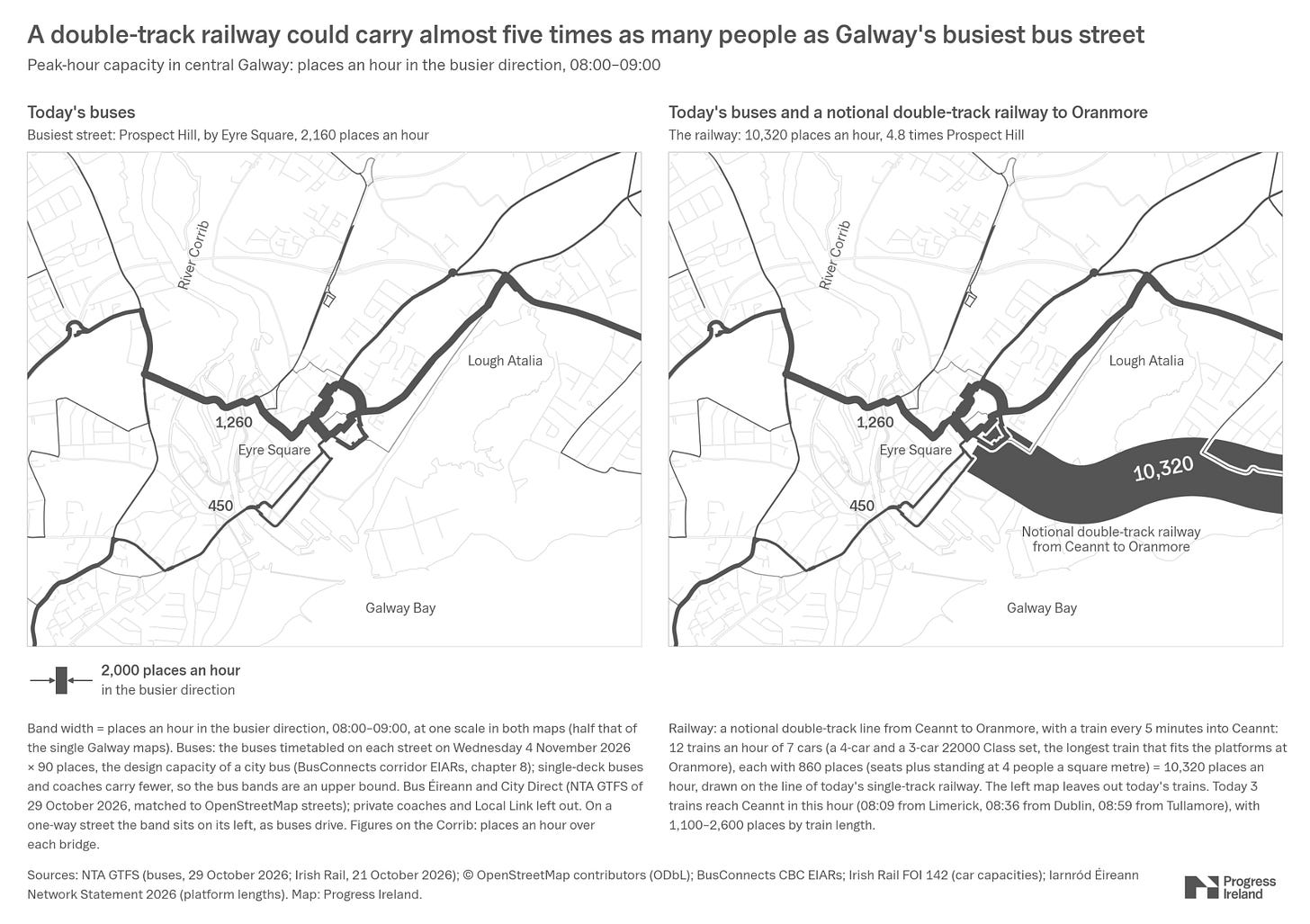
The homes should be serviced by heavy rail. Double-tracking and electrifying the existing line would give a path into Galway city with room for about 10,000 people an hour at peak. That is a very big pipe: nearly five times the capacity of the buses on Galway’s busiest bus street, Prospect Hill. The package would cost between €400 million and €1 billion, which is about half the forecast cost of the ring road and about a quarter the cost of a mooted Galway tram1.
That line – and those fields – have the capacity to support all the homes Galway will need for the next 50 years – plausibly up to 100,000 of them. Parts of that coast are low-lying, and some of its shore, such as the saltmarsh at Roscam, is protected under the Habitats Directive. So the homes would need to sit back from the shore, behind flood defences that could double as a coastal park.
So how does Galway score against my four criteria? It passes the first two tests easily: it has almost no cross-town road, and its one bus bridge is clogged with cars. The other two are choices still to be made. As far as I can tell, nobody plans to toll the ring road, and nothing yet guarantees that its junctions won’t fill up with estates and business parks.
The road needs to be part of a bigger vision for Galway transport. The best way to optimise the transport network – and to build housing at the scale we need – is to conceive of the housing alongside transport. Invest in a big pipe, and then build the homes to fill it.
1 Trams are not common in cities of Galway’s size: of the 77 European cities to have built trams since 1970, only four are smaller than Galway. And what’s more, a tram’s capacity for passengers (and therefore, new housing) is a fraction of that of heavy rail.
Last updated: