Consider for a moment the rolling hills of Dunsink. You get a good look at them out the driver’s window going northbound on the M50, just before the Finglas exit. When the sun is shining, they can look quite beautiful – an interruption of greens and yellows among the grey warehouses on the roadside.
Most Irish people know Dunsink for its observatory, which is where Ireland’s timezone was officially set from before the merger with Greenwich Mean Time. It is mentioned repeatedly by James Joyce in Ulysses, and has been a famous site for Dubliners for almost 250 years.
Others know it for the Dunsink landfill, which occupied part of the site until the 1990s. Landfills get covered over with domed caps so that rainwater runs off them, which is what gives Dunsink’s ‘hills’ that rolling look.
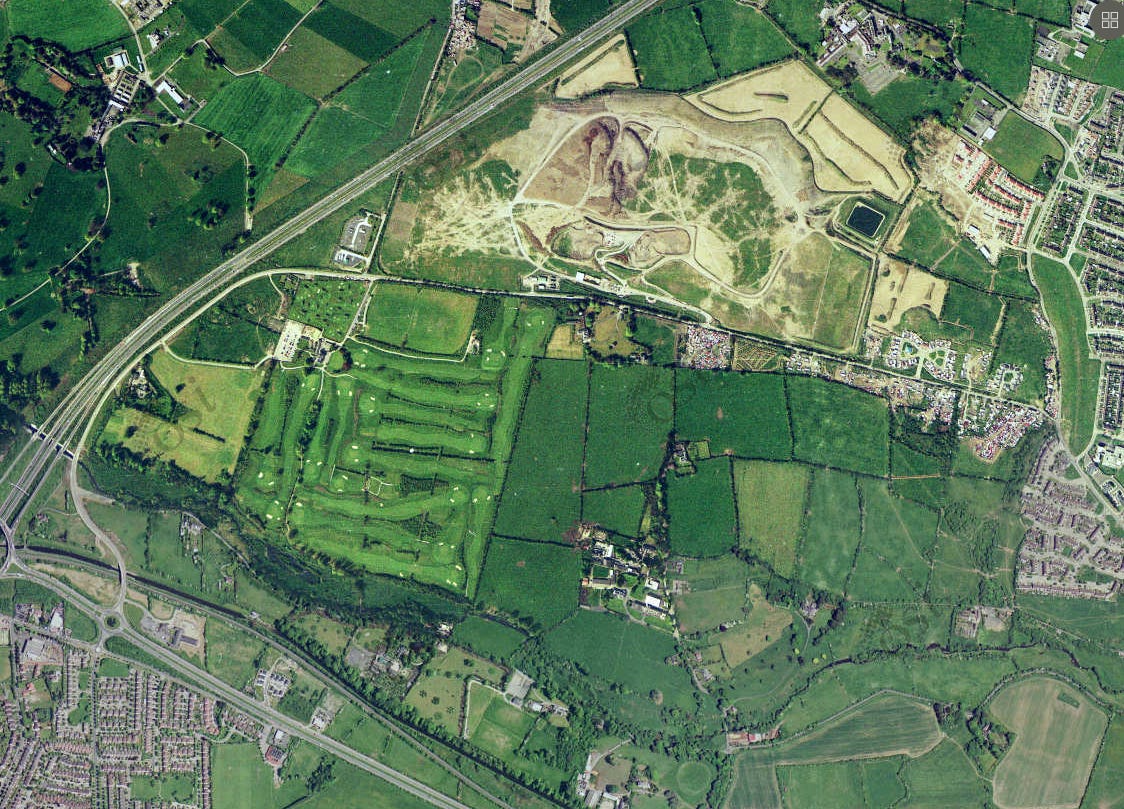
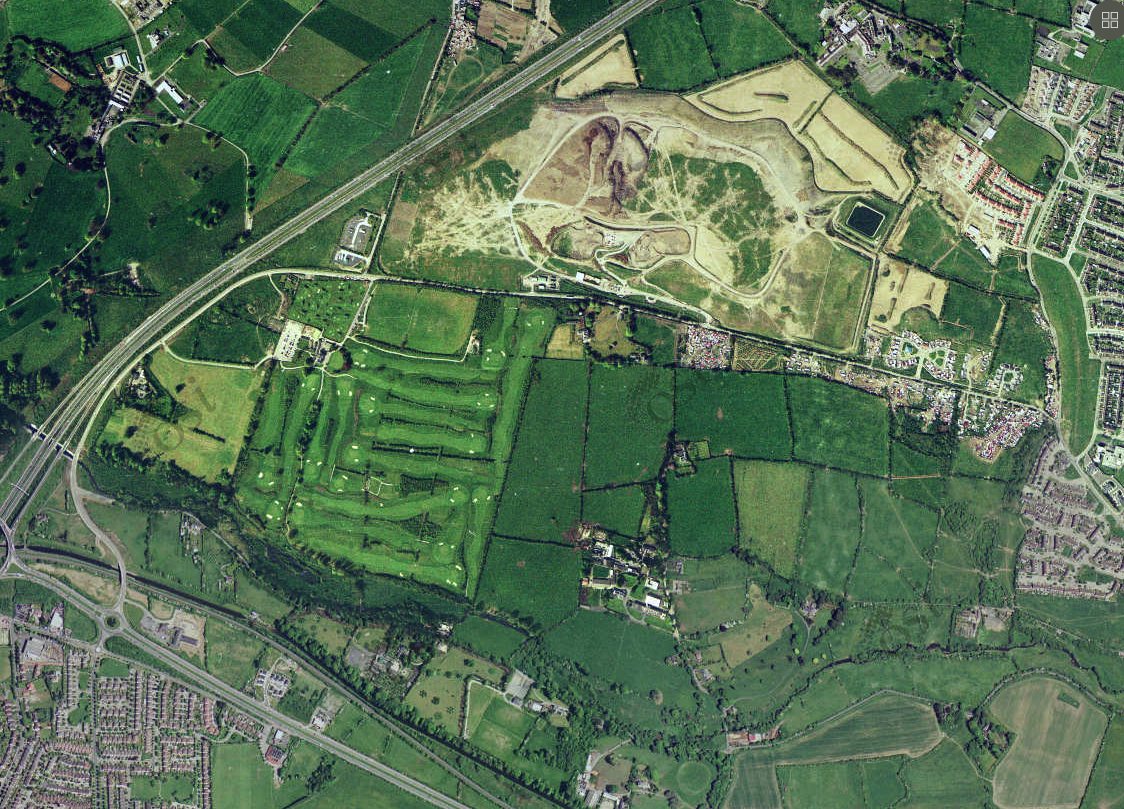
Aerial view of Dunsink, taken between 1996 and 2000. The partially covered landfill can be seen at the northern end of the site. Source: Tailte Éireann
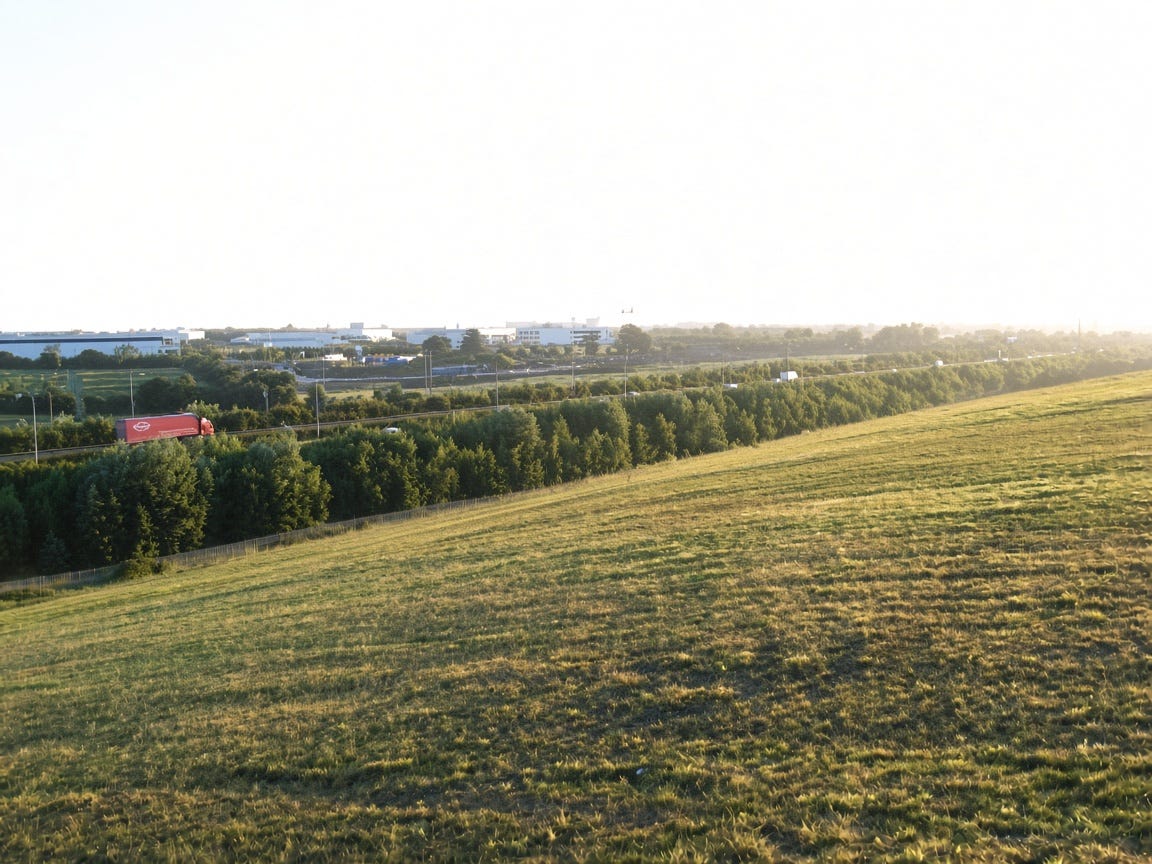
The hills of Dunsink, visible from the M50
Back in June, Fingal County Council announced a big, ambitious plan to build a new town in Dunsink. It was to have 18,500 homes, ten schools, and office and retail space. The former landfill site would remain undeveloped, and be used as a park.
Except now, the big plan has shrunk. In a recent council meeting, councillors voted to cap Dunsink at 2,500 homes, less than 15 per cent of the original plan, until at least the mid-2040s.
We’ve seen how transport bottlenecks new housing, manifested in long queues to get onto the Red Cow that begin at 6am. In Dunsink, councillors are blocking housing on the grounds that the transport infrastructure is not yet ready for it.
Dunsink’s transport links
As a principle, transport infrastructure should be developed alongside housing. The councillors that shrunk the Dunsink plan had the right idea: no one wants a new town without good transport links. But was this principle applied correctly? I would argue that it wasn’t.
When all is said and done, Dunsink will be one of the best-connected towns in Ireland. It’s 7km from Dublin city centre, a 30-minute cycle. It’s right beside the M50. The NTA will extend bus routes into the town, and create some new ones to serve it. But Dunsink’s main advantage is that it is sandwiched between two major upcoming rail projects.
The first is DART+ West. The Ashtown and Navan Road Parkway rail stations sit along Dunsink’s southern boundary. The Maynooth line, which runs through those stations, is being electrified as part of the DART+ project. The new electrified line will carry 12 trains an hour, up from six today. Passenger capacity will more than double, from a total of 5,000 an hour today to 13,200. Enabling works on the line kicked off in late October. According to the National Development Plan’s 2026 Construction Pipeline, the upgraded line will open in 2032.
Dunsink will also, eventually, get its own Luas. The Luas Tyrrelstown extension will run through the heart of Dunsink and link up to the Finglas line, which is entering construction in 2028. The Tyrrelstown extension does not yet have a confirmed budget or a railway order (the rail equivalent of planning permission). It’s scheduled for construction some time after 2042.
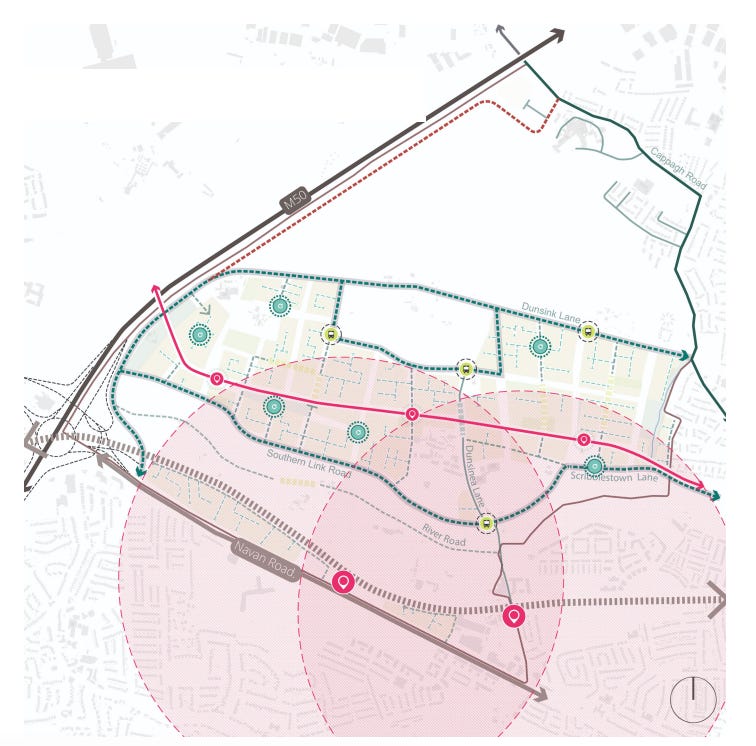
Dunsink’s transport map. The pink line running through the middle is the proposed Luas Tyrrelstown line. The pink icons at the bottom are Ashtown and Navan Road Parkway stations.
The planners in Fingal County Council designed Dunsink to grow alongside its transport links. In a draft version of the Dunsink Urban Area Plan prepared by the planners, the town fills out in three phases. In phase one up to 2,500 homes can be built, along with cycling infrastructure and the extension of the no.36 bus into the town. Phase two included 8,000 more homes and another bus route, the N6. At this point, DART+ West would also enter service, boosting rail capacity.
A further 8,000 homes would be built in phase three, but not until the Luas Tyrrelstown is under construction. The planners decided that the Luas is needed for phase three because the DART’s carrying capacity would be eaten up by the homes built in the first two phases.
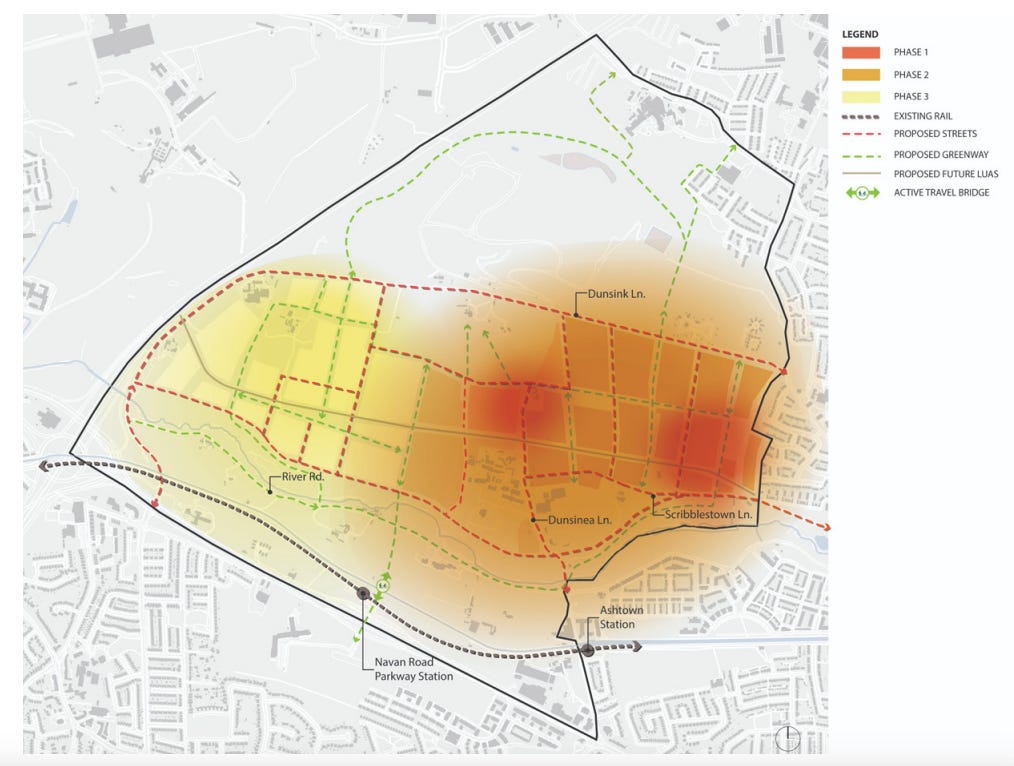
Phased build-out of Dunsink
All of this sounds reasonable. The plan directly linked housing delivery with a transport model, making sure that the new homes are supported by new transport capacity.
Councillors weren’t convinced. On 19th October, the draft plan for Dunsink came before Fingal’s councillors for review. They voted to bring the Luas requirement up to phase two. That means that only the 2,500 homes in phase one can be delivered before the Luas is under construction.
By moving the cap, councillors put themselves at odds with Dunsink’s transport planners. The transport plan found that Dunsink doesn’t need the Luas for the first phases of construction, because DART+ West can handle passengers from the homes built in phase one and two. So why did councillors vote to restrict housing delivery?
Alarm bells
Councillors are worried about overcrowding on public transport. In fairness to them, Dunsink’s transport plan includes a chart that would strike fear in the heart of any councillor. It forecasts transport capacity at different stations on the DART line during the morning rush hour, and includes new passengers expected to come from Dunsink. In 2030, things look good – the DART comfortably handles the extra load from Dunsink.
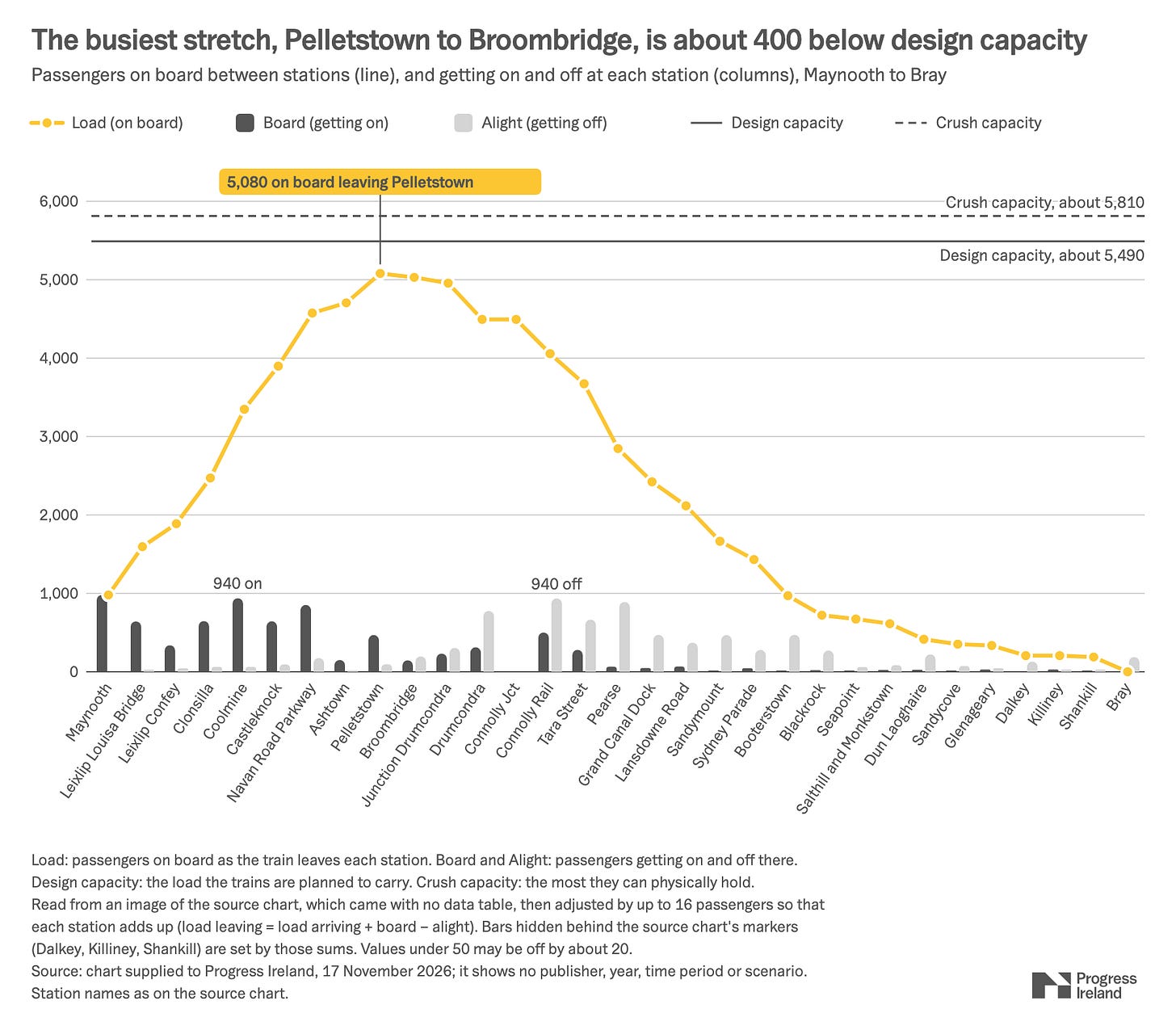
By 2035, it’s a different story. The model shows the DART reaching capacity due to additional passengers from Dunsink.
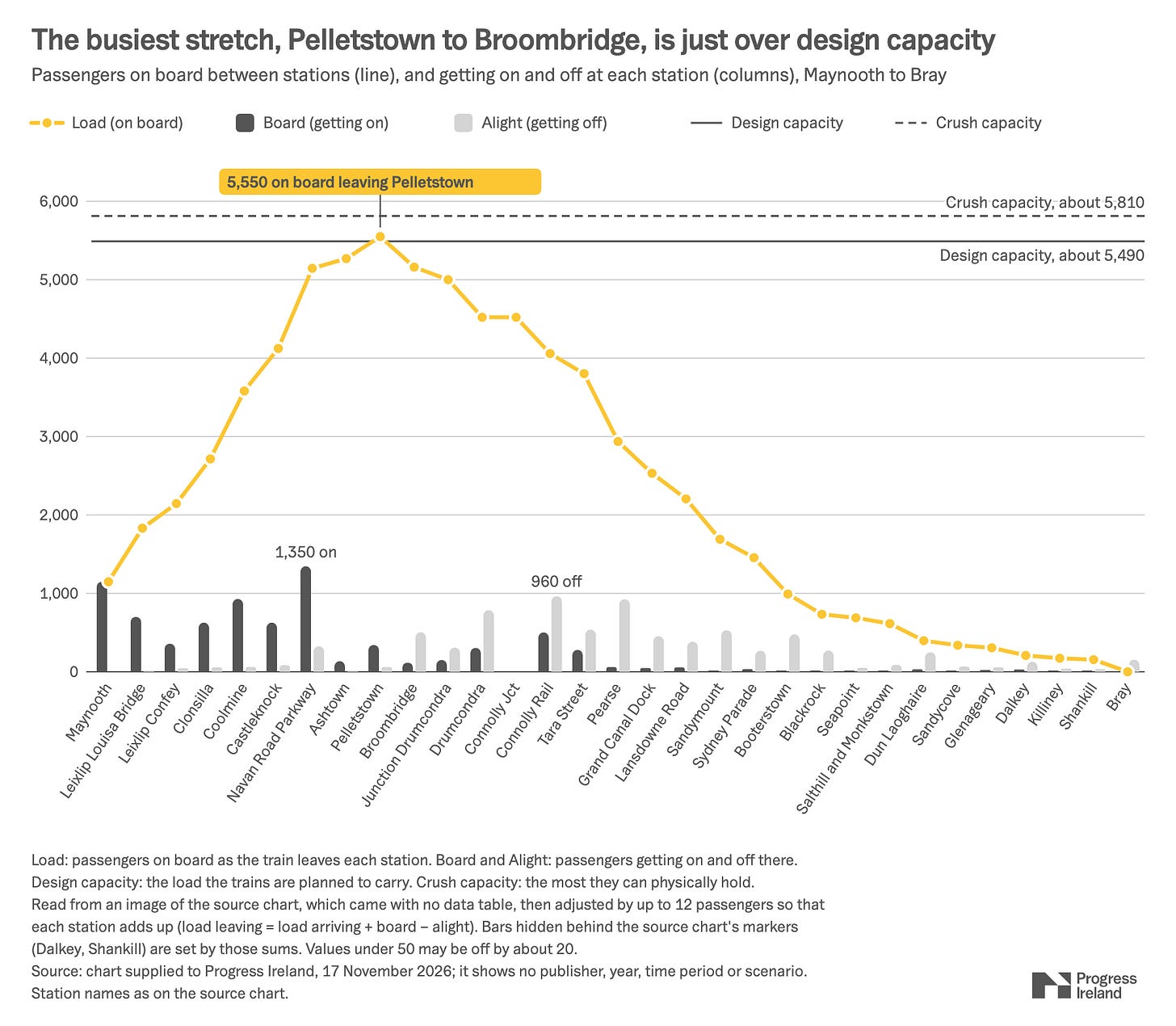
Transport overcrowding is already a major political issue. Emer Currie TD recently raised the issue of ‘chronic capacity issues’ on the Maynooth train line in a Dáil committee, and councillors regularly hear from constituents complaining of packed trains. No councillor wants to hear that today’s overcrowding will be solved by DART+ West, only to return with a vengeance in less than ten years’ time.
But Dunsink’s transport prospects might not be as gloomy as they seem. The transport model doesn’t say how many homes it assumes will be in Dunsink by 2035, but it does say that it expects 22,000 residents in Dunsink that year. It also says that the overall Dunsink plan is for 18,500 residential units with 46,000 residents. That means that they expect 2.49 residents per home. At 22,000 residents in 2035, that’s around 8,800 homes.
Is Dunsink likely to have 8,800 homes by 2035? The first planning applications for homes in Dunsink will likely arrive in 2027. Let’s assume that getting planning permission and building homes in Dunsink takes around four years, which is the Irish average. In that case, the first homes won’t be finished in Dunsink until 2031. To reach 8,800 homes by 2035, you’d need to deliver 2,200 homes per year. How many has Ireland delivered in other large developments? Adamstown managed 450 a year at its height, Cherrywood did 250. To overcrowd the new DART, Dunsink would have to deliver five times more homes per year than peer developments. While I am optimistic that we can increase the pace of homebuilding, this seems too optimistic.
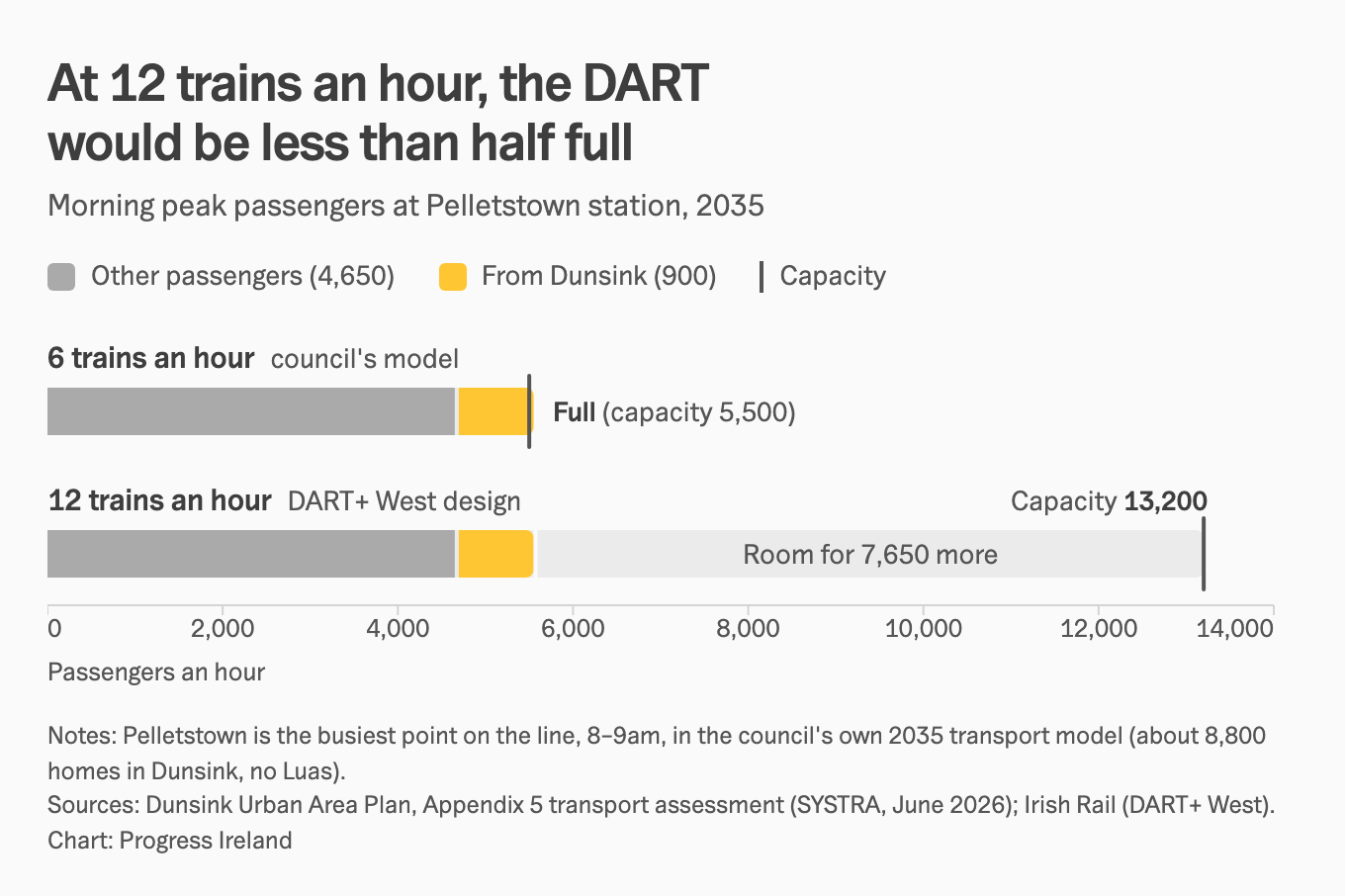
And even if Dunsink built at record levels, it wouldn’t outpace the DART’s full capacity. Dunsink’s transport plan assumes that only six trains will run at peak times, but the DART+ line can carry a maximum of 12 trains per hour. If 12 trains ran per hour instead of six, the capacity at peak time would never fill, even if all 18,500 homes went into Dunsink. The fact that the DART potentially has a lot more carrying capacity wasn’t clear in the transport plan councillors saw, but the council’s planners did assure the councillors that DART+ had enough capacity to accommodate the homes planned in Dunsink.
Burned before
To understand why councillors are being cautious, you need to understand that they’ve been burned before. The rosy picture of a transit-oriented town painted in the Dunsink plan looks very different from the reality on the ground. The Maynooth train line is overcrowded and passengers regularly get left behind. The M50 is approaching perma-rush hour. And residents in Tyrrelstown and Mulhuddart, which would also be served by the new Luas line, complain of a chronic shortage of buses.
DART+ West will relieve pressure from the jammed transport system. But voters just don’t feel that today when they’re squashing into an over-full train. To make things worse, people feel disillusioned after years of promises of big projects like Metro West that never materialise. Even though works have begun on DART+, how can they trust it will be finished anywhere near on time?
This disillusionment feeds back to councillors. And after all, councillors’ main incentive is to keep their current voters happy, not to build homes for future residents who may or may not vote for them.
Councillors wanted a clear solution they could bring back to their voters. It appears that they decided that the best way to do this would be to get the Luas fast-tracked (it’s worth noting that residents in other areas, like Tyrrelstown itself and Mulhuddart, also want the Luas to be fast-tracked). But there’s just one problem: councillors don’t have the power to fast-track tram lines – that’s up to the NTA and the government. What councillors can do is hold back housing.
Escaping transport doom
Transport doom has infected the Dunsink debate. Even an area that has a real rail plan, designed under transit-oriented principles, is getting blocked. Councillors in this case are being overly cautious, but they’re dealing with voters that are jaded from years of traffic jams and promised rail and bus links that don’t materialise.
The flip side of this, though, is that Ireland can’t afford to let transport doom block good housing plans. Homelessness is increasing. House prices are still rising. We need to get homes built, in well-connected areas with access to jobs and services.
There is another, softer path open to councillors. It allows housing to be built as transport comes online, without creating a hard cap on building. On foot of a request by Cllr Ted Leddy, the council agreed to review housing density in Dunsink at the plan’s midpoint, which is about five years after the plan is finalised. The plan will likely be finalised in 2027, which lines the review up nicely with when DART+ West is due to enter service. At this point, the council can review whether public transport has progressed in line with plans, and if not, reduce the housing densities in Dunsink. This ensures public transport is sufficient to carry Dunsink’s residents, without unduly blocking new developments.
Next up
The councillors’ vote isn’t the last word on Dunsink’s housing plan. Councillors voted in significant (known as ‘material’) changes to the plan in their recent meetings. These material changes have to go back out for public consultation. That’s likely to happen in the next few weeks. Once the public consultation is finished, the council’s planners will draft an updated plan, and councillors get a chance to vote on it again. There is still time to reject transport doom, lift the 2,500 cap on housing, and let Dunsink be the transit-oriented success it can be.
Last updated: