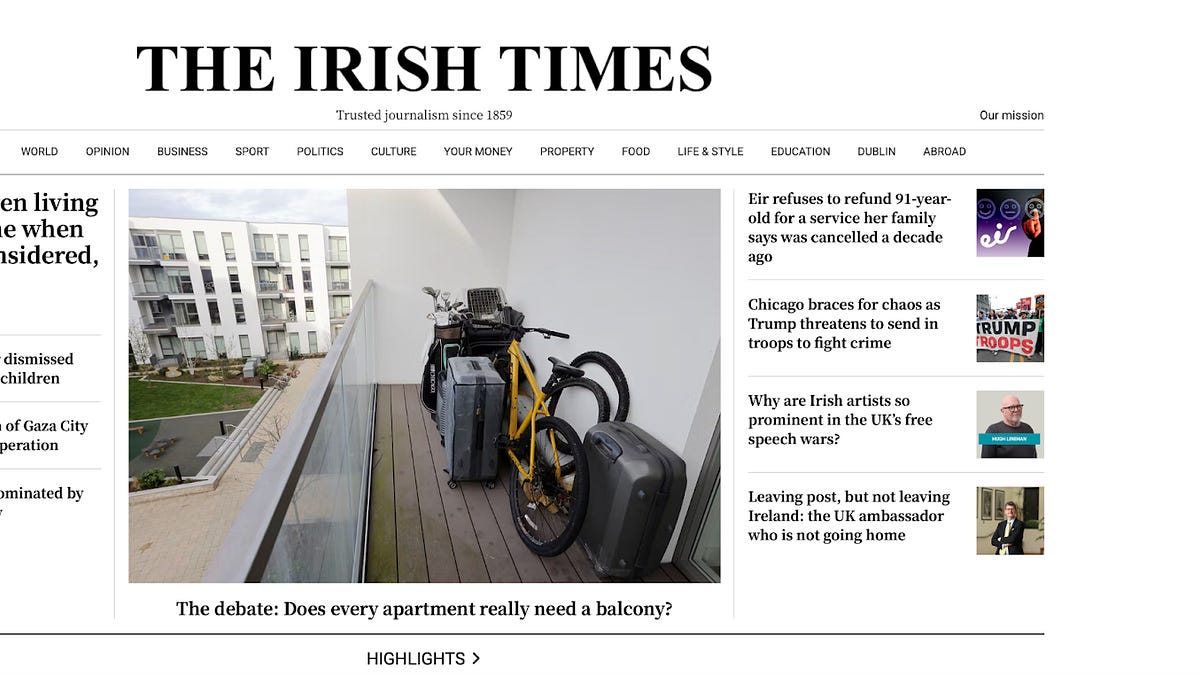
Sean O’Neill McPartlin made the case against mandatory balconies in the Irish Times yesterday.
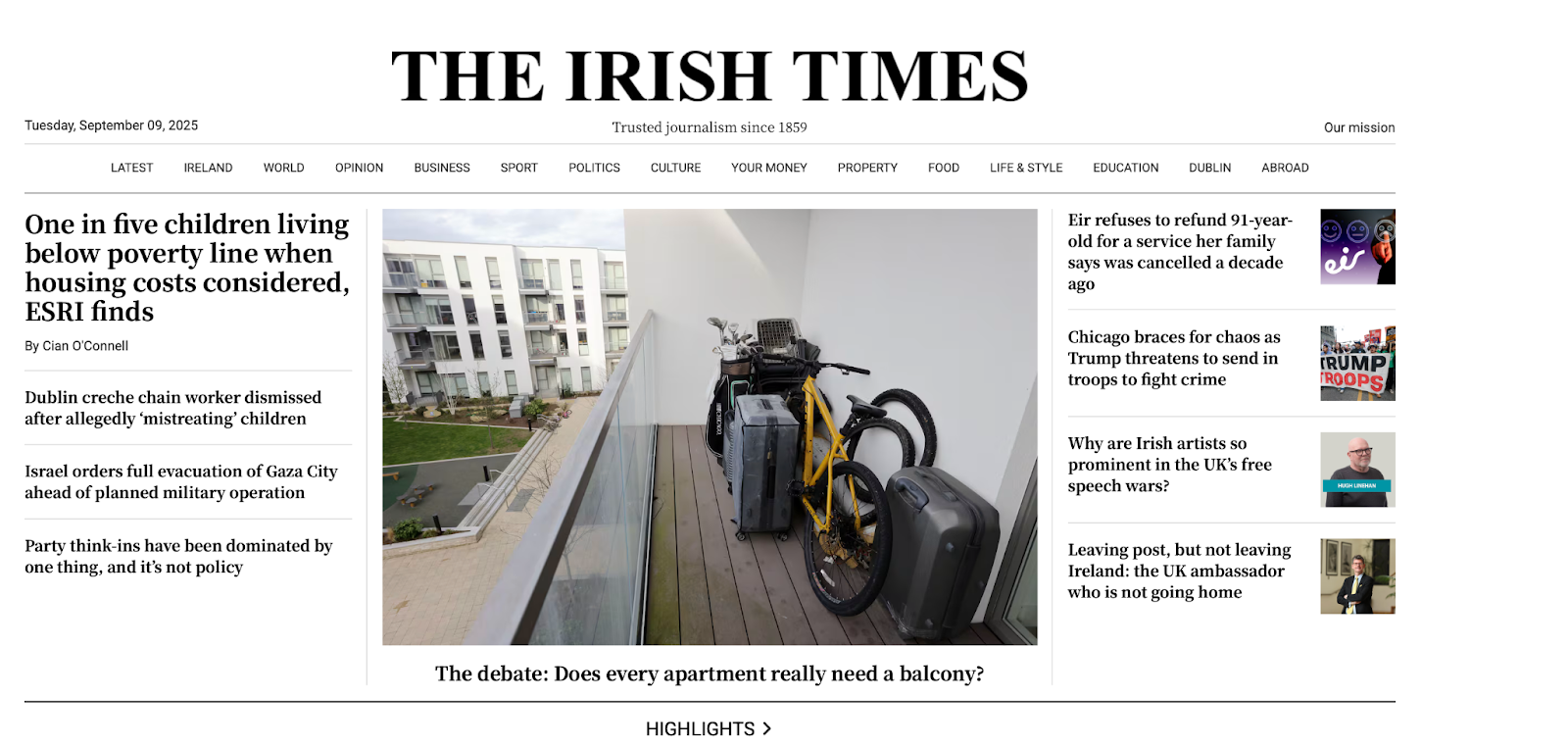
He made a narrow point about balconies and a bigger one about our dysfunctional housing rules. The narrow point is that balconies cost between €6,000 and €20,000 and that cost is borne by the buyer. A lot of people would rather a cheaper apartment or one with lower rent than the amenity of a balcony. It’s unfair to make everyone pay for something only wanted by some people.
Sean’s bigger point was that this isn’t just about balconies. Irish apartments are extraordinarily expensive to build. Dublin apartments cost the second-most to build in Europe – between €550,000 and €600,000 for a two-bed. When apartments cost so much to build, nobody builds them. Fewer apartments being built means fewer people with a place of their own and higher rents for everyone. A recent paper by Günnewig-Mönert and Lyons measured the relationship between high costs and the supply of housing. They found that a fall in costs of approximately 1 per cent results in approximately 1.9 per cent more projects going ahead.
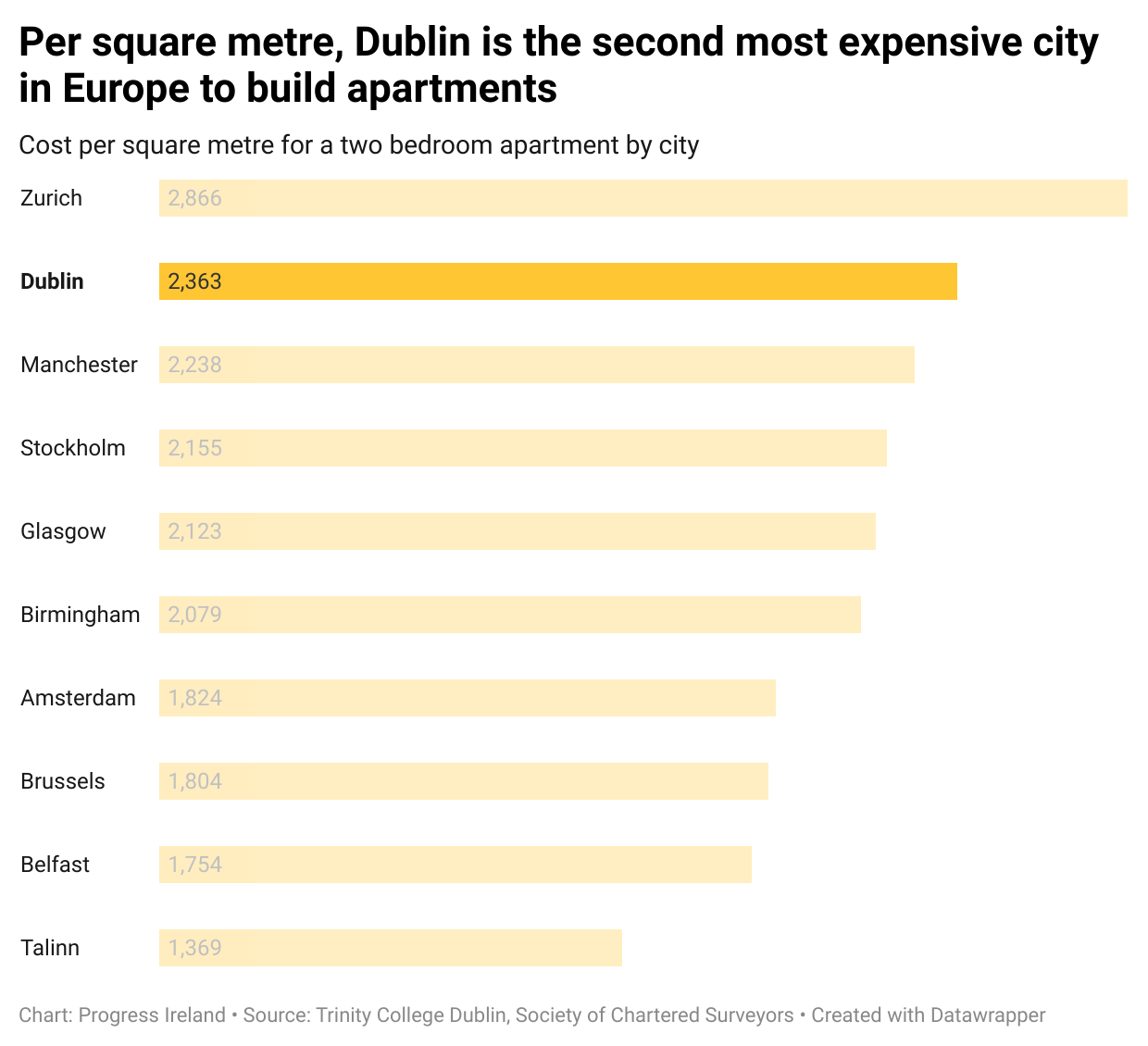
When you look into construction costs in Ireland, there’s a funny inconsistency. One study found that if you were to build precisely the same apartment in Dublin and a range of peer cities in Europe, the Dublin apartment would not cost more. But Dublin also ranks as the second-most expensive city in Europe in which to build, after Zurich. The difference can be accounted for by quality: Dublin apartments are higher quality than those found in peer European cities. That’s why they cost more to build.
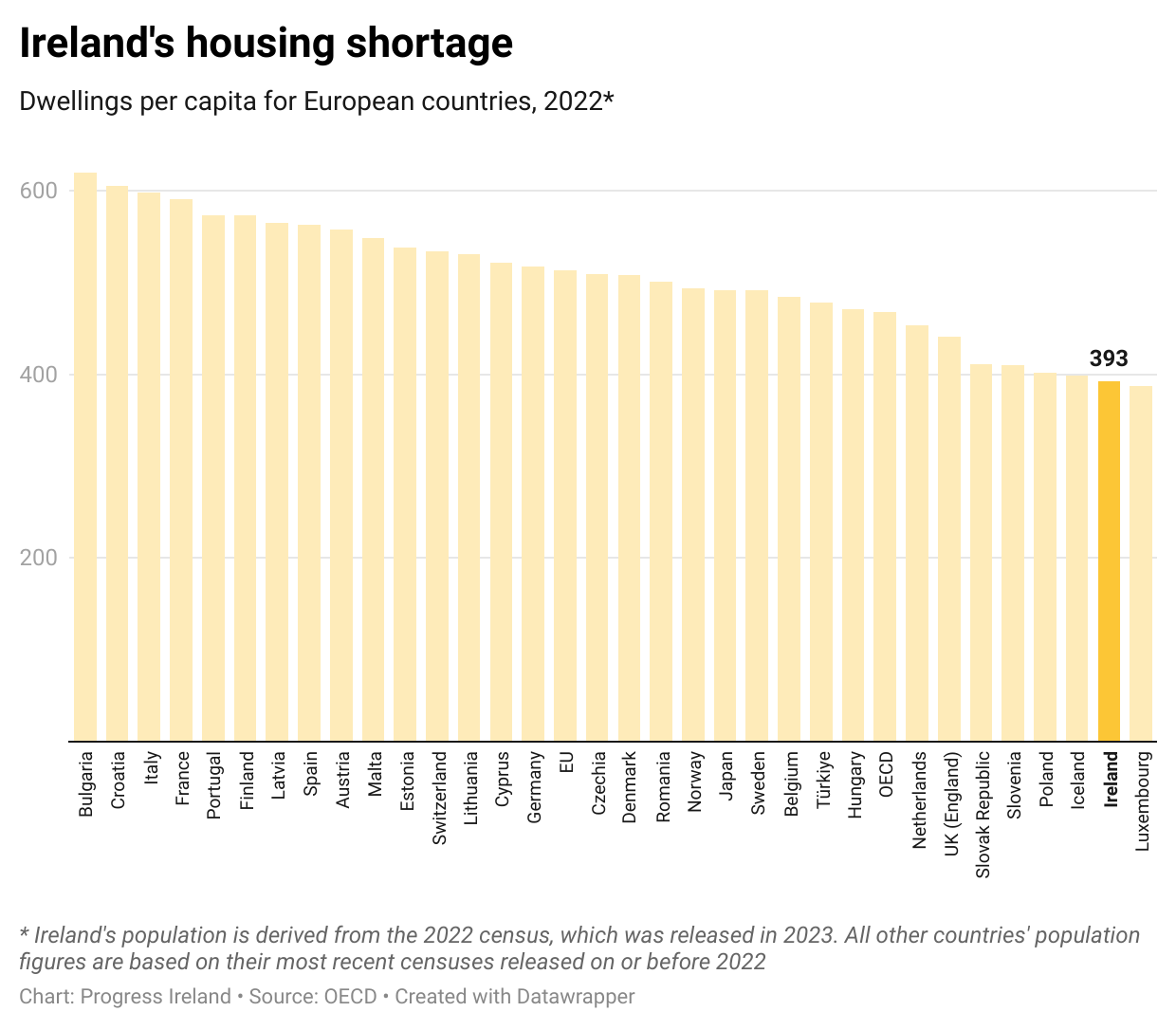
This is why the debate over balcony regulations is important. Ireland has a chronic housing shortage – the second fewest dwellings per capita in Europe in 2022. Given rapid population growth since then, we might even be further back in 2025. We have a lot of building to do. But if construction costs stay as high as they are, we’ll never get there. We need to be fair and realistic about the regulations we impose on new buildings.
The case for regulating construction
If everyone agrees the housing shortage is Ireland’s biggest problem, why bother with regulations at all? Is any building better than no building?
I would be careful to draw a distinction between regulations that stop home buyers getting ripped off, and regulations that force them to spend more than they want to. The first category is good and the second one is bad.
What we don’t want is builders throwing up defective crap and selling it to desperate buyers. Buyers find it hard to assess the quality of wiring, dry wall etc. There’s a role for regulations in creating trust between buyers and sellers by solving the informational asymmetry. Regulation reassures buyers that their new home will still be standing in 60 years. It reassures banks that the property is worth lending against. And it reassures insurance companies that the thing isn’t a risk.
Another important point is safety. The buyer of a flat can’t know how quickly a fire would spread from the kitchen to the bedrooms. Regulations stop corners being cut. Rules like these – ones that prevent abuses that are hard for potential buyers to discern superficially – make perfect sense.
We don’t need toilet rules
After I said on Twitter yesterday that “balconies are great, people should be able to buy them if they want one”, one wag owned me with the following comment:

Now, I get where HalfFullButCracked is coming from. Buyers and renters feel powerless. Queuing for viewings and saving for deposits, they are in a weak position. They see regulations as the only thing stopping builders and sellers from taking advantage of them. Without minimum quality standards, what’s to stop developers from building prison cells?
And to be honest, there could be some truth to this argument. When housing is as scarce as it is, developers and sellers have the whip hand in relations with buyers and renters. They’re not incentivised to build well because there’s always another buyer. It might be that developers who are willing to cut corners on quality will be able to outbid, for sites, developers who build at higher quality.
The good news is that, if developers are permitted to build apartments people can afford, they will build lots of them. We saw this with the explosive growth of the build to rent (BTR) market (before BTR was killed by local authority development plans). More building will put people in homes and will lower rents. As a side effect, buyers will be less desperate, and the pressure on developers to build to a higher standard will rise.
A speculation: I lived in Denmark for a while. It’s a place where buyers are not desperate. There are more homes to go around, per person, (508 per 1,000 residents in 2022, compared to Ireland’s 393) and the population is also quite stable (population up by 13 per cent since 1995, compared to Ireland’s 50 per cent). Denmark doesn’t mandate higher quality standards than Dublin. But there is nonetheless a perceptible difference in quality. Things feel well built over there. The windows are uniformly solid. Maybe this is because, for the last 30 years, Danish buyers haven’t been desperate to buy whatever they can get their hands on? Maybe they can afford to be discerning?
It’s true that in a tight market like Ireland’s, developers will be tempted to skimp on quality. But in attempting to correct for this, minimum quality standards make things worse. They effectively make it “illegal to build an apartment that normal people can afford”, as Sean O’Neill McPartlin said. They backfire on the people they’re intended to help.
To be sure, the government has taken steps to reduce regulations and lower construction cost recently. As Seán O’Neill McPartlin said in the Irish Times: “[The government] reduced the size of studio and three-bed apartments. It relaxed the dual-aspect requirement to 25 per cent of the apartments in a development. It removed the council’s ability to dictate the “mix” of apartments. These changes will cut some costs, and that should be welcomed. But it baulked at removing the necessity for balconies, patios or terraces, which continue to be a requirement in most cases.”
The way to make builders make a good product at a fair price isn’t to pass clumsy rules mandating balconies, dual aspect windows and so on. The way to make developers build a good product at a fair price is the same as in every other industry – by encouraging more competition and more building. You want so much building that developers are one-upping each other to attract buyers.
And to HalfFullButCracked’s point: look around the world. Look at all these European countries whose minimum quality standards are lower than in Ireland. Look at old buildings, either in Ireland or elsewhere, which were built at a time before minimum quality standards. Or look at almost every product other than housing, which are produced without minimum quality standards. We don’t need rules to force companies to make houses and products people want. Companies are good at making money by giving people what they want. Have faith.