When I was young(er), I worked on a construction site. Mostly, I was consigned to cleaning up after everyone else: dust, broken concrete, and yes, the toilets too.
Of all the noteworthy things you may observe on a construction site, what stands out is how inefficient it all is. The construction industry has a productivity problem. And it’s construction productivity that I want to talk about today.
When we talk about productivity, we are talking about the conversion of resources into something (usually we are talking about labour productivity or output per hour worked). In the case of construction, we are talking about the resources it takes to get something built. More productive industries efficiently convert resources into stuff; less productive industries take more and more to produce less and less.
Improvements in the productivity of how we produce everything from food to phones have dramatically decreased their costs. But what has happened to manufacturing and agriculture has not happened for building, well, buildings.
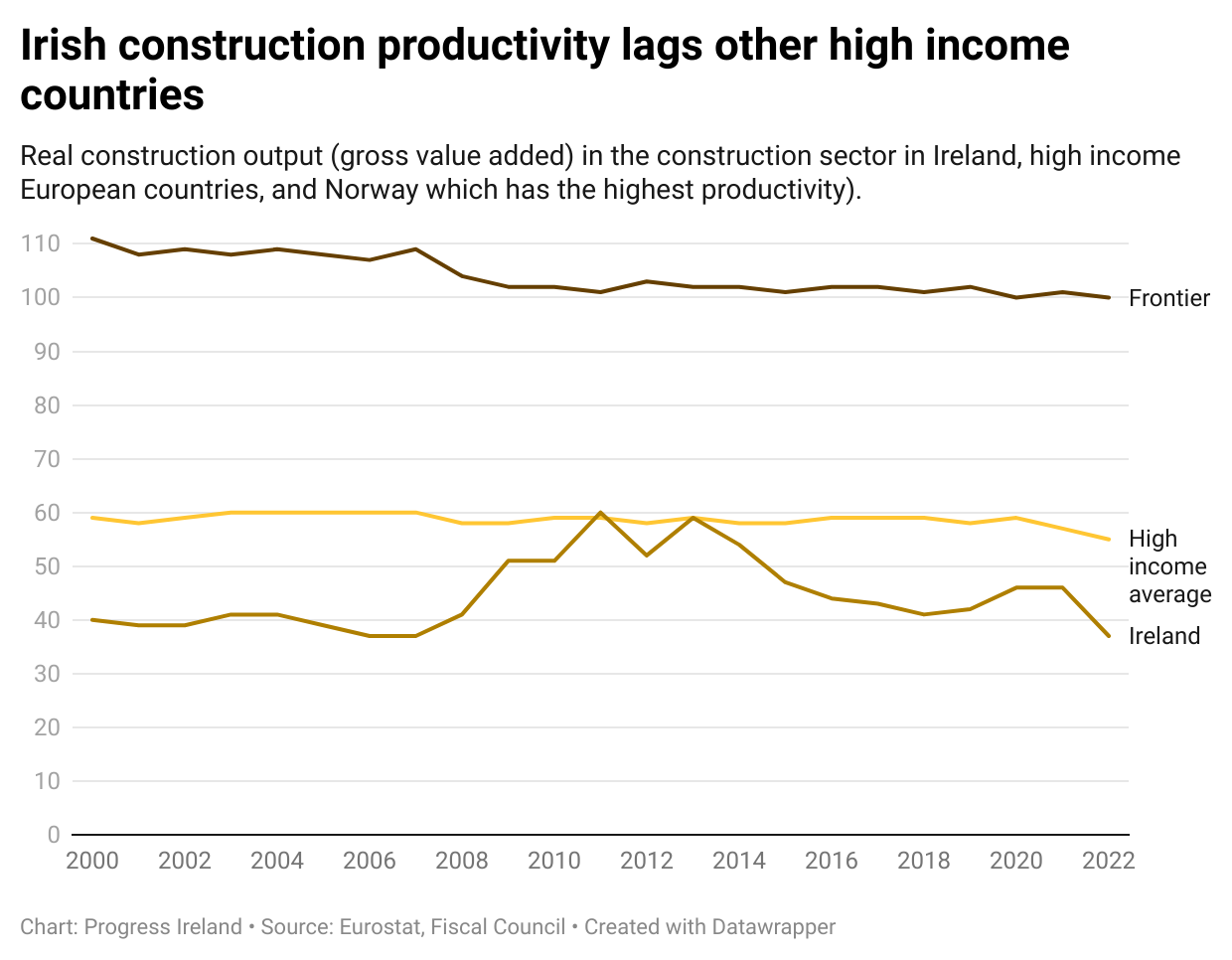
A more productive construction sector would be able to build homes for less, making housing more abundant and affordable. But in Ireland, construction productivity lags that of other high income European countries and is far behind the frontier (which, in this graph, is Norway).
What has gone wrong? And how should we fix it?
The government’s theory
The Irish government thinks that a big part of the answer to the construction productivity problem is to adopt more modular building techniques or modern methods of construction (MMC). One reason construction productivity is so poor in Ireland, according to that view, is that it hasn’t quickly adopted MMC.
MMC usually refers to a cluster of techniques that involve doing parts of construction in a factory and delivering them to be installed onsite. You will see this already happening when you live near a site: lorries with entire sections of concrete strapped together being hauled in to be carefully installed with the help of cranes. For example, this picture is of a light gauge steel frame closed panellised system (basically, a wall built in a factory) being installed onsite.

And the idea has a lot to say for it. A big selling point of MMC is that it could reduce the labour intensity of building. According to the Government’s Build 2024 report, MMC could cut time onsite by up to 70 per cent.
Cutting on-site time is important due to Baumol’s cost disease: productivity gains elsewhere keep pushing wages up, but construction’s own output per hour has barely improved. Shifting more work into factories lets workers do the same jobs faster, raising output per labour hour and closing the gap between rising labour costs and stagnant productivity.
A government commissioned report by EY claimed that “MMC has the potential to improve the speed of construction of new homes through the adoption of innovation by 30 per cent, with a potential 25 per cent reduction in costs” (the EY report itself cites a UK government white paper).
This is right as far as it goes but the question is: how far does it go?
Why MMC won’t solve the problem on its own
Throughout the 20th century, people have been asking why houses can’t be made like cars. The implicit point is that once we introduce MMC–in other words, once we start making houses like cars–we will have solved the construction productivity problem.
But despite the annual churn of reports pointing to MMC as the solution, its full adoption has proved elusive. In order for a large factory to be viable, among other things, it needs a large pipeline of orders of roughly standardised designs.
But there is an important respect in which all of this talk about MMC misses the big picture. To see this consider the case of Manhattan’s skyscrapers.
The Empire State Building commenced construction on March 17th 1930. It opened on May 1st 1931, just 410 days later. One World Trade Center, which began construction in 2006, took 3,112 days to complete. In other words, One World Trade Center took almost eight times as long and cost 5 times as much per square meter to build as the Empire State Building.
This example shows a much wider problem. Developed countries around the world have seen poor or negative construction productivity growth. And nowhere has the trend been reversed through the introduction of MMC alone.
Since 1970, US construction productivity has been in decline. Below you can see the divergence between construction productivity and other industries.
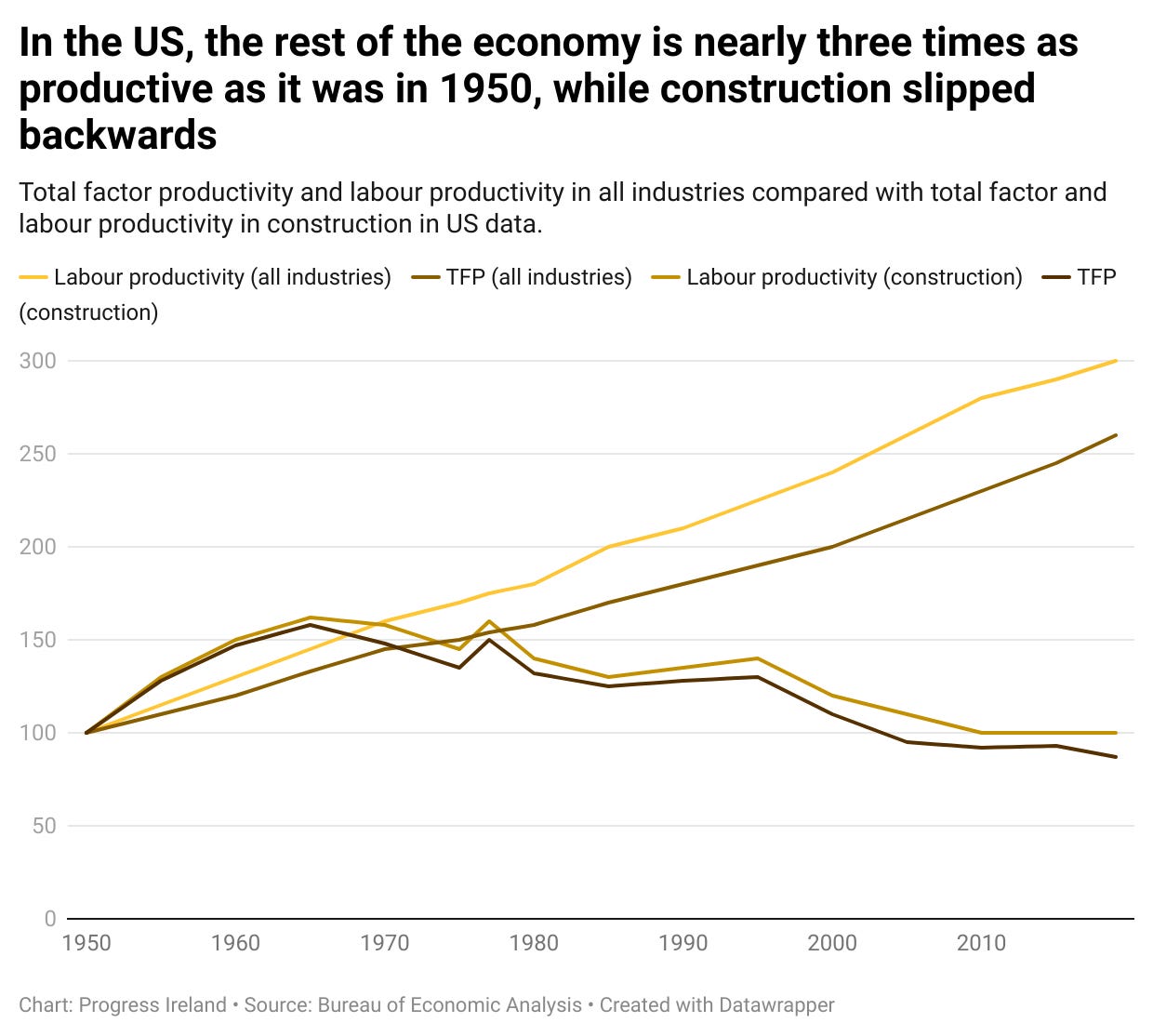
By 2020 in the United States, aggregate labour productivity and total factor productivity (TFP) were nearly 3x and 2.5x higher than in 1950 respectively. In the same period, both of these measures in construction had dipped below their 1950 levels.
The dip in construction productivity is not, of course, explained by the loss of MMC technology. In fact, without MMC, productivity growth in residential construction soared in the United States between 1935 and 1970. During that period, productivity in homebuilding grew faster than in automotive manufacturing (you may have heard people briefly ask: why can’t we build cars like we do houses?)
While there has been significant discussion about the possible role of measurement error in explaining the scale of the problem, the consensus seems to be that the divergence is real.
What caused this divergence in construction productivity?
There have been too many answers canvassed to discuss here. But the timing of the divergence in productivity points to some culprits. As D’Amico et al put it
the construction sector appears to have begun to stagnate around 1970 and soon lagged behind the rest of the economy. At that same time, an increasingly prosperous America started embracing land-use controls and other regulations
According to their papers–and others–it is an increasingly inhospitable regulatory environment, not technology, that underpins construction’s poor productivity. This claim reflects a much broader concern: that it has become more difficult to build physical things in general. It also indicates a crucial way in which a focus on MMC–despite its many benefits–misses the point.
Within the category of restrictive land-use regulation falls a lot of different regulations, some good, others bad.
One category of regulation discussed in the literature, one that is of particular importance in Ireland, is land supply. A perhaps surprising reason why construction productivity growth has been so poor is that policy has restricted the supply of a crucial ingredient in construction: land.
How a tight supply of land hurts productivity growth
To see how limited land supply may underpin poor productivity, we must first see how poor land supply affects the composition of the industry.
It is well known, both in Ireland and abroad, that a fragmented industry made up of small firms damages productivity growth in construction as with other industries. One reason for this is simply scale. Small firms do not have the capital to reinvest in innovation. Nor are their projects large enough to achieve economies of scale. As D’Amico et al put it
The smaller equilibrium size of projects then leads firms to shrink because entrepreneurs cannot monitor one hundred projects with two houses each as easily as two projects with one hundred houses each. As firm size shrinks, so do incentives to invest in technology. The overall productivity of the industry consequently declines.
It is no wonder, then, that Ireland fares so poorly in construction productivity: its construction sector is unusually skewed towards small firms. 91.6 per cent of those employed in construction in Ireland are employed by an SME firm of 250 employees or fewer. The vast majority of construction firms in Ireland, 96.6 per cent, employ 9 or fewer people.
But how does tight land supply cause the fragmentation of firms, and therefore poor productivity growth?
The simplified model for how this might work is that tight land supply makes it difficult to do big projects. Where there is only land capacity to deliver small projects, only small projects happen. And when there are only small projects, there can be only small firms.
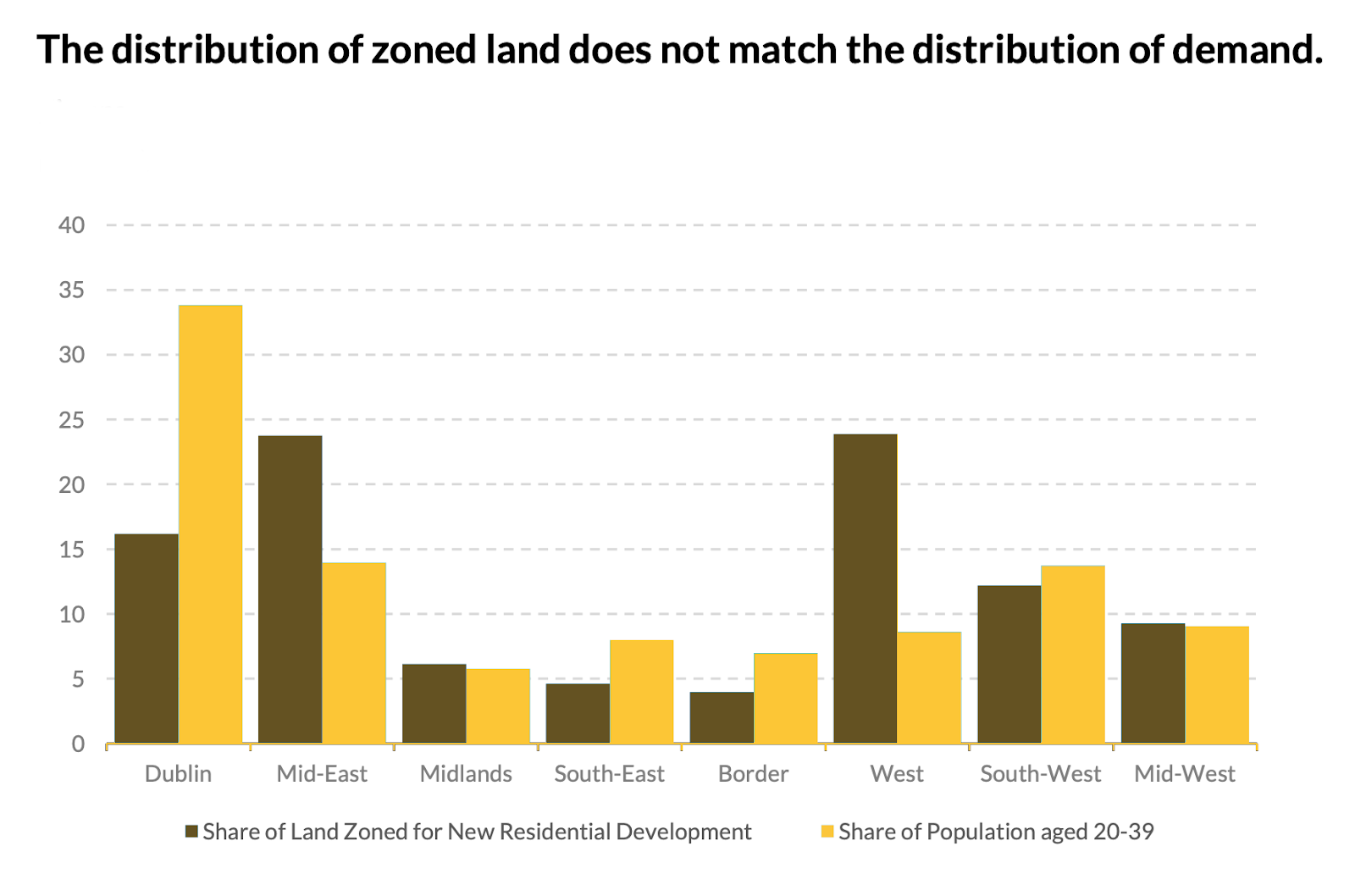
And Ireland’s land supply is highly restricted, as I argued here before. This is especially the case where demand is at its highest. To see this, consider the following graph from the Central Bank. In Dublin, land supply is lagging demand significantly.
While the government has rightly pointed out that construction productivity is a problem in Ireland, most have been slow to acknowledge the extent to which this has been the result of, among other things, land policy.
If we want to build an Ireland with abundant affordable homes, we will have to confront the construction productivity problem head-on. Yes, that will mean doing better on MMC, as most observers acknowledge. But it will also mean freeing up land supply. I couldn’t say it better than D’Amico et al when they said
If regulation keeps projects small, and small projects mean small firms, and small firms invest less in technology then productivity growth will decline.