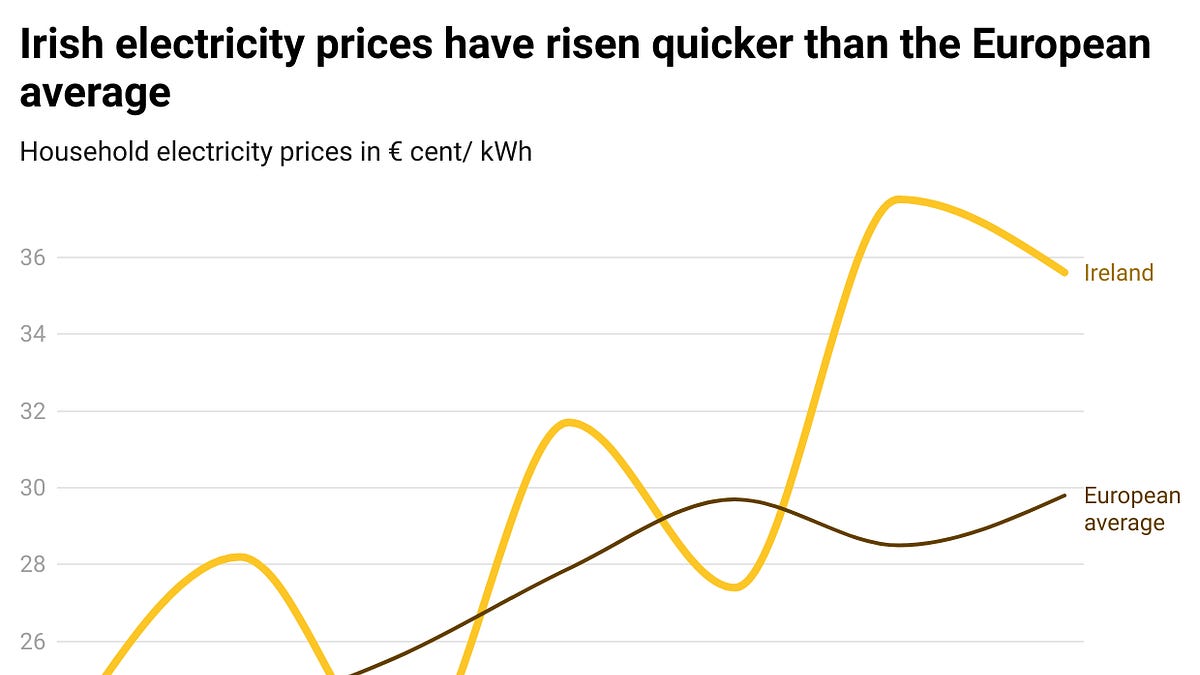
Every two months, by post or email, we are reminded of the extravagant cost of electricity in Ireland. Electricity bills to Irish households have gone up 45 per cent in the last four years.
Much has happened in energy markets in four years. Russia’s invasion of Ukraine, in particular, made a mess of the European energy system. One might think high Irish electricity costs are simply part of the “new normal” of permanently high energy prices.
But when it comes to electricity prices, Ireland isn’t normal. When Russia invaded Ukraine in 2022, Irish prices rose much faster than in the rest of Europe. And they stayed high.
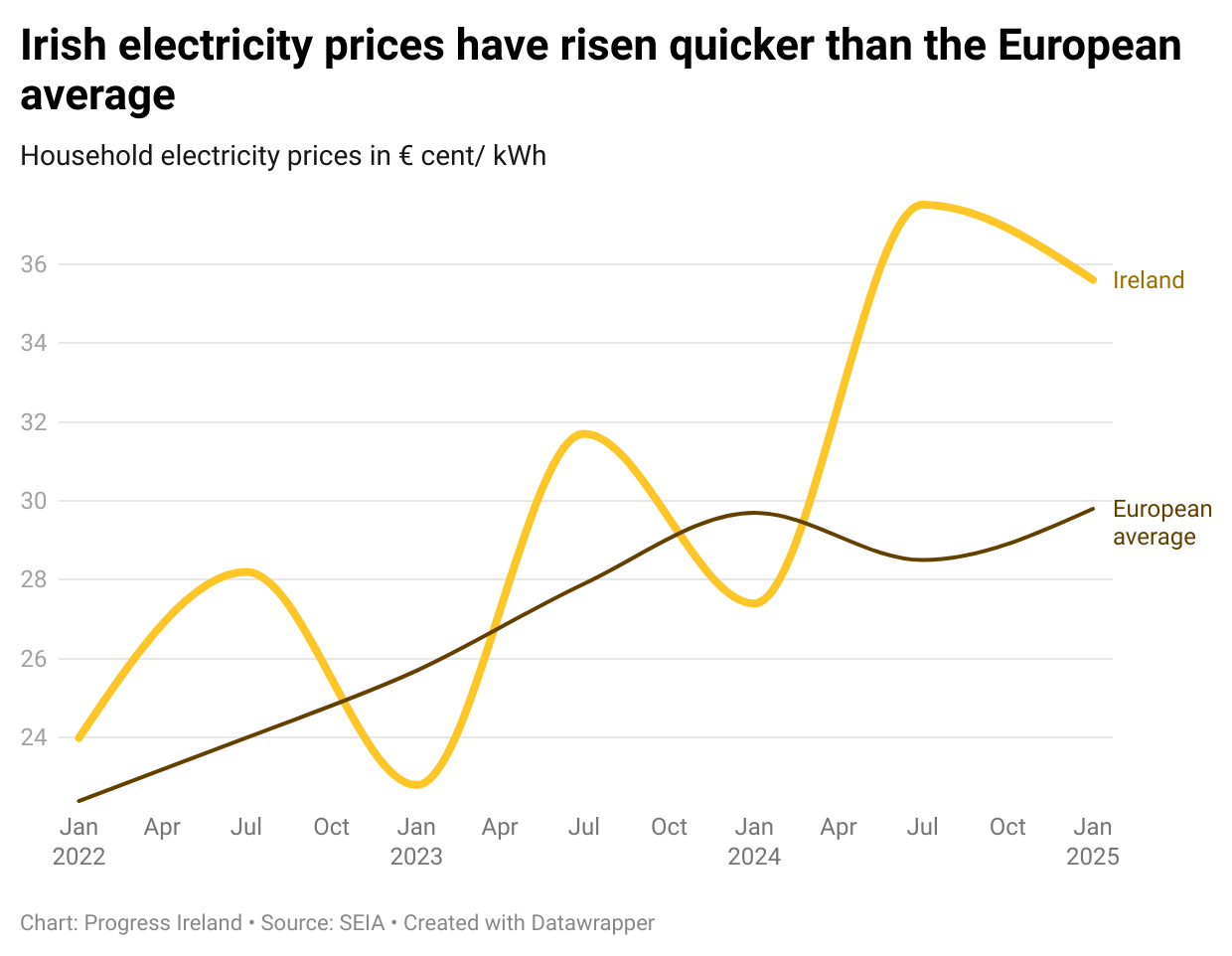
Irish electricity now costs 77 per cent more than the European average. These prices are not merely high: they are the highest in Europe.
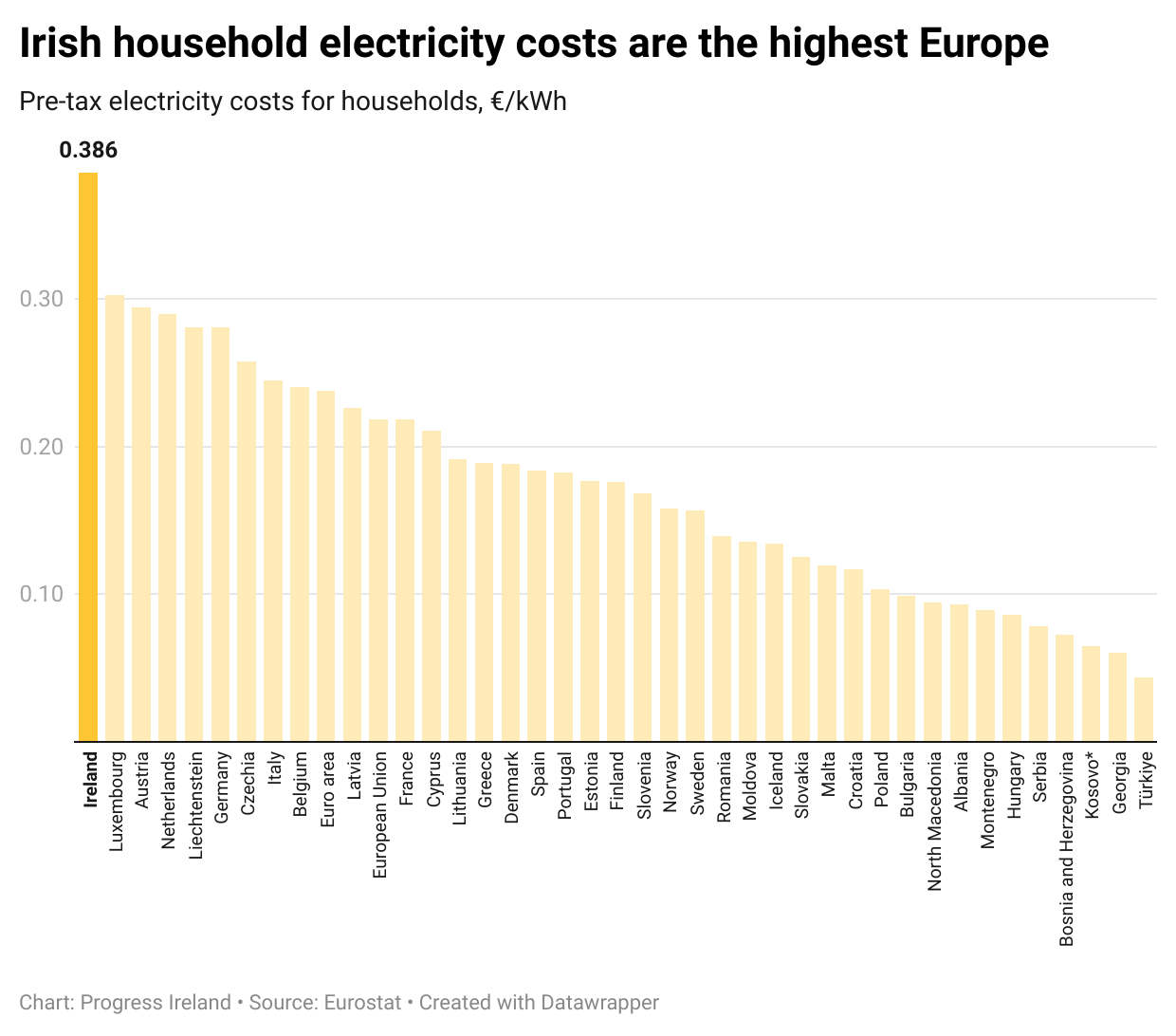
This isn’t just a household issue. Businesses are exposed too. Ireland also has the highest non-household electricity prices in Europe, which IBEC explains threatens ‘business viability, future investment, and decarbonisation efforts’. They are a material cost for small businesses like shops as well as large ones like factories.
So why is electricity here so expensive? A variety of factors are involved, from our investment in renewables to increased demand from new housing and data centres to our lack of indigenous fuel sources.
In this piece I want to focus on one barrier to cheaper electricity: our patchy national grid.
The national grid is the system of pylons that moves electricity, in bulk, from power stations to households and businesses. A well functioning grid moves electricity efficiently from where it is in surplus to where it is in deficit. A patchy national grid is unable to match supply and demand efficiently – which contributes to high prices for consumers.
23 years in the making
One example of Ireland’s grid problems is the north south interconnector. It’s a single proposed 400kV overhead line from Meath to Tyrone, suspended on pylons. It would span five counties and the border with Northern Ireland.
Ireland only has three interconnectors between the northern and southern grid, of which just one (the Louth–Tandragee 275 kV line) has significant capacity. A weather event could damage this line, which would also necessitate closing the other two lines to prevent overloading (or else we’d risk blackouts across the region).
To manage this risk, the grid currently limits the power flows on this line to less than half of peak demand. But that means the two grids aren’t as well connected as they could or should be. It means that electricity can’t easily get from places where it’s cheaper to generate to places where it’s more expensive – for instance, if there’s more wind on one part of the island than another.
The result is that consumers pay higher bills, on both sides of the border. About a decade ago, the interconnector was estimated to save €20 million a year, rising to €40-€60 million a year by 2030. At the upper end, that means €33 a year for every household in Ireland, every year.
And as Northern Ireland’s fossil fuel plants close, they become more dependent on that single interconnector – and at greater risk of blackouts.
A second interconnector would derisk the grid. There would be greater capacity for green energy to connect. Bills would come down.
To be sure, the interconnector would not save billions for consumers. It would not cause Irish electricity costs to revert to the European average. It is one representative example of dozens of medium sized projects we will need to undertake in order to build a more efficient and less carbon intensive energy system.
So why haven’t we built it yet?
Why it’s stuck
The interconnector has been on the cards for more than twenty years. An initial study was carried out in 2002, followed by two separate applications for planning permission. An Bord Pleanála granted permission in 2016. We’re still not ready to build it.
What’s stopped it? The first category of obstacle is local opposition and judicial reviews. Locals have opposed the project from the start. The group Safe Electricity for Armagh and Tyrone has been campaigning against the interconnector since 2009, including one man walking the entire 80 mile route in protest. They’re ably complemented by the North East Pylon Pressure (NEPP) group south of the border. This small number of people has been inflicting costs on a much larger number by judicially reviewing the decision repeatedly.
In Ireland, canny objectors find ways to slow down development. The NEPP launched a judicial review of An Bord Pleanála’s planning permission. It was rejected by the high court in August 2017, but was brought to the Supreme Court only to be rejected again in February 2019. That’s over two years of delay, without a meaningful impact on the final outcome. The project will still go ahead.
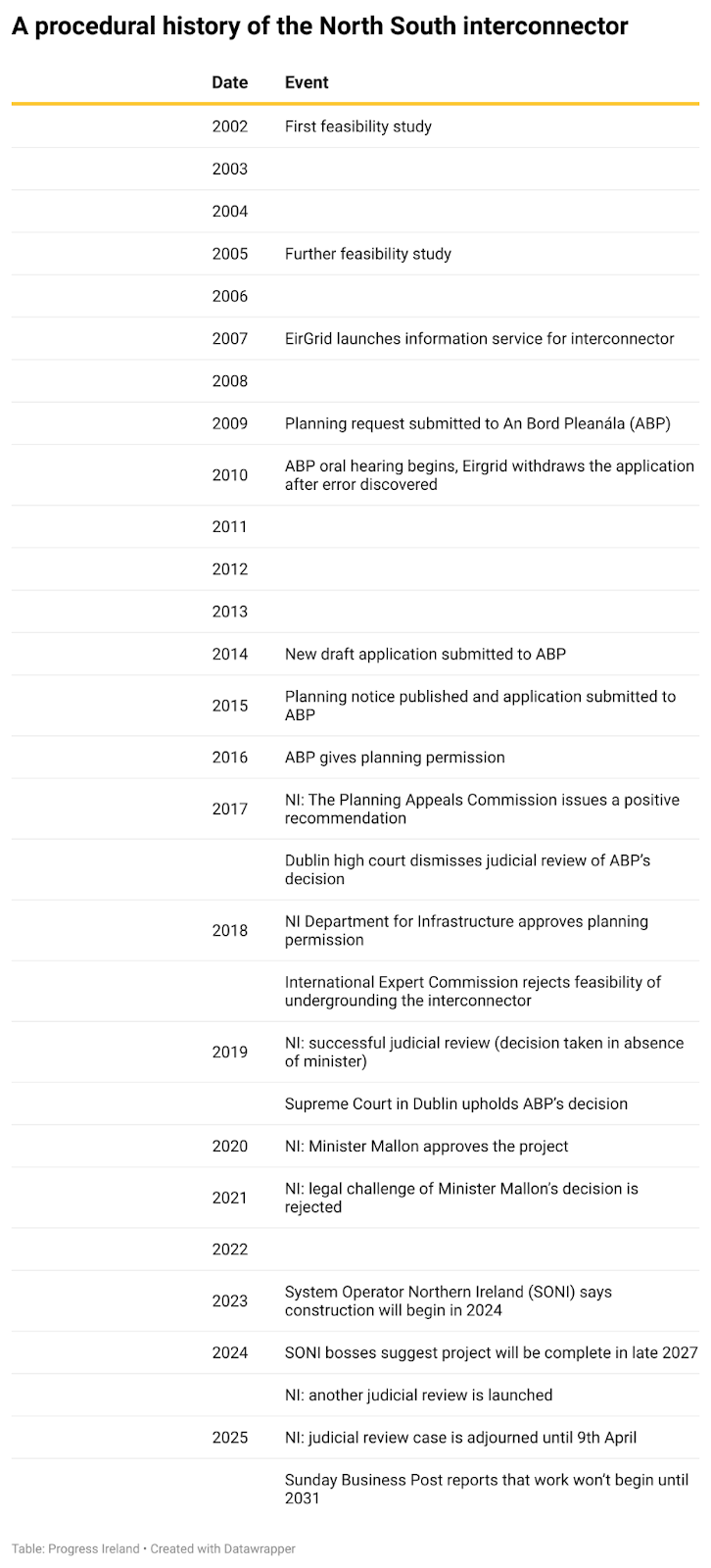
The second category of obstacle is the project’s cross-border nature. This means that there are two jurisdictions in which applications must be submitted, planners must sign off, and judicial reviews can be filed. The most recent delays have come from Northern Ireland, especially because the Executive wasn’t functioning for several years.
The third category of obstacle has been avoidable errors. A planning application for the interconnector was originally submitted in 2009, but was abandoned the next year after a mistake was discovered. It would be 2014 before the application was resubmitted. The option of burying the cable underground was examined “comprehensively” on three separate occasions spanning over a decade, and each time it was rejected. Were three investigations of the same question really necessary?
Now the project has planning permission, it’s still not proceeding quickly. Compensation is being negotiated with landowners, and another application for judicial review has been filed in Belfast.
All of these factors add together into more than two decades of delay. The latest estimates are that it will be the 2030s before work even begins.
The bottom line is that we don’t build much infrastructure in Ireland because we make it incredibly difficult to do so. It’s not a physical factor (like mountain ranges), nor an economic one (like wages being extremely high). There are legal and political barriers to getting things built.
Procedure fetish
It might not sound like much, but every other big infrastructure project gets stuck like this. Trinity College economist Barra Roantree recently wrote about the attempt to build a single bus lane in Dublin:
For example, the Lucan to city centre scheme includes 4-volume environmental impact assessment report with 23 main chapters coming to 1,000+ pages (not counting the 33 appendices), alongside detailed drawings, a Preferred Route Option Report (50 pages plus 9 appendices), a Preliminary Design Report (195 pages plus 43 appendices), a Natura Impact Statement (290 pages plus 5 appendices) and a Public Consultation Report (567 pages, including a lengthy appendix) among other documents.
Ireland is suffering from a disease where we can’t get important things done. Roantree calls this Ireland’s procedure fetish – the elevation of strict rules to an illogical degree.
The north-south interconnector is one more example of this fetish. It’s part of a wider grid problem that is costing us hundreds of millions each year, and rising. It’s stopping the grid modernisation that homes and businesses need.