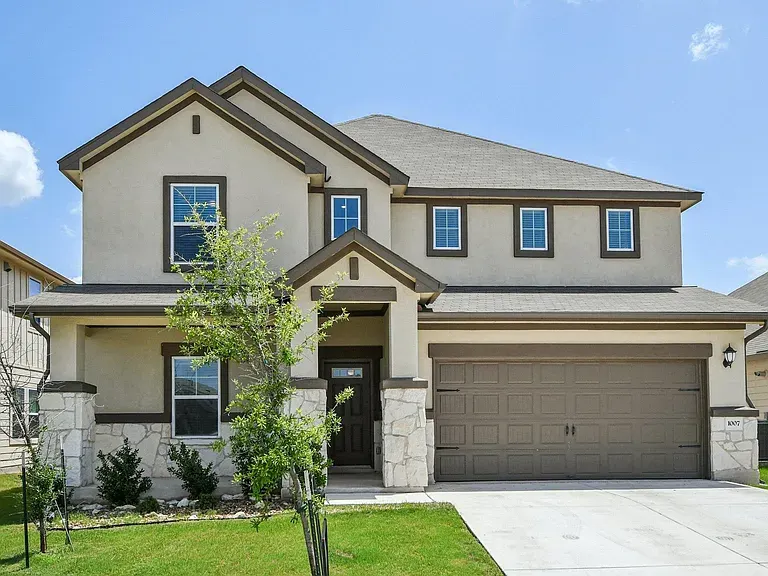
The European mind cannot comprehend the material plenty of American suburban housing. There are 3,000 square foot mansions with four bathrooms and a split staircase, 30 minutes from a booming downtown, on sale for €380,000.
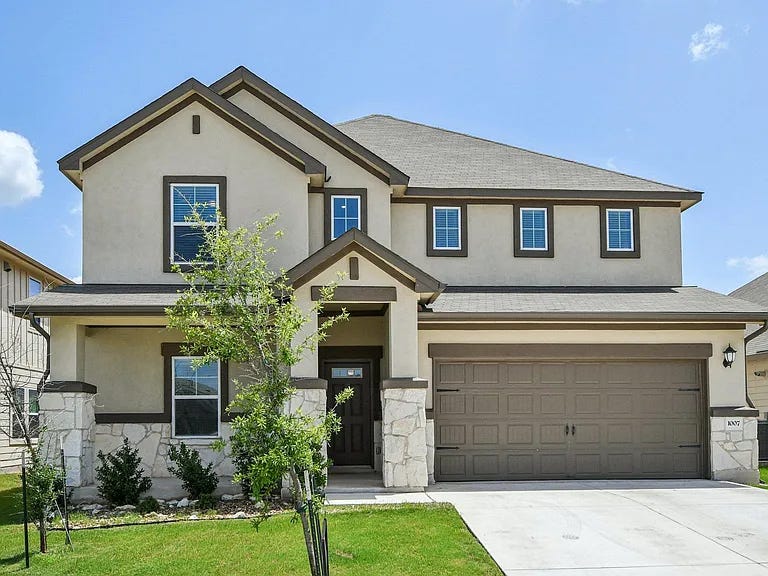
How do Americans achieve this? It is hard to pin down a single story. Part of it is their commitment to the combination of urban sprawl and large roads, allowing cheaper land to be accessed for housing.
A big part of the story is that Americans are richer. Pieter and Louis Garicano recently made the point that “the median American earns 30 percent more than the median Dutchman, about 31 percent more than the median German, and about 52 percent more than the median Frenchman.” Despite having bigger homes, American housing is often cheaper than European counterparts (and is of comparable quality).
Being rich gives Americans latitude that Europeans do not have. High incomes mean you can get away with more. Like in Europe, American construction costs have been rising fast. As far as I can tell, American construction costs are comparable to European ones.
But in America, they have the money to pay for these costs. While in Europe, high construction costs have become a growing problem.
In Brussels, people sometimes talk about competitiveness. By this they mean a few things. But one thing they mean is that America and China are growing faster than Europe. One piece of addressing that problem, among many, is that Europe has to fix its housing problem.
Housing matters for competitiveness for a few reasons. An elastic housing supply, that is one where housing supply responds to demand, means people can move to opportunity as it arises. Conversely, where successful cities are bad at building housing, this is bad for innovation and growth. Another reason is agglomeration. People are more innovative when they are near one another, they can share ideas and work together. A good housing system enables people to live and work near one another. If Europe wants to become more competitive, its member states are going to have to take housing more seriously.
What should taking housing more seriously look like from a European perspective? As I have argued elsewhere, the main impediments to housing supply are land availability, planning restrictions, and construction costs. Today, I want to look at the last one: construction costs.
Why construction costs matter
There are a few reasons to start with construction costs. The first reason is that high construction costs make building everything harder, especially if you don’t have American wages to cover them. For example, public housing is harder because it requires more fiscal space: the State needs money to pay for expensive goods like housing. A recent renovation proposal in Dublin had each new social home costing 700,000 euros per home to deliver. At costs like that, delivering public housing becomes politically and financially difficult.
Another way in which high construction costs damage housing systems is through misaligning housing costs with incomes. Put simply, if it costs more to build a house than people can afford to pay, that home won’t get built without subsidy.
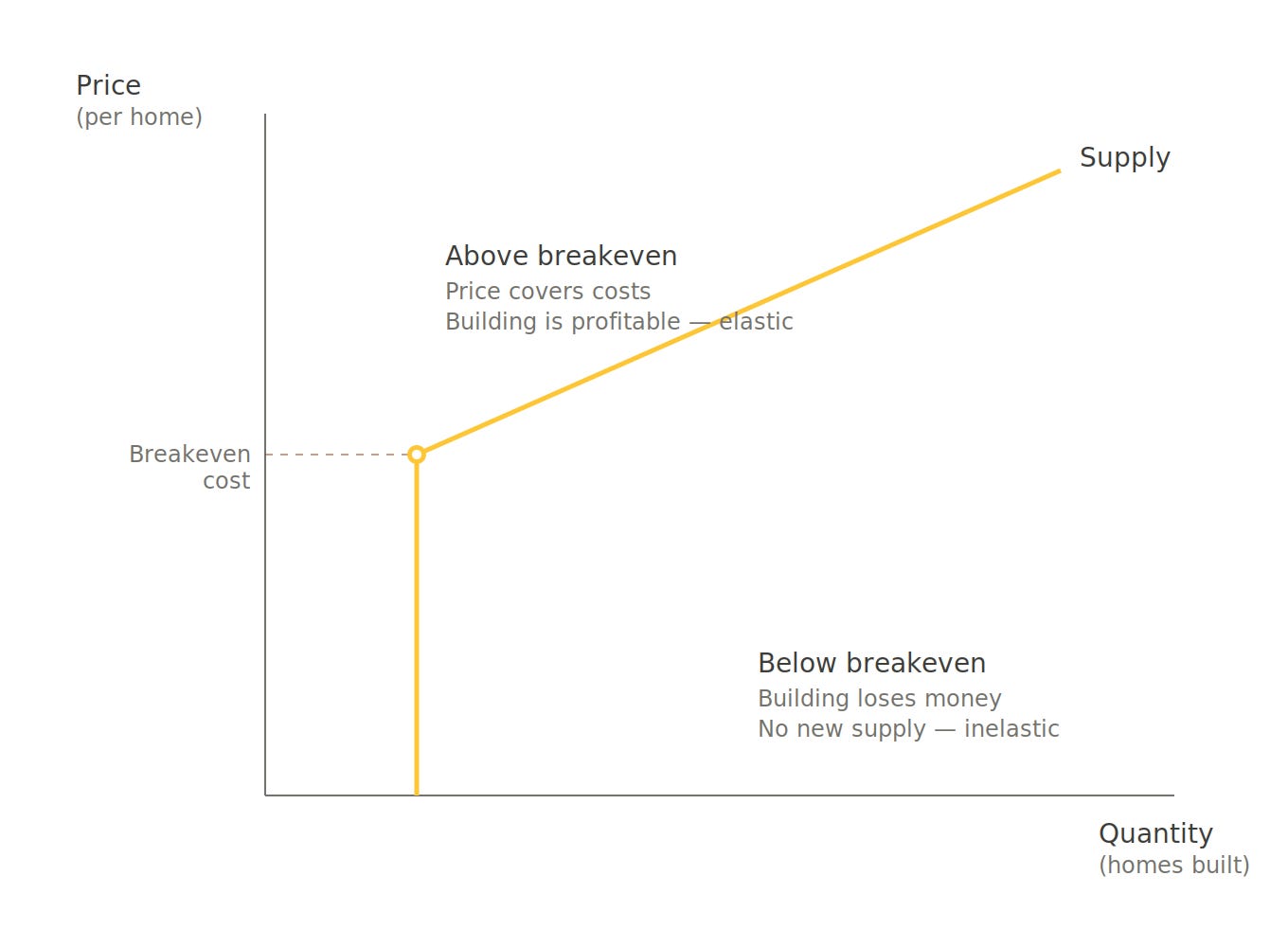
Very high construction costs can stop construction. This is because high costs increase the breakeven cost for development. Breakeven costs are the costs at which developers do not make a loss on a project. Breakeven costs work like a traffic light system. If it costs more to build an apartment than that apartment can be sold for, then the traffic lights will be red. No one will want to build something for a loss. This is what economists mean when they say that below breakeven costs, supply is inelastic.
This graph shows that relationship. When prices are above people’s ability to pay, there is a kink in the supply curve. That means, below the breakeven point, there is no new supply of housing. Above that point, there is an incentive to build. This is what is meant when academics say that a price is a signal wrapped in an incentive. The price of housing signals people’s willingness to pay and if that willingness to pay covers construction costs, it incentivises someone else to provide that housing. If butter costs 1,000,000 euro per kg, there would be no butter. This is because there would be no (economic) demand for butter in the sense that no one would be willing to pay that.
High construction costs also mean fewer homes. In my last post, I discussed work by Lyons and Günnewig-Mönert that showed that a 1 per cent increase in construction costs relates to a 1.9 percent decrease in housing supply in the long run. Using this elasticity estimate, I argued that inflationary regulations decreased housing supply in Ireland by about 10,000 homes since 2019.
When construction costs are too high, it means there is no demand signal to the market to build. This doesn’t mean that people do not need housing. But it means that not enough people can afford a new house, given how much it costs to build. You can see this dynamic in Ireland. This graph shows the maximum mortgage credit allowable in each income decile. The horizontal dotted line represents the midway cost of delivering a new apartment, according to the SCSI. Costs also exceed people’s ability to rent. The same dynamic applies.
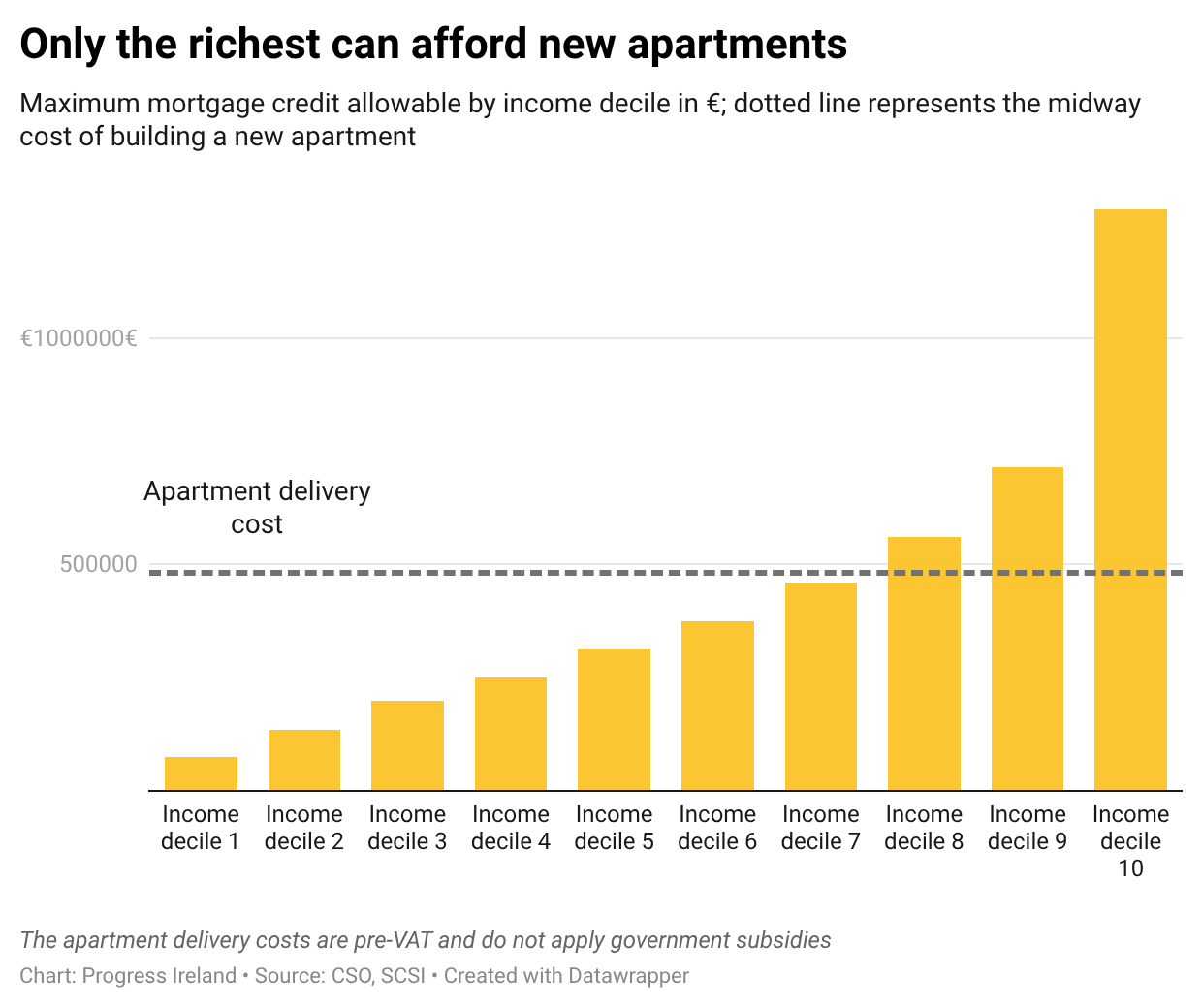
Ronan Lyons set out a good framework for thinking about this in a recent podcast in anticipation of his forthcoming book. The housing system is made of roughly three groups, call them As, Bs, and Cs. The As make up the first few income deciles, perhaps the first three. The As need help, no matter what. The Cs are well-off, making up the top three income deciles, and can take care of themselves. The Bs earn too much for social housing but not enough for the current market. They make up the middle four income deciles. For the Bs, high construction costs have meant the market cannot provide them housing, it has also meant the level of public spending required to meet their housing needs is high and growing. Europe and Ireland are spending lots on housing but delivering fewer homes than in the past.
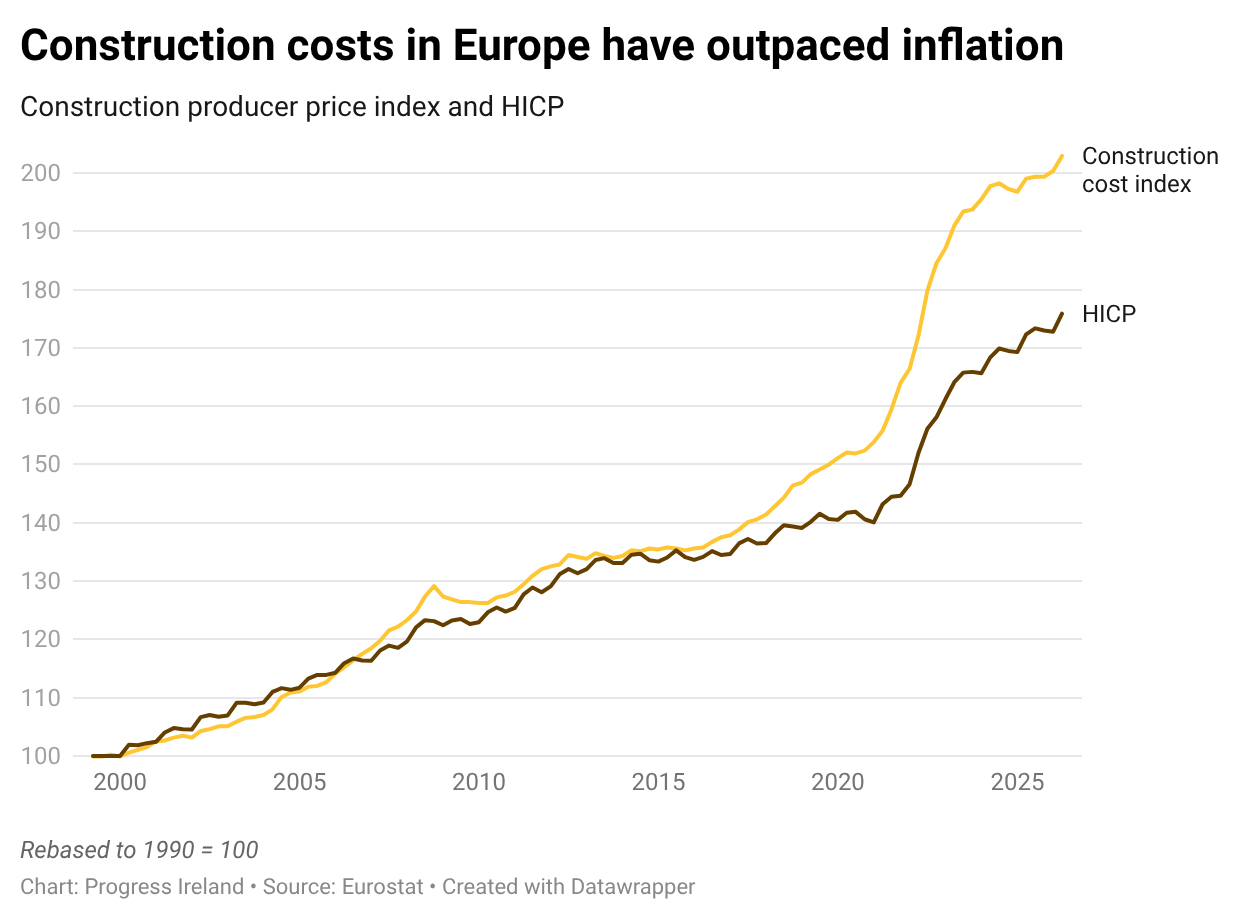
That is the problem. Europe needs housing abundance to be competitive. And high construction costs present a formidable barrier to that goal. Like Ireland, Europe in general has seen high levels of construction inflation.This graph compares the construction produce price index, which measures the prices of construction activities from the point of view of the building constructor, and the HICP.
How should we think about fixing it?
There are basically two ways to fix this: Cut costs or subsidise. In other words, policymakers can think of ways to systematically dial down the cost base or slow down its inflation in the hopes incomes catch-up. Examples include productivity measures, land reforms, changes to regulation, or changes to tax. Or they can find ways to cover the difference, accepting that construction costs and incomes will remain misaligned indefinitely. Examples include subsidies of various kinds.
The benefit of cutting costs is that it is cheaper and would, if successful, result in a more sustainable housing market. It allows markets to provide for Bs and Cs, allowing the State the space to assist the As. It is also positive-sum in the sense that a low cost base allows homes to trade in a mutually beneficial way between developers and new residents. But you may have to change some regulations, introduce tax cuts, and land reforms.
The benefit of the latter is that you get to keep the regulations. But the problem is ballooning costs. This has two problems. One is that it exposes the country to fiscal risks. Another is that it makes the housing system an economic burden that must be shouldered. Once subsidies are introduced, they tend to be sticky.
One thing Brussels shouldn’t do, however, is introduce laws that increase construction costs. Brussels has tried to help with the cost of building through European market integration and the Construction Services Act. These are, in principle, supposed to combat inefficiencies in construction (particularly in supply chains). However, Brussels has introduced some Directives that have been inflationary.
The European Performance of Building Directive (EPBD), in its various iterations, has a laudable goal. Buildings account for 36 per cent of carbon emissions in Europe. So, it is the goal of the EPBD to combat this. If it worked, that would be a serious benefit to the policy. (However, there are doubts of the extent to which it is working as intended).
But the costs of the policy have been inflation. In Germany it has raised costs by about 3 per cent. In Greece it has raised costs by 4,300 to 7,400 per home. In the UK, which also signed up to the EPBD, it was predicted to raise the costs of construction by around 4,000 GBP but actually raised it probably went up more. In Ireland, it officially was predicted to raise costs by 0.7 to 4.2 per cent over and above the previous year’s construction costs based on the former standards. However as I argued in my last post, I suspect that number underestimated the inflationary effect. None of these figures, as pointed out by one German report, take into account the knock-on costs of this inflation: on land costs, on financing costs, and labour costs (as the introduction of new methods and equipment require the deployment of specialised skills and materials).
To be sure, these numbers on their own may not seem like a huge issue. What’s one or five per cent inflation between friends? By no means do I wish to place all of the inflationary pressures on the shoulders of the EPBD: the evidence simply doesn’t support that. Nevertheless in the context of a broader inflationary environment, anything that raises construction costs should be scrutinised.
What should be done about this?
In that spirit, there are a few options for Europeans as concerned as I am about rising costs. First, the multilateral approach would be to extend the deadlines for implementation of the EPBD requirements or allow more national wiggle room on the implementation. (Ireland is due to implement the 2024 recast of the EPBD this month, though it looks like it will be slightly delayed). There is scope for the EU to look at the EPBD through the lens of cost. And perhaps Ireland’s presidency of the Council of the European Union may be an appropriate venue for this to be raised under the banner of competitiveness.
However, as a member state, Ireland has unilateral options. The unilateral approach, which other EU states seem to have taken, is to work within the Directive. European Directives are complex pieces of legislation (and they are better thought of as legislation than regulation). As a product of many hands coming from many nations, they almost always have intricate wiggle room built within them.
Within the EPBD, there is set out what is called cost optimal methodology. That is the level at which lifecycle energy savings from the regulation equal lifecycle additional costs, a kind of breakeven measure. Member states, according to the latest recast of the EPBD, have to be within 15 per cent of the cost optimal levels. In member state’s transposition of the EPBD, each is required to carry out cost-optimality calculations every five years. The Commission provides a framework to assist member states. This graph shows somewhat intuitively what cost optimal calculations are trying to get at.
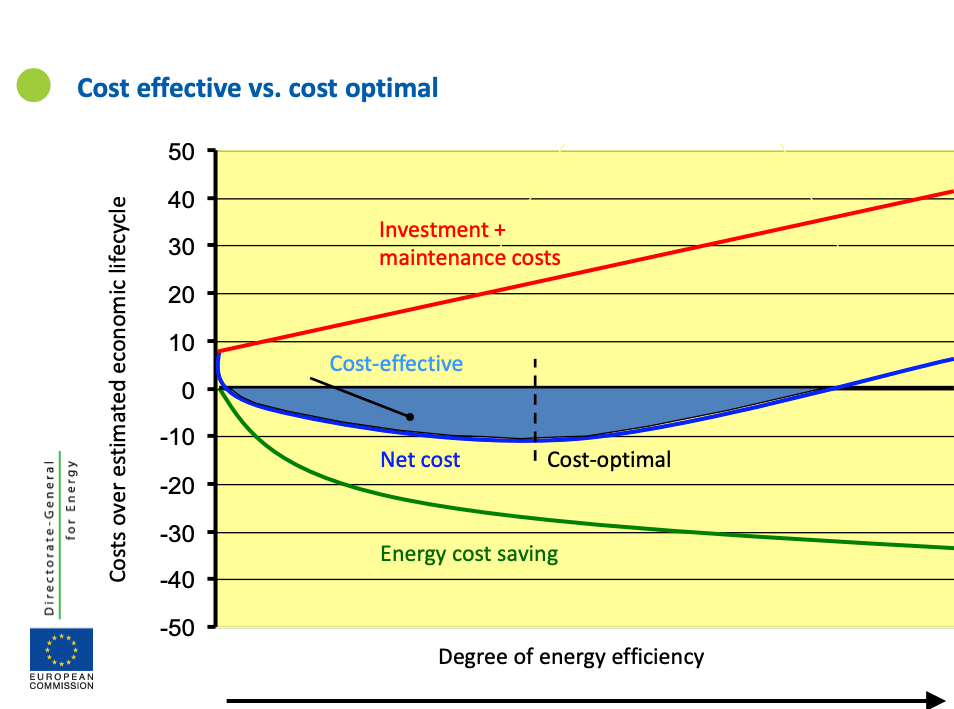
The competencies of the Commission and Member States differ in a cost optimal calculation. The Commission determines some high level elements such as the starting year, cost categories, calculation period, need for sensitivity analysis for energy prices and discount rate, sets the reference building and sets rules for selecting measures/packages
Member states on the other hand determine a lot of the main inputs such as primary energy factors, estimated economic lifecycle, cost input data, discount rates, establish reference buildings, and select measures/packages.
This matters for construction costs because the regulations on energy usage permitted by the EPBD are determined in part by the cost optimal level determined at member state level. If that level is higher (meaning that it costs more), then the permitted energy usage will be higher. This is because the relationship between the cost optimal level and the permitted regulations stays constant, at 15 per cent: member states are permitted to allow for regulations that achieve performance within 15 per cent of the cost optimal level.
It may not be surprising then that there is a lot of variation in how cost optimal calculations are done across member states. The result of this is that one and the same building can be treated differently across member states. One review said that Member State choices on “primary energy factors” for electricity ranged from 1.2 (Finland) to 3.5 (Malta), a factor of three.
There are limits to what sorts of considerations can be included in a cost optimal calculation (and that is something Brussels could think about changing). But now is as good a time as ever to revisit the EPBD and Part L of the Technical Guidance Documents in Ireland. Ireland is about to host the Presidency of the Council of the European Union and it is due to revise its cost optimal calculation soon, now is as good a time as ever to take a look at it.
Last updated: