The Government just announced Budget 2027, Ireland’s biggest-ever spending package. Today, we’re sharing Progress Ireland’s pre-budget submission, which looks at four ways the State could build more housing and rail with the money it already spends.
Executive summary
Ireland is an economic success story. In 1988, The Economist dubbed Ireland “The poorest of the rich”; today, the average Irish worker’s earnings are the second-highest in the EU.
The country has grown rapidly, but growth has created its own challenges.
Ireland has a housing deficit of around 300,000 homes. When compared with other high-income countries, it has a 32 per cent deficit of infrastructure stock and a 27 per cent quality gap.
The government is investing heavily to address the housing shortage and close the infrastructure gap. As a proportion of GNI, Ireland spends 2.3 per cent on housing, the highest in Europe. France is the second-highest spender at 1 per cent of GNI, less than half the rate of Irish spending. Housing outlays rose from approximately €3.3 billion in 2021 to over €9 billion in 2026.
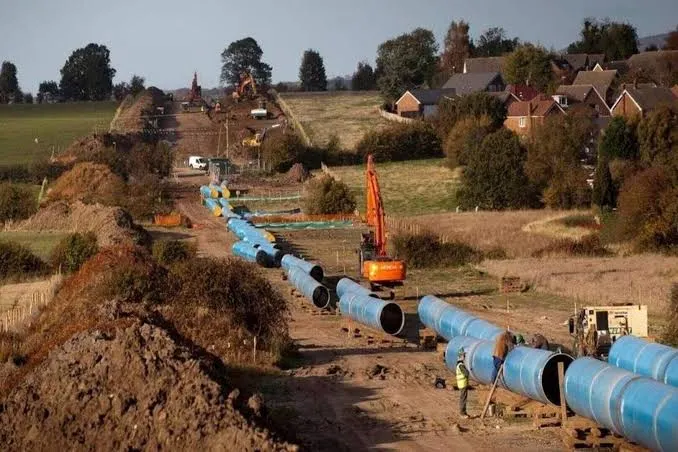
At the same time, Ireland is gearing up for some of the largest infrastructure projects in the history of the State, including Metrolink, the Water Supply Project, the Galway Ring Road, and the Cork Area Commuter Rail Programme.
While the scale of the challenge warrants such public commitment, the rate of increase of spending is not sustainable.
Reforms are needed to protect Ireland’s fiscal position, while delivering the housing and infrastructure that Ireland needs.
This pre-budget submission welcomes the approach taken by this government to drive reform and efficiencies in each government department. In keeping with this approach, this submission is not requesting additional public spending. Instead, we outline four ways that we can make public investment in building homes and rail go further:
- The way Ireland funds housing-infrastructure is expensive. A new funding model could save the government €1 billion across 60,000 homes.
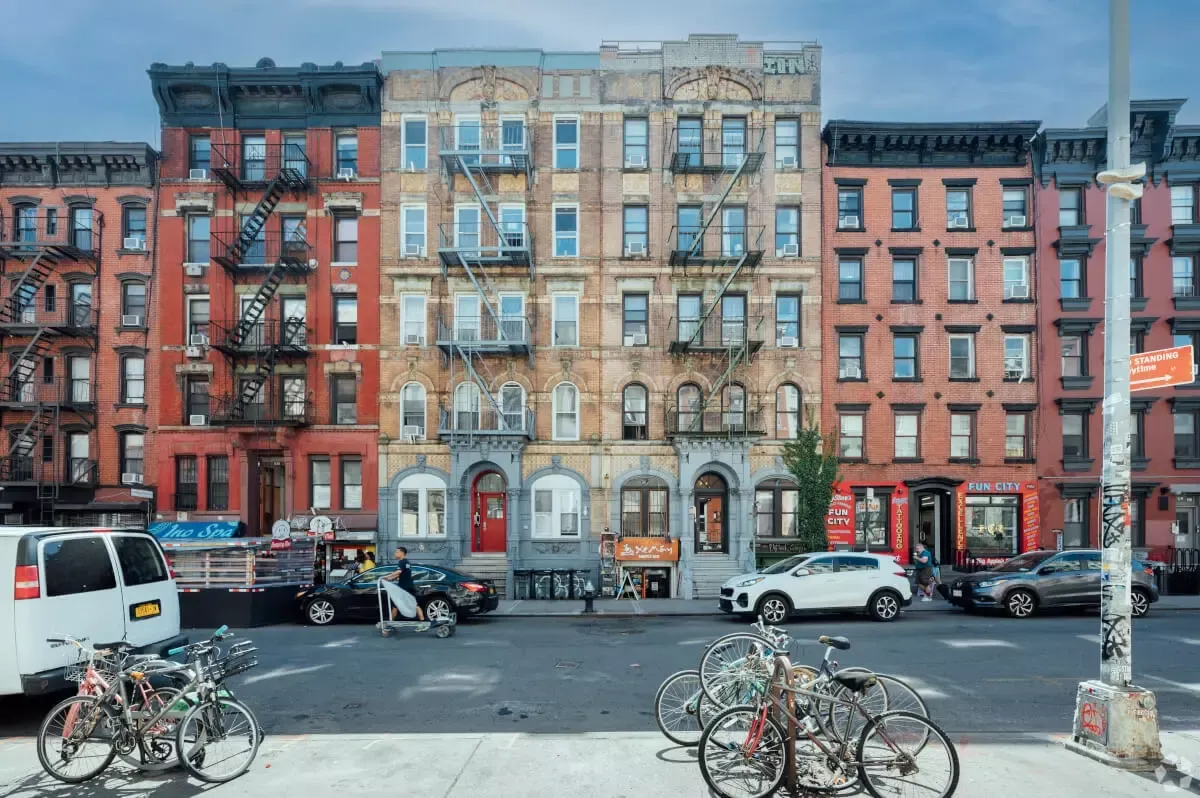
- Allowing residents living near transit corridors to opt-into greater densities could deliver 10,000 new homes in the GDA and save the State €67 million to €133 million in greenfield servicing and energy-upgrade costs, and up to €1.28 billion compared with delivering the same homes through subsidised apartment schemes.
- Metro construction costs vary widely by country. Delivering Metrolink the way that the best-performing countries do could save the State up to €14.9 billion.
- A specialised Approved Housing Body delivering housing for those with disabilities could save the State up to ⅓ in costs per home.
1. How Ireland could save €1 billion on housing infrastructure
Summary
- The government is committed to funding new large-scale housing schemes in what are called “new urban communities”.
- Funded the way previous large-scale developments were, 40,000 to 80,000 homes will cost the exchequer approximately €0.94 billion to €1.88 billion for the construction of supporting infrastructure such as roads, water, wastewater, parks, and power lines.
- The other way Ireland funds housing-infrastructure is funded through development contributions. But these make housing more expensive and scarcer. When contributions were waived in 2023, commencements rose 84 per cent..
- We propose land readjustment, a tool that pays for housing-infrastructure, assembles large plots of land, and incentivises landowner participation. It has delivered cost-effective urban development in over 30 countries, including Spain, Germany, Japan, and South Korea.
- Land readjustment could save the government approximately €1 billion across 60,000 new homes and replace development contributions.
The way Ireland funds housing-enabling infrastructure is costly to the State
In Delivering Homes, Building Communities the government has set out its plan to deliver new urban communities connected to high-capacity transport (transit-orientated-development or TOD). This goal will be achieved through Urban Development Zones, or UDZs. Under the plan, the government has also indicated its intention to review the development contributions process. That invites the question of how infrastructure in these new communities will be funded.
The government has committed to funding UDZs, as noted in the National Planning Framework and National Development Plan, with €1 billion set aside for the Housing Infrastructure Investment Fund and an additional €500 million for the URDF. The urgency reflected in these commitments is welcomed by Progress Ireland.
Building new urban areas has historically entailed substantial public investment. One example is Clonburris. In 2022 the government granted €186.3 million in URDF grant funding to provide the enabling infrastructure for 8,700 homes. The National Transport Authority contributed a further ~€18 million for related projects. This public funding amounts to approximately €23,500 per home (in 2022 prices).
While this public investment was necessary to make successful schemes like Clonburris work, if future schemes rely on existing levels of public spending, Ireland’s housing output will be exposed to the risk of fiscal downturns. Hence there is an opportunity to find less costly means of funding the infrastructure required to meet Ireland’s ambitious housing goals.
Development contributions can recover some costs, but they reduce the supply of housing
Development contributions (s.28 contributions, as they are sometimes called) help pay for infrastructure. However, under s.1.8 of its housing plan, the government has indicated its intention to review the development contributions process.
Reform of the development contribution system is necessary to stimulate the supply of housing. While development contributions are widely considered to be a well-designed tax, the cost of development in Ireland is high enough relative to market demand to justify a reconsideration of the wisdom of taxes on development.
There are at least three reasons underpinning our call for replacing development contributions.
First, development contributions raise financing costs. The contributions are payable up front, usually at commencement. The cost of the contribution is taken into account in land bids which reduce their overall impact on viability. However, since contributions are cash payments, they require higher financing costs by raising peak funding requirements. This has an impact on viability.
Second, contributions disincentivise building at higher density. The government’s policy is to promote compact growth and higher densities, reducing the environmental and capital costs associated with development. However, contributions are charged on the marginal square metre of development. This acts as a tax on the marginal square metre, which can disincentivise higher densities by driving up the costs of additional floor space.
The final reason is that the government has successfully tested the impact of development contribution waivers which saw an 84 per cent increase in commencements, the highest figure since the mid-2000s.
Given the ubiquity of projects whose viability is marginal – which have necessitated welcome interventions, such as Project Tosaigh – any additional upward pressure on the cost of development will undermine Ireland’s response to its housing shortage. This is especially acute in the context of the unusually high quality of homes being delivered in Ireland which adds upward pressure on costs, a point emphasised in recent research conducted by Glenveagh.
As the government has recognised, there is a need to consider alternatives to development contributions. However, as the last section emphasised, a crucial constraint on any alternative funding mechanism is the limits of sustainable public spending.
How much will the government spend on new urban communities if the business-as-usual approach is applied?
To estimate the cost to the Exchequer of new urban communities, we take Clonburris as the base case, noting that there was considerable variability across SDZs.
In Clonburris, the cost of infrastructure per home for the State was about €23,500. In Cherrywood, the cost to the State will be approximately €13,000-26,000 per home, depending on how many homes ultimately get delivered there.
On the assumption that new urban communities could deliver anywhere from 40,000-80,000 homes through UDZ designations around major transport connections, the total cost to the State of infrastructure to enable the delivery of these homes will range from €0.94 billion to €1.88 billion.
This figure does not include various associated costs, such as
- The capital costs associated with major infrastructure projects, such as DART+, Metrolink, regional wastewater treatment plants such as the Greater Dublin Drainage Project, the Water Supply Project, the Galway Ringroad, and Cork Commuter Rail.
- Subsidies to first-time buyers such as Help to Buy and related subsidies such as Croí Cónainthe
- Schools, Garda stations, healthcare facilities.
| Low (40,000 homes) | Central (60,000 homes) | High (80,000 homes) | |
| Exchequer cost, current model | €0.94 bn | €1.41 bn | €1.88 bn |
Freeing up fiscal space while delivering homes
To reduce the cost of infrastructure to the State associated with new communities, we propose the introduction of land readjustment as an alternative means to fund infrastructure for large scale development within UDZs.
Land readjustment (LR) is a tool to pool land, replot it, and capture value from urban development. It performs three functions at once: it assembles fragmented land into a coherent development area, it funds the infrastructure that area requires, and it gives landowners a financial reason to participate in development.
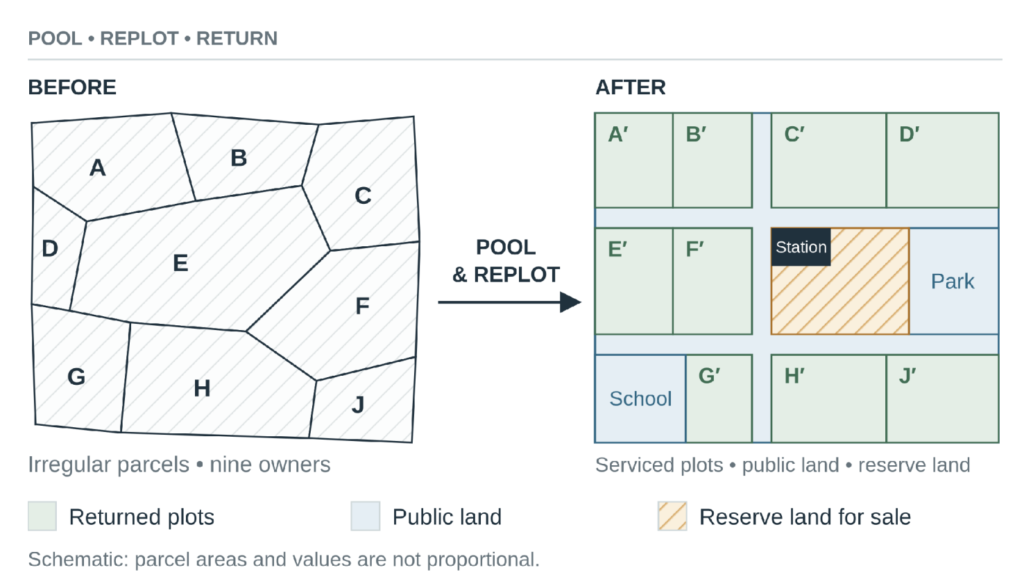
Land readjustment is an established mechanism to assemble and service land around the world. It has been used in over 30 countries, with widespread use in, for example, Germany, Spain, South Korea and Japan. In Japan it has been involved in the development of roughly a third of the country’s urban land area across more than eleven thousand projects. It was the instrument through which much of Gangnam was built in Seoul. It is codified in German federal planning law and widely used to create building plots. Spain uses it extensively for major urban development.
Land readjustment enables a delivering body within a UDZ to self-fund some of the infrastructure costs associated with development. It achieves this by enabling landowners to exchange their plots for smaller, more valuable plots. Land is exchanged for development rights and rezoning. The delivering body, a special purpose vehicle, takes a portion of the land (called the “reserve land”) and sells it to recoup the cost of infrastructure.
Land readjustment systems around the world routinely fund 100 per cent of infrastructure costs for large schemes with the general range falling between 60 to 100 per cent.
How much public money could be saved by the introduction of land readjustment?
Land readjustment could save the exchequer approximately €1 billion on the first wave of Urban Development Zones.
On our central assumptions, land readjustment reduces the exchequer cost of servicing the first wave of Urban Development Zones from approximately €1.4 billion to between €0.3 billion and €0.4 billion, a saving of approximately €1 billion in one-way grants.
| Low (40,000 homes) | Central (60,000 homes) | High (80,000 homes) | |
| Exchequer cost, current model | €0.94 bn | €1.41 bn | €1.88 bn |
| Funded by land readjustment (70 to 80 per cent) | €0.66 bn to €0.75 bn | €0.99 bn to €1.13 bn | €1.31 bn to €1.50 bn |
| Exchequer cost, with land readjustment | €0.19 bn to €0.28 bn | €0.28 bn to €0.42 bn | €0.38 bn to €0.56 bn |
2. Delivering compact growth without subsidies
- Ireland is investing in high-capacity transport at historic levels. The National Development Plan allocates €24.3 billion to transport for 2026 to 2030, including approximately €10 billion for public transport and €2 billion committed to MetroLink, alongside DART+ and the Cork Area Commuter Rail Programme.
- One of the major benefits of this investment is that it enables housing delivery along rail corridors.
- However, while Ireland is pursuing ambitious housing delivery on greenfield lands close to rail stations, there are no policies directly pursuing incremental development within existing towns along rail corridors.
- The lack of policy intervention in this area will have a fiscal cost. Building on greenfield lands increases the cost of infrastructure, as new roads, pipes, and parks must be built to service these areas. Brownfield sites in existing towns require less infrastructure investment, and regeneration of these sites also avoids costs related to upgrading aging housing stock. Energy upgrades to existing housing stock has cost the State€1.67 billion since 2019.
- We acknowledge that adding homes to existing communities is uniquely difficult. It can be more expensive to build. And it often meets with more resistance, as locals bear some cost of development in their areas, for instance, disruption and noise.
- Street Plan Development Zones offer a way to add homes near high-capacity transit links in existing serviced areas, by giving the residents who bear the costs of new development a share in its benefits.
- By introducing Street Plan Development Zones, Ireland could deliver new apartments without State subsidies, saving the Exchequer in infrastructure costs, energy upgrade expenditure, and apartment subsidy costs. Per new apartment, this could save the State between €20,000 and €120,000, depending on whether you include the savings from foregone subsidies.
Despite major transport investments, Ireland is not delivering enough housing along high-capacity rail corridors
Ireland wants to build more homes in cities and towns. The National Planning Framework plans for 40 per cent of all new homes nationally to be delivered within the built-up footprint of existing settlements.
Investments in high-capacity transport will help deliver more homes on greenfield sites. However, there exists no mechanism to sustainably deliver homes in existing built-up areas along these improved rail-corridors. Without a proactive policy for these areas, there is a risk that the State’s investment will be capitalised into house prices. This is a regressive windfall to incumbent owners in the most accessible locations in the country and an opportunity cost for the State, since no mechanism exists to turn that uplift into new homes in a self-sustaining way.
But infill is difficult. Research commissioned by the Office of the Planning Regulator (OPR) found that developing an identical scheme on an urban brownfield site costs €58,000 to €77,000 more per unit than on a greenfield site, roughly 13 to 18 per cent more. Infill also meets more political resistance, because neighbours bear the disruption of construction while the owner of the redeveloped plot captures the gain.
The absence of policy intervention here has a fiscal cost.
There are many costs to dispersed settlements, some of them indirect. Two direct costs to the State, however, stand out. First is infrastructure costs. Schemes such as the Local Infrastructure Housing Activation Fund (LIHAF) cost the State approximately €10,000 per new home to unlock greenfield development. According to the OPR, ongoing costs for suburban or dispersed settlements cost the State twice as much as their urban counterparts.
Secondly, the State pays to upgrade an aging housing stock. Since 2019, approximately €1.67 billion has been spent on energy-upgrade grants across almost a quarter of a million homes.
Without a proactive policy to facilitate incremental compact growth within existing settlements, the costs of dispersed settlements and upgrading the existing stock will continue to grow.
Enabling infill development near stations
Ireland’s suburbs are frozen in the late twentieth century. There is no mechanism available for them to change and improve over time, even when prices signal chronic scarcity.
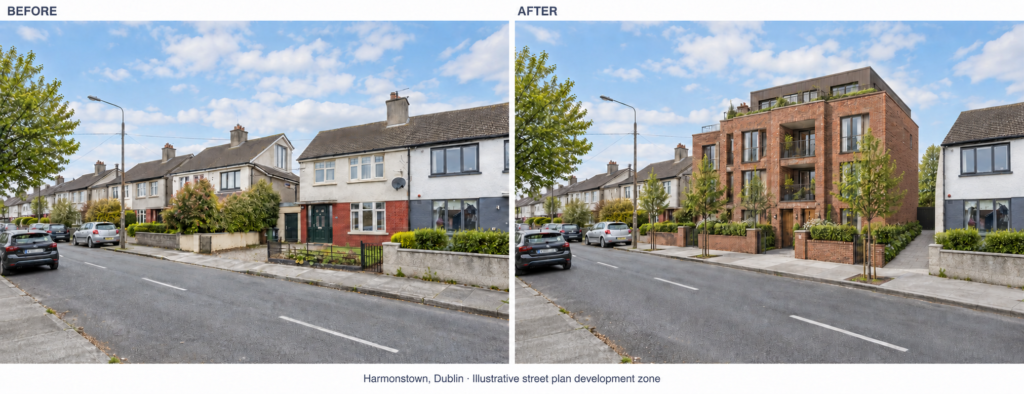
Street Plan Development Zones (SPZs) are designed to give communities a mechanism to respond to local scarcity, in a way that benefits their area.
The basic idea is to introduce a policy that enables residents on a street to opt-into a planning framework for their area. Residents would be balloted on a planning framework for their street. If passed by a supermajority vote, the “street plan” would take effect. Development within that plan would be permissible for those residents.
Typically, local residents resist new development due to a perception that new development means downsides for them. A central benefit of SPZs is that it creates a mechanism for new housing to be delivered in a way that directly benefits the residents who are empowered to approve it. We discuss the mechanism in more detail here.
How much public money could be saved?
We modelled SPZs along the improved DART and Metro corridor. The model applies the policy to every street within 1.2km (approximately a 15 minute walk) of the 39 suburban and city stations within about 20 minutes of the city centre on the post-DART+ and MetroLink network.
Counted from Census 2022 Small Area data, these 39 catchments contain approximately 109,000 houses. Social housing was removed from each catchment’s measured tenure share (12.4 per cent on average) leaving approximately 95,600 relevant houses. Of these we treat 80 per cent as financially viable for redevelopment due to sale prices in these catchments of €5,300 to €6,700 per square metre compared against an estimated all-in break-even of €4,000 to €5,500 per square metre.
We then assume modest uptake of 5, 7 and 10 per cent of viable plots over the programme’s life. In the central scenario, each participating plot is redeveloped from one house into three homes.
The results across scenarios:
| Uptake of viable plots | Additional homes | Exchequer saving |
| 5% | ~7,700 | €67m |
| 7% | ~10,700 | €93m |
| 10% | ~15,300 | €133m |
7 per cent uptake delivers approximately 10,700 additional homes within a 15 minute walk of high-capacity rail, and saves the exchequer approximately €93 million it would otherwise spend servicing greenfield land and upgrading old housing stock.
Crucially, these additional homes would not require any viability subsidy. If these homes were delivered through the Croí Cónaithe (Cities) with an average subsidy of €120,000, it would cost the state an additional €1.28 billion.
The economic gains due to this policy are potentially larger than the fiscal savings. On standard effective-density assumptions, the additional residents these homes place within the existing 45 minute public transport catchment of the city centre add approximately €59 million per year in output (falling somewhere in a range of €38 million to €103 million).
3. Upgrade Metrolink’s in-house delivery capability to save up to €14.9 billion
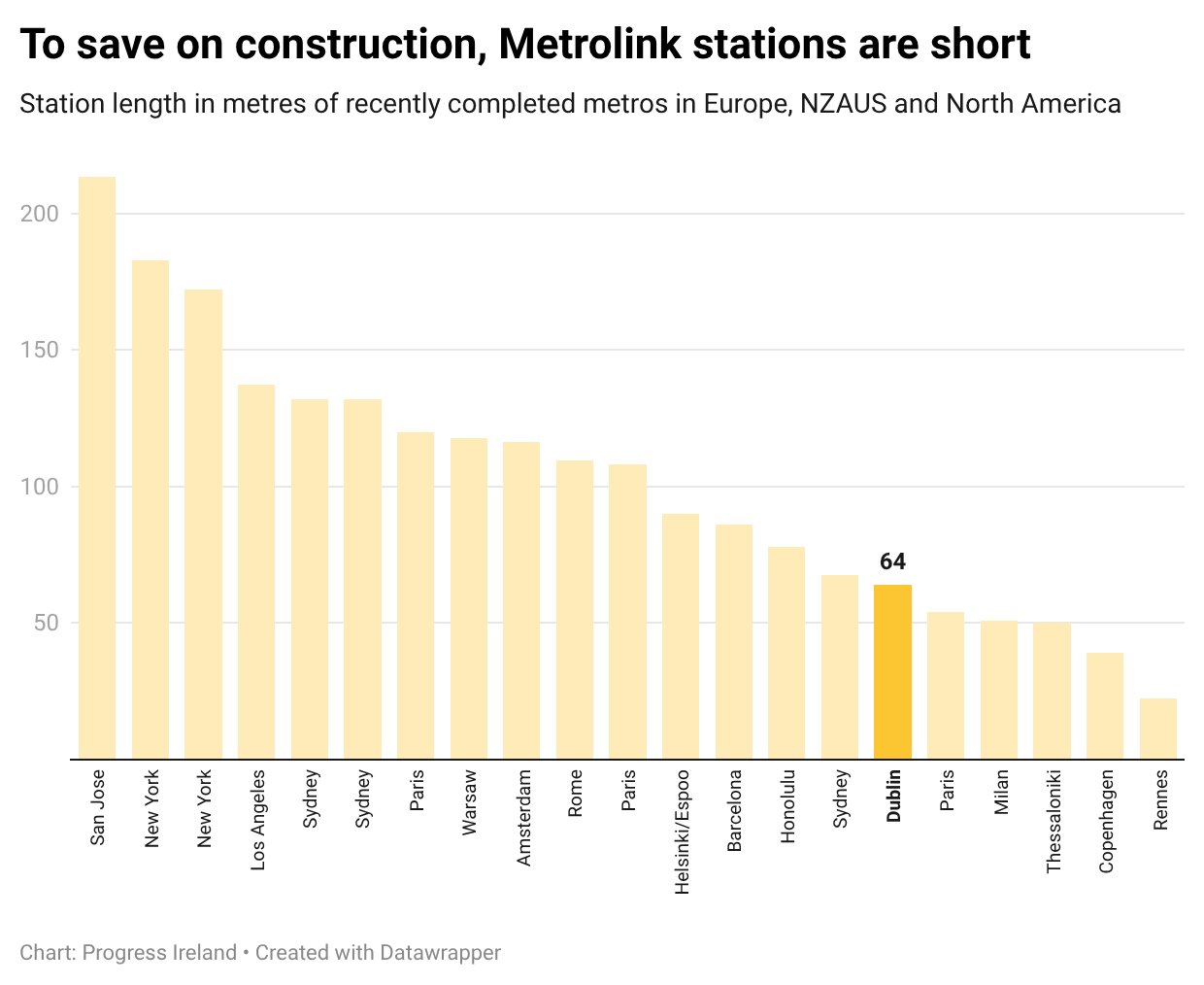
- MetroLink’s forecasted cost ranges from €9.5 billion to €24.4 billion for 18.8km, or €505m to €1,300m per kilometre.
- The cheapest metros, in places like Spain and Finland, come in at $100m to $200m per kilometre.
- Ireland could follow the example of the best systems by ensuring the Metrolink delivery agency is staffed with experts and given enough autonomy to drive value for money.
- This could save up to €14.9 billion.
Metro projects cost can vary widely
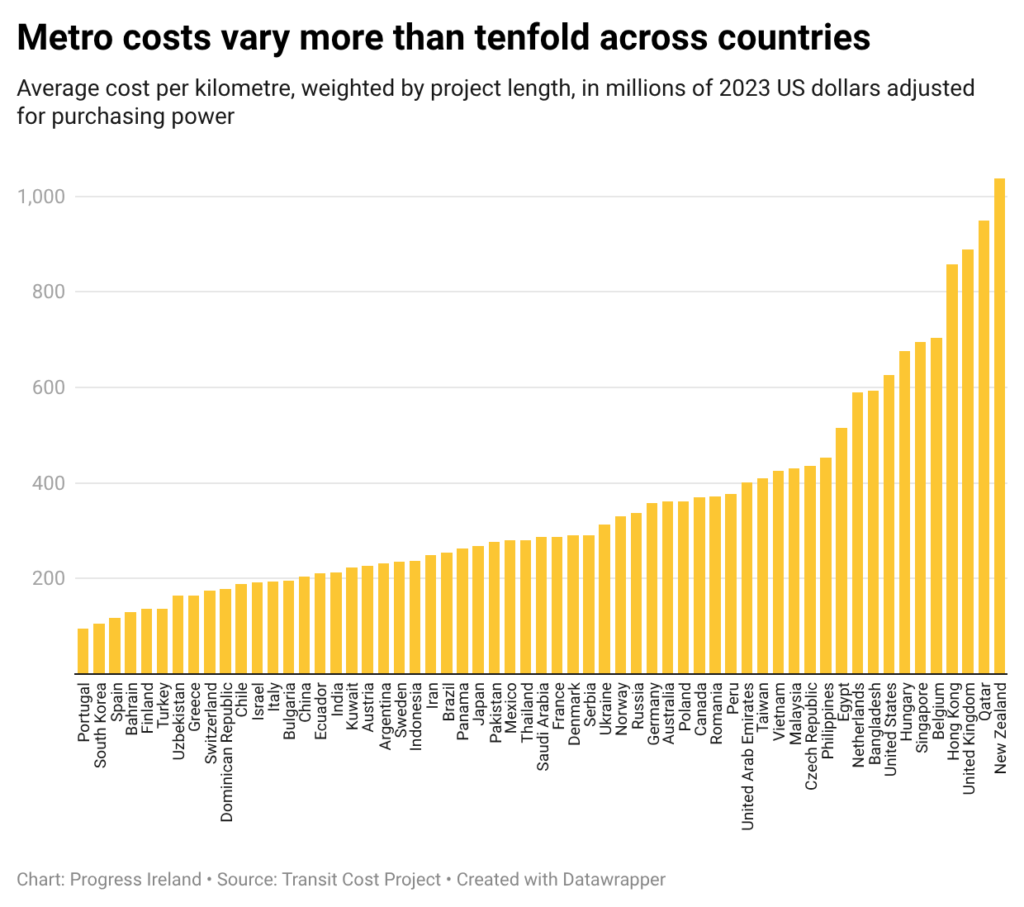
There’s an enormous difference between the most efficient metro-building countries and the least efficient ones. The most efficient countries can build one kilometre of metro for between $100m and $200m; in the least efficient countries, a kilometre costs $600-$1,000 million.
MetroLink’s estimated cost is between €505m and €1,300m per kilometre, putting us at the top end of the range.
One might think that metros would be cheapest in low-income countries, where labour and other input costs are lower. But there is no correlation between national income and metro construction cost.
Instead, the most efficient builders include many European countries like Portugal, Spain and Finland, as well as South Korea and Turkey.
Efficient countries keep expert clients in-house. English-speaking countries hand project management to consultants, who are more likely to gold-plate designs and allow scope creep. In addition, handing over project management to consultants slows down decisions. They have to defer to their state client on big decisions, and additional layers of management authority leads to delays.
To save on costs, Metrolink should hire and empower experts
The State plans to create a dedicated agency to deliver Metrolink. This agency, once established, should be authorised to hire 10 to 20 experienced delivery engineers at the going international rate of €300,000 to €400,000, as Milan, Turin and Istanbul do.
These experts should be empowered to make decisions regarding the day-to-day management of the project.
The agency should also be empowered to appoint board members with delivery expertise and pay them accordingly: fees of approximately €59,000 would be required, rather than the current €12,600.
How much can the State save by doing what the most cost-effective countries do?
Hiring the delivery engineers would cost €5.8m per year; approximately €52m over a nine-year build.
This could lead to savings of up to €14.9 billion. Milan delivers metro at $149m per kilometre, Istanbul at $156m, Turin at $195m.
The same client capability then carries over to DART+, Luas extensions and the wider national rail programme.
Read more here.
4. Better housing for people with disabilities at a 33 per cent discount
Summary
- The State spends hundreds of millions annually on housing for those with disabilities.
- The existing model is fragmented and highly inefficient.
- A non profit developer focused solely on those with special needs would deliver housing at approximately two-thirds the cost.
Money spent renting and adapting housing could be used for purpose-built homes
The State spends significant sums each year on housing for people with disabilities. Exactly how much is hard to discern, because the money is spent by different departments and levels of government, on slightly differing target groups, in a mixture of capital spending and operational spending. It’s safe to say the outlay is in the hundreds of millions of euro per year.
The most expensive element of this is emergency placement. When needed, the HSE usually rents a place from a for-profit provider and renovates it, at its own expense. The Department’s Action Plan for Disability Services says the provider: “may have paid off the mortgage on the premises, but the State has no ownership rights to it.”
The other avenue is for the State to buy homes and adapt them. The Capital Assistance Scheme delivered 111 homes for people with disabilities in 2021 and 68 in 2025.
The buy-and-adapt model can’t keep up with demand. Some 1,389 people are waiting for a residential place, up 79 per cent since 2019, and 2,065 adults with disabilities depend on a carer over 70.
Notionally, building specialised accommodation would be an Approved Housing Body’s (AHB) job. It is their job to provide accommodation for those whose needs are not met by the market. But the median AHB is tiny. With the exception of the biggest three AHBs, they don’t have the scale or sophistication to build this many units.
Custom-built housing at less cost
A dedicated not-for-profit developer builds purpose-designed homes for those with disabilities. We call this the custom build model. The developer differs from the existing AHBs in that it is focused on construction rather than operation. Having built the units, they would be handed back to the existing AHBs and care providers for operation.
Below, a table explains how the custom build model compares to the status quo solution for disability housing. Currently the government does this in two ways. Either it buys standard properties and adapts them, or it rents standard properties and adapts them.
| Route | What the State funds | Does the State or charity own the home? | Who provides ongoing care? |
| Custom build | Buys a site, builds a house designed for high-support living | Yes | Charity/state bodies |
| Purchase and adapt | Buys an existing house and retrofits it to standard | Yes | Charity/state bodies |
| Private rent and adapt | Rents a house, pays for the adaptations, pays rent for 30 years | No | Charity/state bodies |
How much could the State save?
To compare these three alternatives apples-to-apples, we applied a discounted cash flow (DCF) model to get the present cost of future disabled housing provision.
We built a detailed model. It is based on one house for four people who need round-the-clock care. We showed the present cost of the custom build model, the buy-and-adapt model, and the rent-and-adapt model. There is a variant for Kildare and for Dublin.
The model considers only construction costs, not care costs. Care costs are the same whichever way the house is procured.
The model shows net present cost (so a lower number is better than a higher one). Net present cost is the upfront cost of building the structure plus the present cost of future rents, minus the present value of the asset still owned at year 30.
The model has nine inputs:
| Input | Base | Where it comes from |
| Appraisal horizon | 30 years | Loan and availability-agreement term |
| Real discount rate | 4 per cent | Infrastructure Guidelines central parameters |
| Real rent growth | 2 per cent | Daft records 3–4 per cent real over the past decade; 2 per cent is a discount on that |
| Residents per house | 4 | Assumption |
| Market rent, Kildare | €2,296/month | Daft Q1 2026, four-bed house, Leinster excluding Dublin |
| Market rent, Dublin | €3,872/month | Daft Q1 2026, four-bed house, Dublin |
| Residual value, Kildare | €480,000 | Comparable property, no real growth assumed |
| Residual value, Dublin | €800,000 | Comparable property, no real growth assumed |
| Include white goods and wardrobes | No | Pending QS confirmation |
In addition there are site and surveys, construction at €2,600 per sqm, the adaptation schedule, VAT at 13.5 per cent on works and 23 per cent on fees, design fees at 11 per cent of net works, project management, utilities, certification, legal costs and a 10 per cent contingency.
The difference in construction costs comes from the cost of adaptation, which is less efficient than building to spec from the start. Building to specification from the start costs €176,000. Retrofitting the same specification into an existing house costs €821,500, because it requires strip-out, reconfiguration, a fabric upgrade, new drainage and fire works.
The headline finding is that it’s a lot cheaper for the State, in the long run, to custom build than to build-and-adapt or rent-and-adapt.
| Net present cost per house | Kildare | Dublin | Asset at year 30 |
| Custom build | €1,282,025 | €1,475,000 | Yes |
| Purchase and adapt | €1,654,858 | €2,007,217 | Yes |
| Private rent and adapt | €1,929,094 | €2,477,619 | No |
Purchasing and adapting costs €372,834 more per house in Kildare and €532,217 more in Dublin. Renting costs €647,069 and €1,002,619 more, and leaves the State with no fixed asset.
By custom building homes using a dedicated AHB for disabilities, the State could save up to €1 million per home in Dublin, and a third of costs in Kildare.