The NIMBY final boss.
It’s a beautiful, breezy day in north county Mayo. Just the kind of day that wind farms were made for. Dozens of turbines dot the landscape, ready to harvest power from the wind. But today, the huge blades of the turbines stand still.
This is an increasingly common sight in Ireland. In the first six months of this year, wind farms spent around 15% of their potentially productive time idle.
We pay for this downtime in three ways. First, while the wind farms stand idle, we buy imported gas, often at higher prices than we could have produced wind.
Then, in some cases we compensate wind farms directly for their time spent idle.1
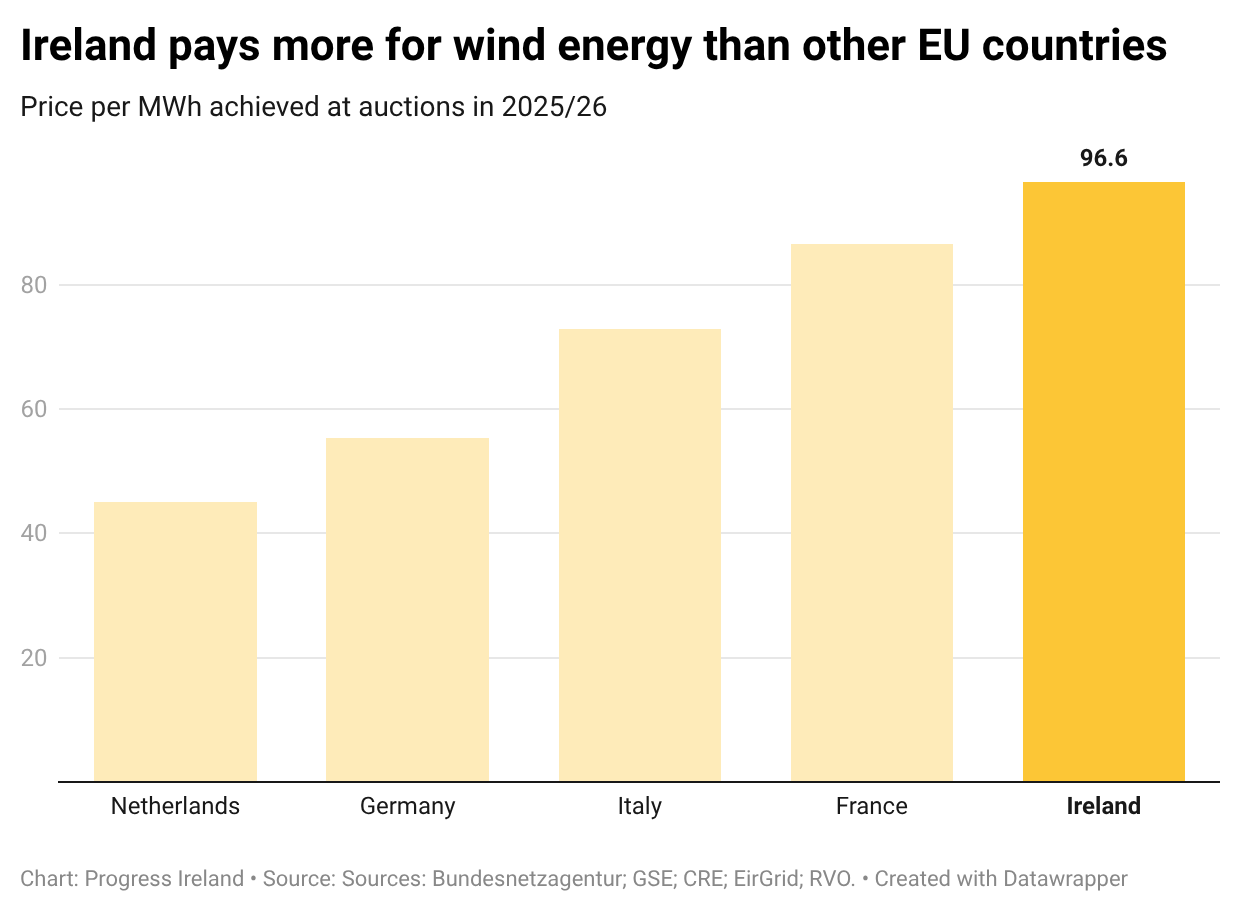
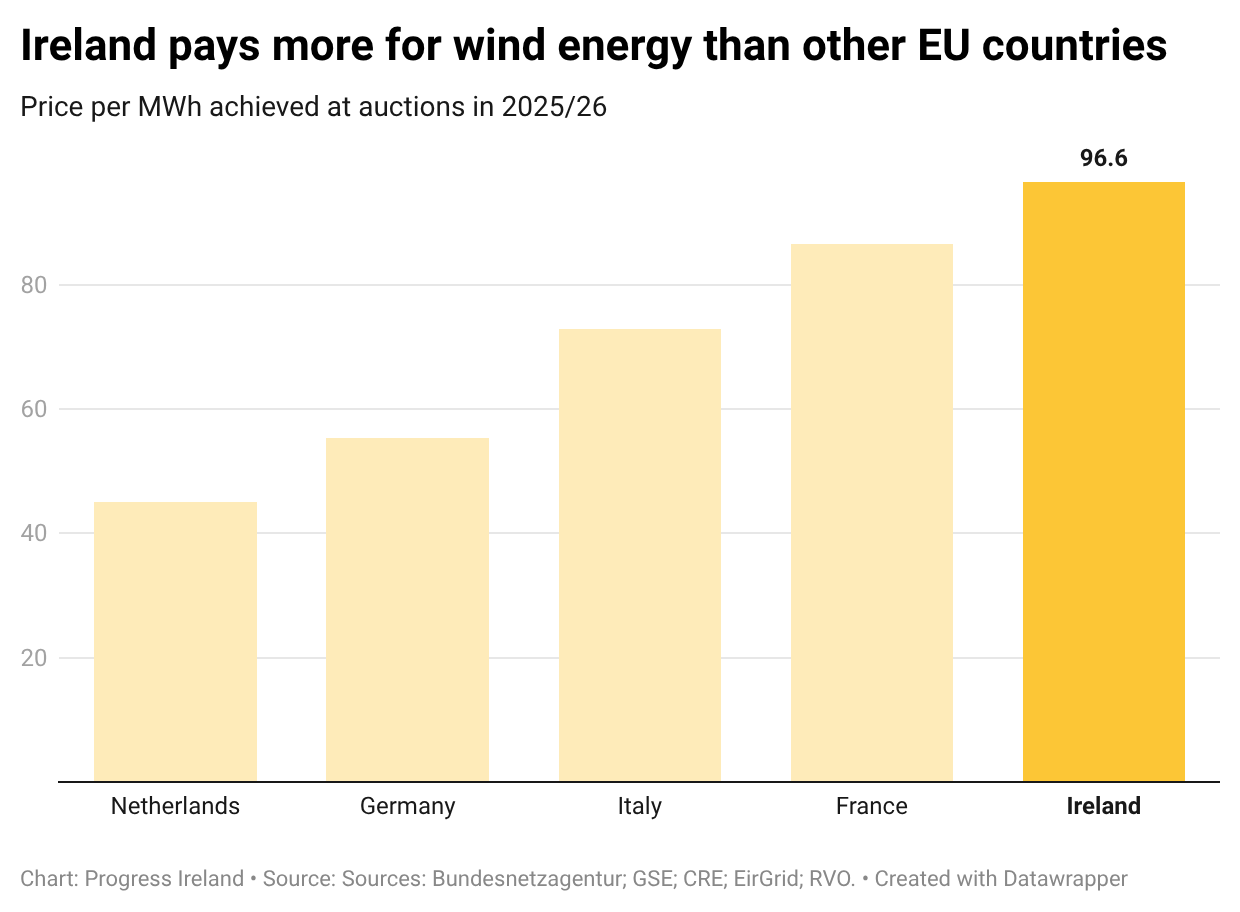
The rest of the time spent idle gets bundled into wind prices. Wind farm developers set their prices higher to account for the time when they can’t produce. We pay higher wind prices than other countries in the EU.
Power lines and pylons
The time turbines spend sitting idle while the wind blows is known as dispatch down. It happens when the electricity network around the wind farm is too congested to take on more energy, or when the national network is temporarily overloaded with renewables.
Why is the network congested? Part of the answer is power lines and pylons.
Wind farms are often in remote locations, but need to send electricity to power-hungry urban centres.
To do so, they need high-capacity 400kV (kilovolt) power lines, capable of carrying lots of power over longer distances than standard lines. The high-capacity lines are thick and heavy, and need pylons to suspend them instead of utility poles.
We currently don’t have enough of these lines to bring wind energy to consumers.
Interconnectors, which are useful for exporting excess wind to other countries and helping us balance our renewables-heavy network, use the same type of high-voltage lines.
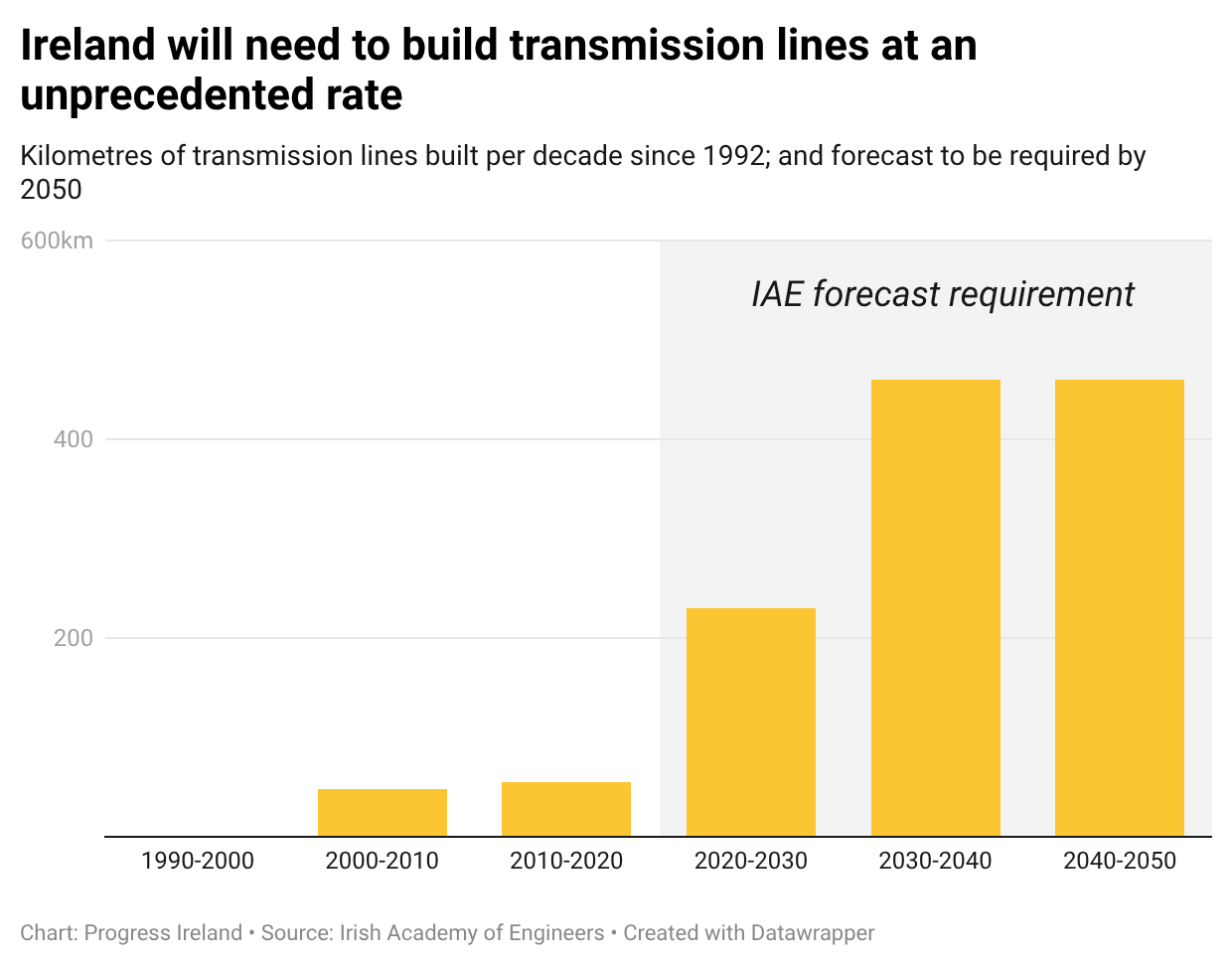
All this, plus Ireland’s growing demand for electricity, means that we need to build far more transmission lines in coming years than we have in recent history. Many of those will be the high-capacity kind that need big pylons to support them.
How much do we need to build? The Irish Academy of Engineering estimates at least 1,150 km of new high voltage transmission lines.
That may seem easy to solve in theory: if we need more power lines, just build them!
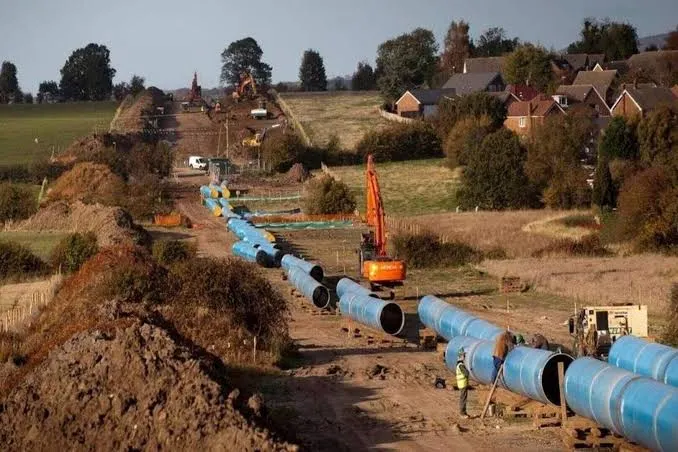
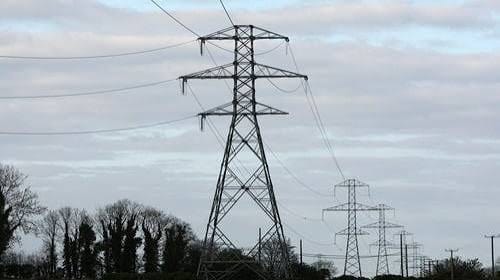
The problem, though, is the pylons. They’re 40 metres tall, the equivalent of a 13-storey building. To support all the new lines, we’ll need around 3,000 of them.
Pylons are imposing. They can be seen from kilometres away, changing the visual fabric of their surroundings. People don’t like how they look.
We don’t have positive associations with pylons like we do with other kinds of development. A wind farm nearby might make a community feel proud to be contributing to our clean energy ambitions. With pylons, that link is less intuitive.
So locals are understandably resistant to the pylons that come with these new power lines being driven into their communities.
We saw this dynamic play out in the late 2000s and early 2010s, when three 400kV line projects were launched: the North-South Interconnector, which would provide us with a high-capacity link to Northern Ireland. Grid Link, linking Cork to Kildare. And Grid West, which would carry energy from new wind farms from west to east.
All important projects, which, had they been built, would have helped solve the congestion we face today. All faced strong local opposition, and were subsequently deferred.
The North-South Interconnector got planning permission granted in 2016, but opposition remains strong and construction has not yet begun.
Can’t we just put them underground?
One of the main points of contention for the North-South Interconnector is whether the line can be dug underground instead of suspended on pylons. Various European countries have done this on specific projects, which seems to support the point.
But while undergrounding would save everyone a lot of headaches, it’s unfortunately technically challenging.
The type of electric cable we typically use, alternating current (AC), overheats when large sections of it are buried. Switching to a direct current (DC) is possible, but then substations need to be added at regular intervals on the line, adding substantial costs.
Undergrounding leads to four to five times more expense per project. The countries that opted for undergrounding to avoid local opposition: Germany, France, Denmark, the Netherlands, have largely backed away from that approach due to prohibitive costs.
So how do we get more pylons built? There are three options.
Railroading
Railroading means simply sticking the pylons where the state wants them, regardless of the views of locals.
Tools like expedited planning processes, restricting judicial reviews, and ministerial designation of priority projects can help here. If all this sounds familiar, it’s because we’ve introduced tools like this in the recent Critical Infrastructure Act and the Planning and Development Act 2024.
Railroading is effective in the sense of getting projects built quickly, but it has its limits.
Norway found this out in 2010, when thousands of people attended protests against a new 92 kilometre high-capacity line, which would pass through the scenic area of Hardanger fjord.
They pressed ahead, completing the project in 2013, but the backlash threatened the stability of the coalition in power at the time and cost them deeply in terms of political support.

So railroading can be done, but it’s not easy. And democracies can only push this approach so far before public outcry overwhelms a project.
Give them things
Projects that change the local environment, such as a new housing development, a metro station, or high voltage cable with pylons, are a case of concentrated costs and diffuse benefits.
People that live right beside the scheme have to deal with disruption during construction and ongoing noise and visual nuisance, while the broader community gets something of value, like faster transport or cheaper electricity.
But what if we make it so that locals capture more of the gains from the scheme? The idea is that if locals benefit more directly, they’ll be more likely to support it.
The energy sector is already quite good at this. Community benefit funds ensure areas that host new grid infrastructure get money to invest in local projects. Direct cash payments are made to neighbours living close to the development.
When it comes to pylons, Ireland has one of the more generous cash payment schemes in Europe: neighbours living 50-200 metres from a new pylon get up to €30,000. People with houses less than 50 metres from the pylon get bought out.
But offering people money can backfire. Research found that offering compensation to Swiss communities asked to host a nuclear waste repository cut acceptance of the project from 50.8 per cent to 27.4 per cent. The money was seen as a bribe and reduced their feelings of civic duty.
Talk to them
This leads us to option three: engaging with the local community, listening to their concerns, and making real efforts to address them.
This is exactly the sort of “feelingsy” approach that engineers and policy nerds tend to dismiss. They worry people will be unreasonable. That people will try to fully stop the project, or squeeze more money out of it, and ultimately it’ll be a waste of time.
But experience shows that democracies that ignore local concerns often get stopped in their tracks, and can end up wasting billions in the form of delays.
We’ve seen this with our halted 400kV projects here. Germany experienced similar issues with their SuedLink line. Originally conceived of in 2011 to connect northern and southern Germany, it was blocked by the Bavarian premier in 2014. After many years of political strife, it is now set for completion in 2028.
John Aston, who runs a natural resources consultancy called Aston Eco, says there are three key principles for engagement with the local community. Getting them right is the difference between years of opposition, bad feeling, and delay, and getting everyone on the same page so construction can begin.
The first is recognition. People need to feel genuinely listened to, and as though their concerns have been acknowledged rather than explained away.
A project that changes the physical environment close to someone’s house touches on deep emotions. It impacts their sense of home, the community they have lived in for their whole lives, the legacy they expected to leave for their children. All of that needs to be treated with respect. The worst way to kick off a new project is to show up at their front door and tell them dispassionately that it’s going ahead.
The second is procedural justice. They want to feel as though they have a seat at the table, and that what they’ve said will get a real response.
They don’t want to be brought in for a consultation that presents the project as a foregone conclusion, or provides three predetermined “design options” to choose between to give the illusion of choice. They want to hear why the project should be built and have some real say in its design.
The third is fairness. The burdens and the benefits of the project have to be shared between local residents and the developer.
The developer must be willing to make compromises based on the desires of the local community. For wind turbines, this could mean reducing the total number of turbines in the project, or increasing their distance from homes or villages. For pylons, it could be the exact placement of the pylons.
Crucially, community engagement can’t be an afterthought. Leadership of the organisation should be on the ground, hearing directly from the local community. This has a double benefit; leaders hear the actual concerns from the community rather than the glossy version from their direct reports, and residents feel like they have the ear of people with real decision-making power.
All this takes time. It requires uncomfortable, face-to-face interactions where difficult emotions will be expressed. It requires time from leaders, and a willingness to change parts of the project to accommodate their concerns.
Is it worth it?
Well, compare it to delaying projects for 10 plus years. The lack of cables needed to move energy around. The higher electricity prices. The lost productivity and economic growth. And then yes, the investment likely seems worth it.
1 This happens when wind farms have ‘firm access’ agreements with Eirgrid. Most wind farms don’t get firm access until a few years after they start producing energy, so in their early years they carry the risk of sitting idle without compensation.