Jonathan English a transport planner and Founding Principal of Infrastory Insights. You can subscribe to his Substack here.
There are reservations about the significant cost of Metrolink. But few cities in the world have built a metro and regretted it. Instead, it usually becomes the critical transportation backbone that no one could imagine living without.
Metros are fundamentally different from surface transit, whether bus, tram, or even light rail (LRT). They combine high capacity, speed, and reliability. A bus or a tram shares the street with other road users. LRTS, with their own lanes, have to cross streets. This means that they typically have significantly lower average speed, and they also are vulnerable to disruption from traffic accidents and other incidents. LRTs like the Luas have quick speeds in the suburbs, but have to dramatically slow down as they pass through the dense city centre. This becomes a bottleneck that limits the entire line. A metro’s fast trains and high frequency allow it to cross the city at speeds that are often faster than a car, enabling it to serve as a true backbone for a whole region’s public transit.
A metro can therefore be very useful to enormous numbers of people who live nowhere near it. Because a fast, uninterrupted spine collapses the time it takes to cross the city, it makes a whole class of journey viable that would otherwise be infeasible. Someone in a suburb distant from any station can catch a local bus to their nearest metro stop, then ride the metro right across the city in a few minutes, and then even switch to a second bus at the far end to reach their final destination. On surface transit alone, such a journey would be far too slow to be competitive. But the very high average speed of a metro makes it work, as long as the local buses on either end are frequent enough to make transfers reasonable and the fares are integrated across all modes. It works especially well if the bus network is designed around serving metro stations, potentially even with small bus terminals or direct entrances from the street near bus stops. This speed and integration makes transit a viable option even for journeys to and from places far outside the city centre.
A reasonable objection is that Dublin could expand its existing networks by running more buses or extending the Luas, rather than embarking on an ambitious metro project. The Luas has been a considerable success, carrying more than 50 million passengers per year. But surface modes have a ceiling that a metro does not. A tram in an existing road corridor through the city centre reaches limits in terms of both frequency and train length. The Luas corridors are already approaching that point. Buses meet the same constraint at even lower volumes. Beyond a certain level of demand, the only way to move very large numbers of people quickly through a dense city is to take them off the street entirely. Rather than duplicating the Luas, MetroLink relieves it and enables it to focus on the riders that it can serve best.
Automated trains and construction savings
Like most new metros around the world, the MetroLink plan calls for fully automated trains with no driver aboard. This makes it possible to run trains very frequently without increasing costs, making the wait at the station not much longer than the wait for a lift. Modern metros also have exceptionally high performance, including very quick acceleration and braking. This allows for very frequent stops in dense urban areas without sacrificing trip times. Effectively, you can get the speed of a train with stops not much more widely spaced than a light rail.
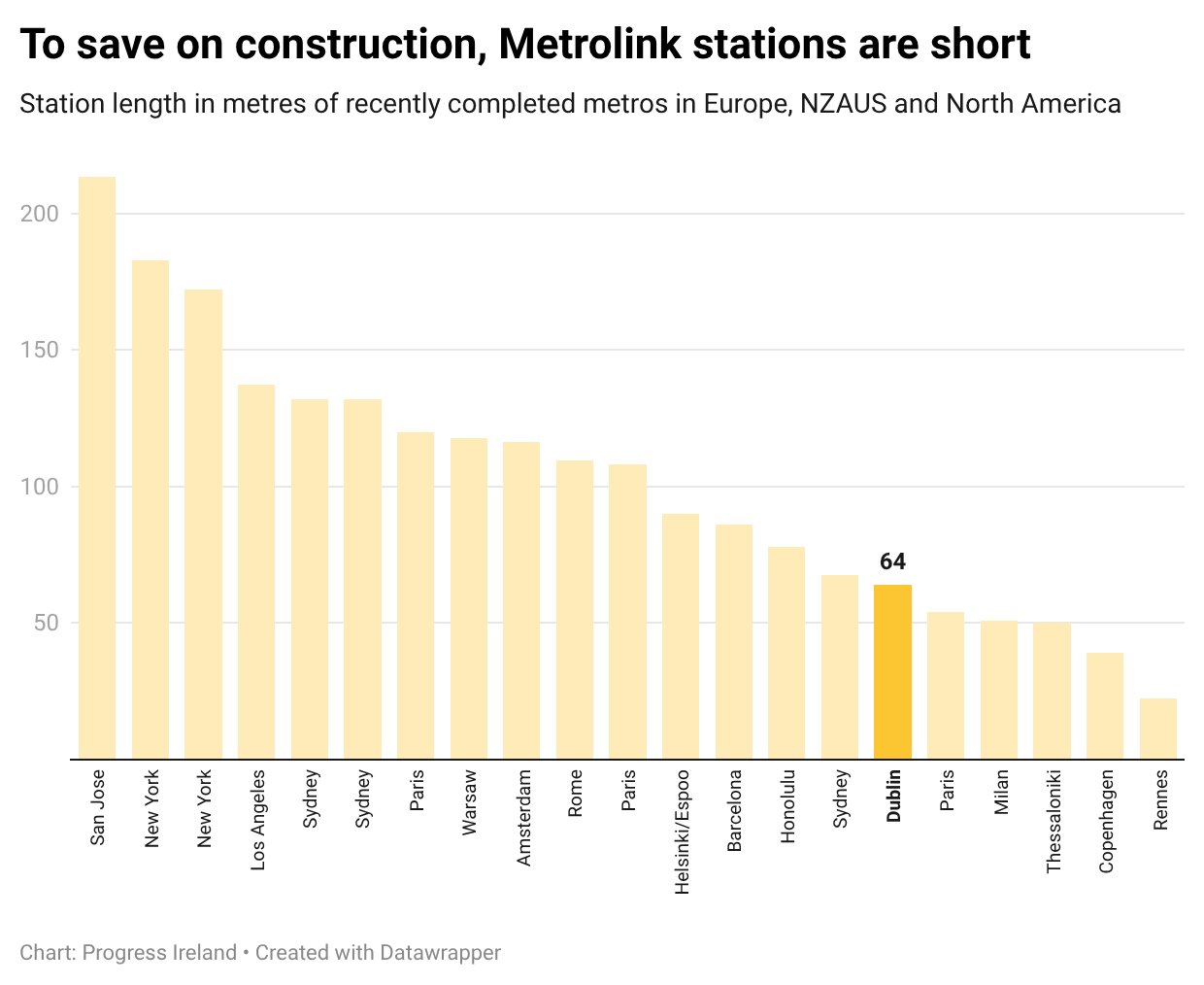
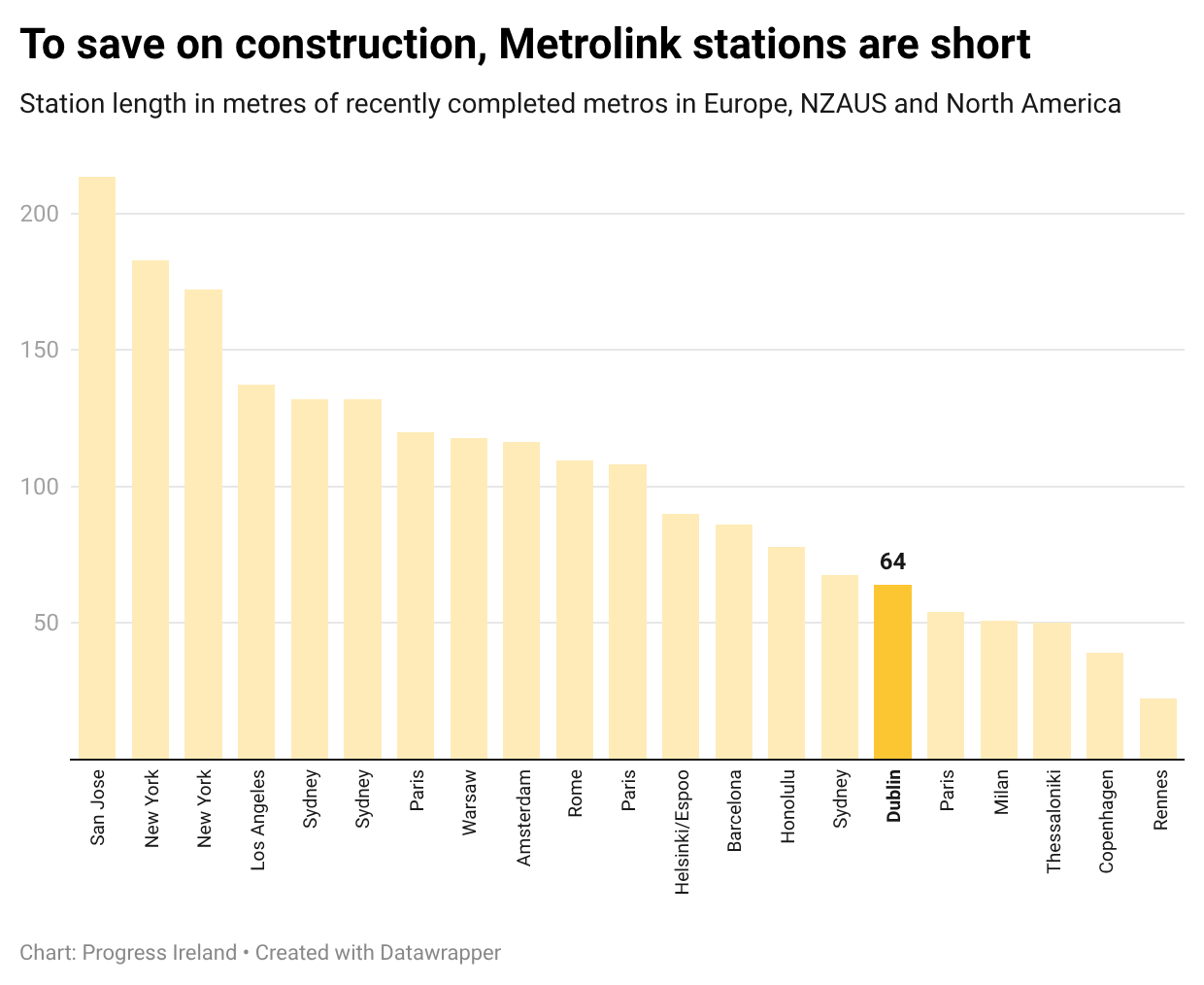
The price of building transportation infrastructure has skyrocketed around the world over the past decade, though some jurisdictions, like the United States and United Kingdom, tend to struggle with higher costs than others. Still, there are certain approaches, most of which MetroLink intends to use, that usually reduce costs. The highest-cost item on most underground metros is the stations, and station costs tend to be a function of their volume. This means that shorter and, ideally, shallower stations are much less expensive. Many cities, therefore, are shifting away from the very long and relatively infrequent trains of older systems. Instead, they are taking advantage of automation to run shorter trains more often. This is Metrolink’s approach: stations are 65 metres long, compared to a typical platform length for new metros of 90-120 metres. People spend less time waiting at stations, and capacity remains the same because the cost of running two short automated trains every 90 seconds is basically identical to one long train every three minutes.
This automation is an advantage even over the other main form of rapid transit, which is regional rail. Dublin’s DART takes effective advantage of historic legacy rail corridors to run trains through the city. The challenge is that it is limited to existing lines, which do not necessarily serve all of the region’s major destinations or demand corridors. Integration with existing transit is critical, and a good connection between MetroLink and DART at Tara Street, along with future DART corridors, will make the metro far more useful as part of a genuine integrated regional transit system rather than as an isolated line. This means seamless integration, including reasonable walking distances for transfers, well-designed informational signage, and common fare policies that also include Luas and local buses. This is the approach that has made transit in Germany, France, Denmark, the Netherlands, and Switzerland so successful. The cost of these changes is a rounding error compared with the cost of heavy construction, and they go a long way to maximizing the value of the investment.
Sydney is an excellent example of a city that has long operated an extensive regional rail network, but has chosen to supplement it with an automated metro. It has proven to be very successful, extending service to fast-growing suburbs and central neighbourhoods, while taking pressure off legacy infrastructure. The metro works especially well at handling frequent stops through core neighbourhoods while the regional rail effectively carries longer journeys. Dublin has the opportunity to build just such a complementary pairing, with MetroLink alongside expanded DART.
It is a misconception that metros are always underground, and it is wise that the MetroLink plan doesn’t try to dig deep tunnels for its entire length. Nearly every major global metro has long above-ground sections outside the city centre. Even the London Underground is a bit of a misnomer as much of it runs on the surface. Above-ground construction is much less expensive and the impact of a quiet modern metro in a suburban neighbourhood is usually quite minimal. Even elevated guideways are relatively sleek and new developments can easily be built around them in a way that integrates the transit guideway so the visual impact is minimal. Electric trains have no local emissions and are typically quieter than a truck. Building the line above-ground maximizes the rapid transit that can be delivered for a given budget, and outside a historic city centre it is often the right choice.
Airport rail links have sometimes gotten a bit of a bad name as less important priorities than more urban focused transit, but there are two very different kinds of airport rail link. A line that provides a non-stop service from the city centre with high fares geared to business travellers offers relatively limited overall transportation benefit and usually doesn’t make sense anywhere other than the largest global cities. But a rapid transit line that serves many destinations along with an airport is usually very successful. Of course, it will be very useful for tourists and other travellers wishing to quickly and affordably get to the city centre. But the airport is also one of the largest single centres of employment in the country. The many thousands of people employed there are exactly the sort of steady, all-day ridership that keeps a line busy between the commuter peaks. Ride an airport metro in almost any city and you will see numerous flight attendants and security staff conspicuously in uniform. Connecting the airport to the city’s rapid transit system is an effective means of getting thousands of travellers’ and commuters’ cars off the roads.
Around the world, metros have been successful at inspiring dense, walkable transit-oriented development. The areas surrounding suburban stations will suddenly find themsleves just a few minutes away from the city centre, reliably all day, every day. It will have a chance to create neighbourhoods that feel like real communities, rather than simply business parks and collections of houses. The new station areas will become ideal locations to add the housing Dublin badly needs without overcrowding its existing infrastructure.
A model for Dublin
Dublin is somewhat unusual among European capitals in having no metro. The obvious model for Dublin is Copenhagen, a city of similar size that has become an outstanding model for transportation and broader urban planning. It long had a regional rail system, the S-Tog, that is somewhat analogous to DART. More recently, they have added an automated metro system like MetroLink that both provides denser coverage of the core urban area and extends out to new development areas and the airport. Copenhagen has built a strong multimodal transportation network, incorporating everything from bikes, through buses, metros, and regional rail. Each mode is well-integrated with the others, and it is coupled with the longstanding “finger plan” that guides urban development in the region to encourage outward growth to locate along rail corridors. Between these corridors, undeveloped green land can be preserved so that everyone in the city is reasonably close to natural areas and countryside. Copenhagen even mandates any substantial new office development to be located within walking distance of a rail station. Like in Copenhagen, a metro can be a core component of an effective regional transportation and land use plan.
These benefits inarguably come at a significant financial cost. The projected €9.5 billion from 2022 is now expected to be in the double-digit billions. Certainly, all efforts should be made to emulate successful approaches in low-cost jurisdictions like Spain, France, and South Korea to keep costs as low as possible. The Transit Costs Project at New York University has compiled a database and a series of cases that examine approaches to rapid transit construction that tend to be responsible for driving costs up or keeping them lower than peer jurisdictions. Smaller frequent trains, standardized station designs, above-ground construction where feasible, and adopting proven off-the-shelf systems wherever possible are all effective means of keeping costs down.
Still, the bill should not preclude the development of infrastructure that will positively reshape the city for decades to come. Though the cost is high, this is infrastructure that can last a century or more. Virtually every city in the world that has built a metro has wished that they’d built even more decades ago when it was cheaper. The best time to build a metro was 50 years ago, but the second-best time is now.
Last updated: