When it comes to electricity, Ireland has lots of hard problems to solve.
The one most people feel is cost. Electricity prices are up 36 per cent since 2021, with no sign of getting cheaper any time soon.
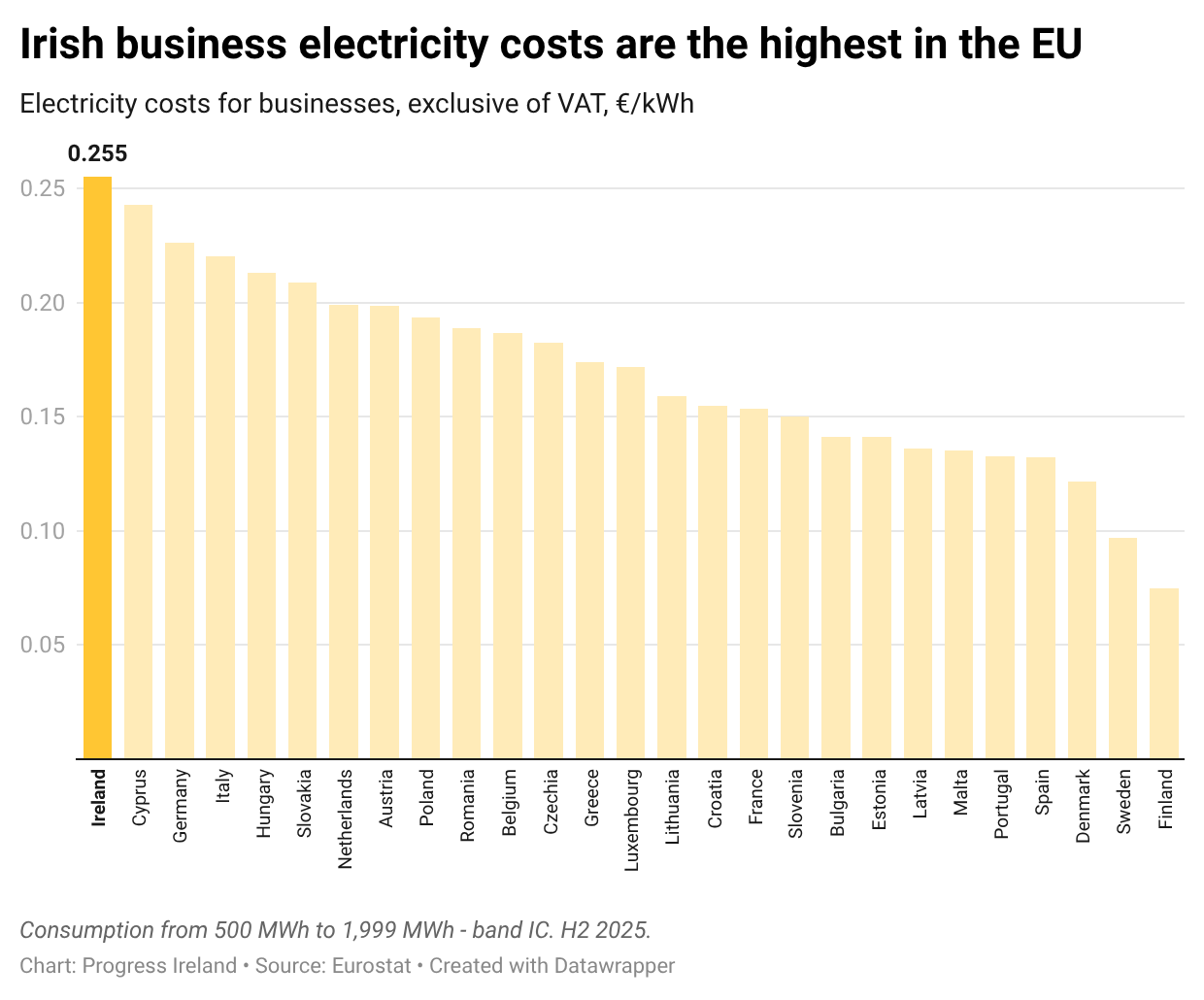
Irish businesses also feel the pain of high electricity prices. When electricity is cheaper in other countries, businesses here have a harder time selling their products at an attractive price abroad. Currently, Ireland has the highest electricity prices in the EU.
Then, there are the problems that lead to high prices. One of them is supply. Nearly half (47 per cent) of Irish electricity is generated from gas. We import most of the gas we use, and the global supply of gas has been disrupted by the wars in Ukraine and Iran. Gas prices are up 130 per cent compared with last year due to constrained supply.
To protect ourselves from gas price shocks, we’re building more wind farms. But wind prices are rising too. Planning can be slow for wind farms, and over a dozen wind farms have been waiting more than a year for planning permission. These delays add to costs for wind farm developers, and limit new supply coming online for consumers.
Finally, there’s the grid. The electricity grid was built in a different era, when a few dozen fossil fuel plants generated most of Ireland’s electricity. Hundreds of wind farms have since been added to the network, many in remote locations that are not well-served by power lines. We’re behind on adding new power lines, plus other supporting infrastructure like substations and batteries, to handle all the wind we’ve added to the grid. That’s why 10 per cent of all renewable energy went to waste in 2025.
Building grid infrastructure is harder than it seems. No one wants to look at the big pylons that hold up power lines outside their window, and local opposition has delayed critical projects for years.
All of this is complex, and each individual problem will take years to solve. But there is a type of solution that can help in the near term. It’s less contentious than building physical infrastructure, and can be deployed faster. It involves getting more power out of the existing grid.
Grid investments
The state is investing billions to make the grid more renewable-friendly, and most of those costs show up on electricity bills. The CRU, Ireland’s energy regulator, recently approved an €18.9 billion grid investment, the largest in Irish history. Much of that investment will be used to modernise the grid so it can better handle the renewable energy we push through it.
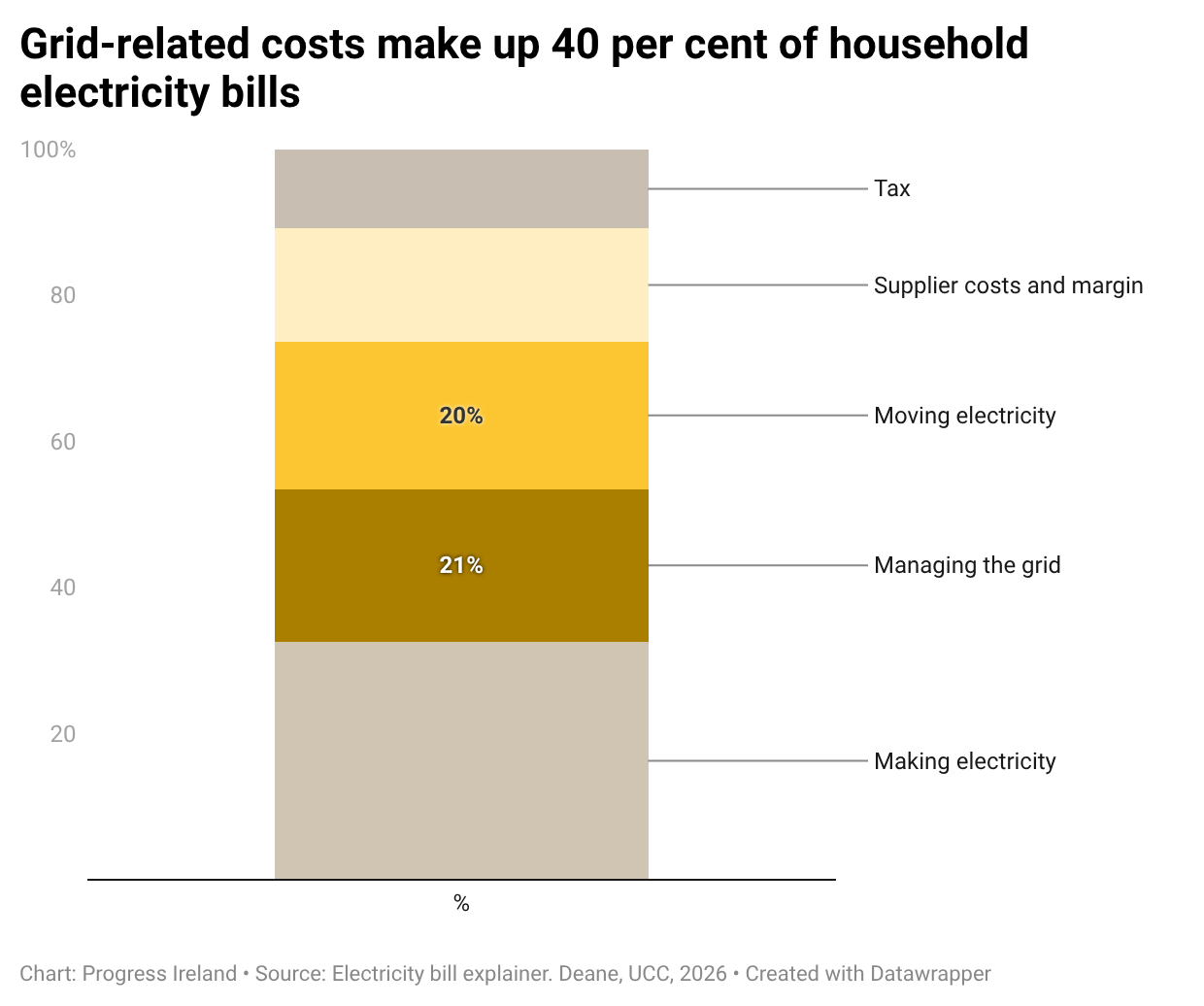
That investment is funded by network charges, which are levied on each unit of electricity a household or business uses. Electricity providers collect the network charges via electricity bills, and pass them on to Eirgrid and ESB. A recent study shows costs related to operating the grid account for around 40 per cent of the typical household bill.
This level of grid investment is important and necessary, but there’s a way to reduce its impact on bills. If we push more electricity through the system, the cost of improving the grid is spread over more units of electricity.
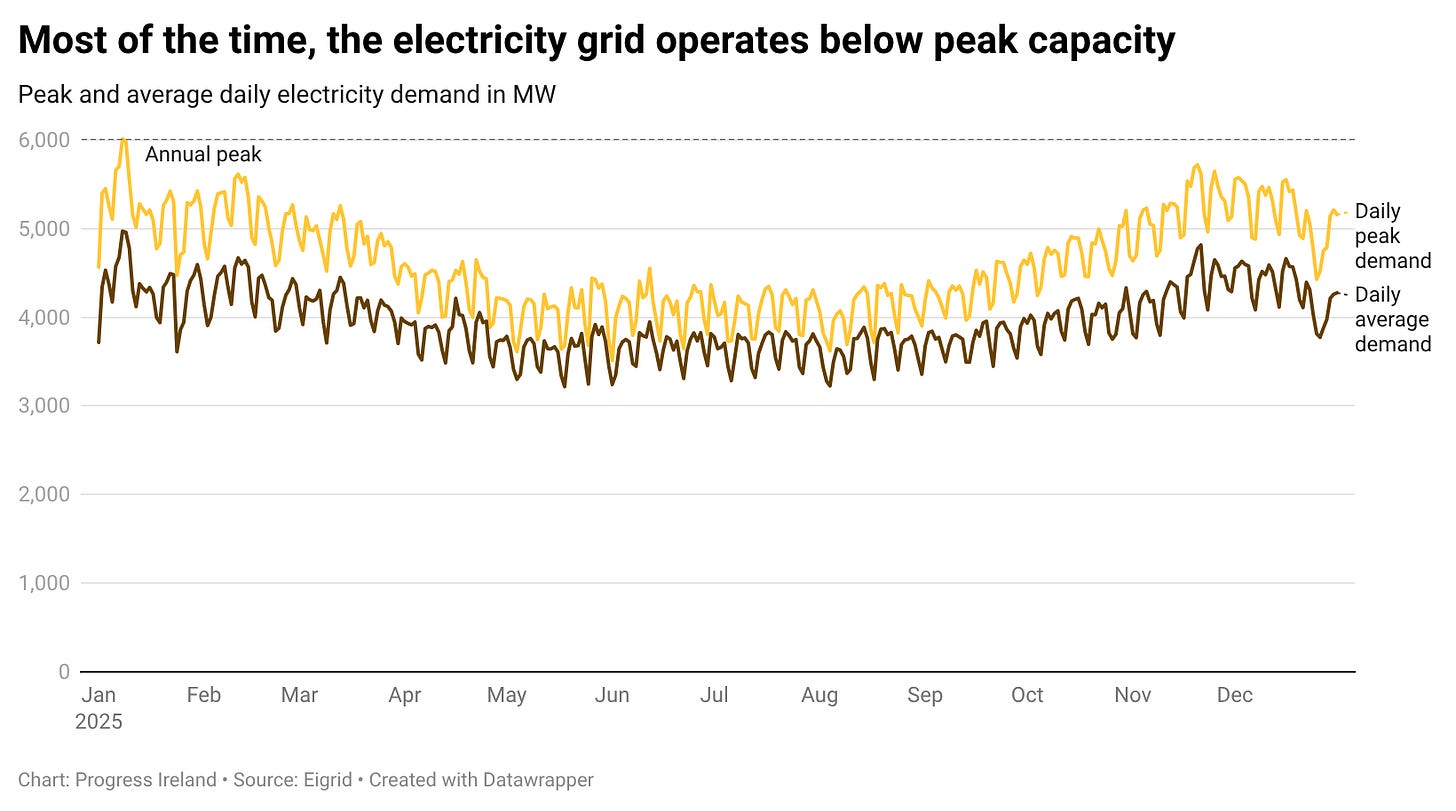
To understand how this works, it’s worth explaining how the electricity grid is built. Electricity grids are designed to handle the busiest times of the year. In Ireland, demand for electricity peaks on cold winter evenings, as people around the country get home from work and switch their heating on.
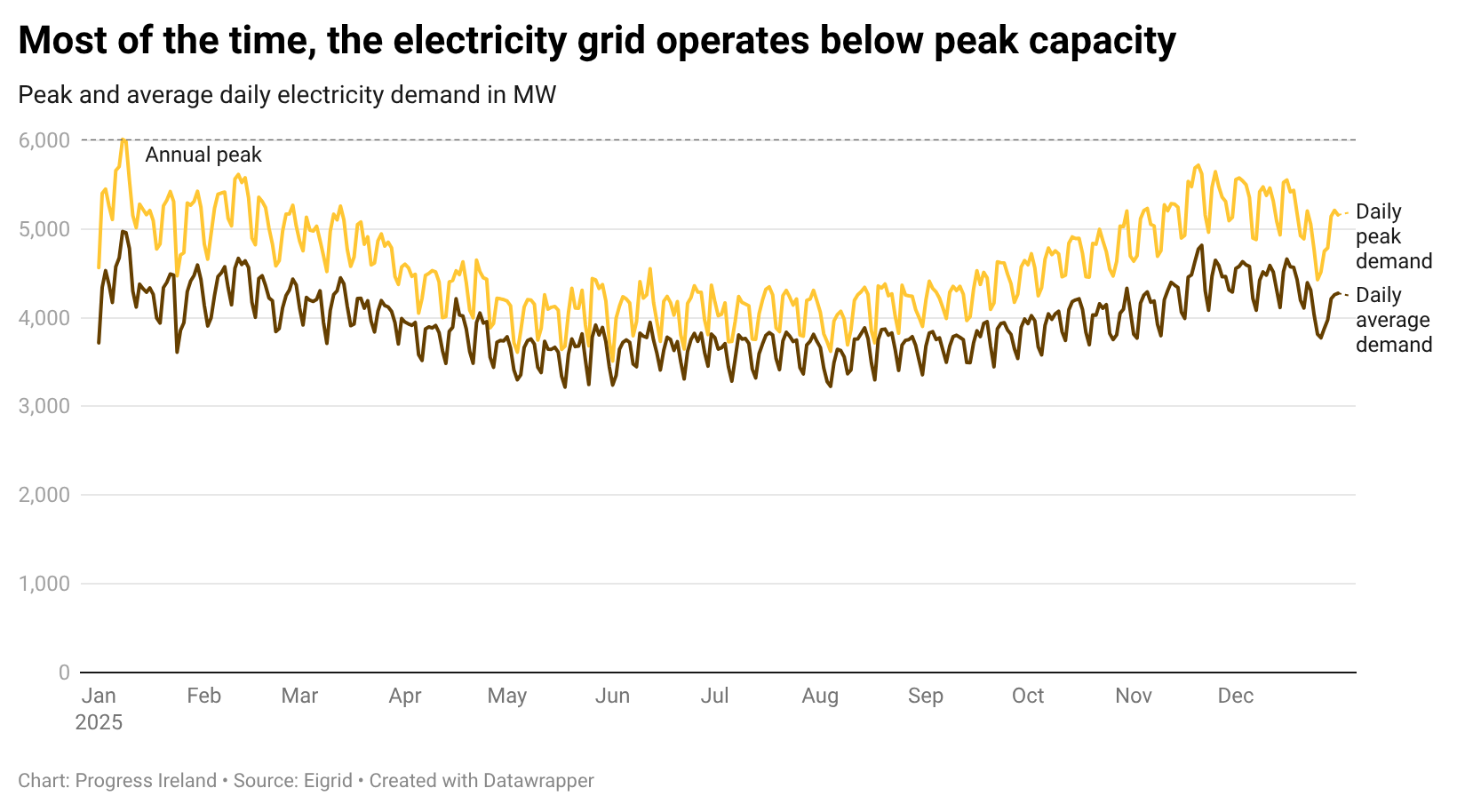
The state has to build enough power lines and substations to deliver all the electricity households and businesses need on those chilly evenings. But on the average day, the grid is nowhere near peak capacity. Last year, peak demand in Ireland hit six gigawatts (GW) on an evening in January. For the rest of the year, average demand was 3.9 GW. That means on average, we are only using 66 per cent of the grid’s capacity.
So how can we get people to use more energy outside of peak hours?
Flexible connections
Flexible connections allow businesses to use the grid when others are not. This spreads fixed grid costs over more units of electricity, lowering prices for everyone.
Imagine you’re a biscuit company, and you want to double your production by adding a new industrial-scale electric oven. To do so, you need to apply to ESB Networks and tell them how much power you want to draw. ESB will assess the grid around your factory, and decide whether it can handle your increased energy demand. If it can’t, you might need to wait years for the grid to be reinforced so you can draw down more power.
But what if you agree to reduce your energy consumption during peak hours? You could then connect today and use the spare capacity in the grid during non-peak hours. This would spread grid charges over more units of electricity, reducing the charges for everyone.
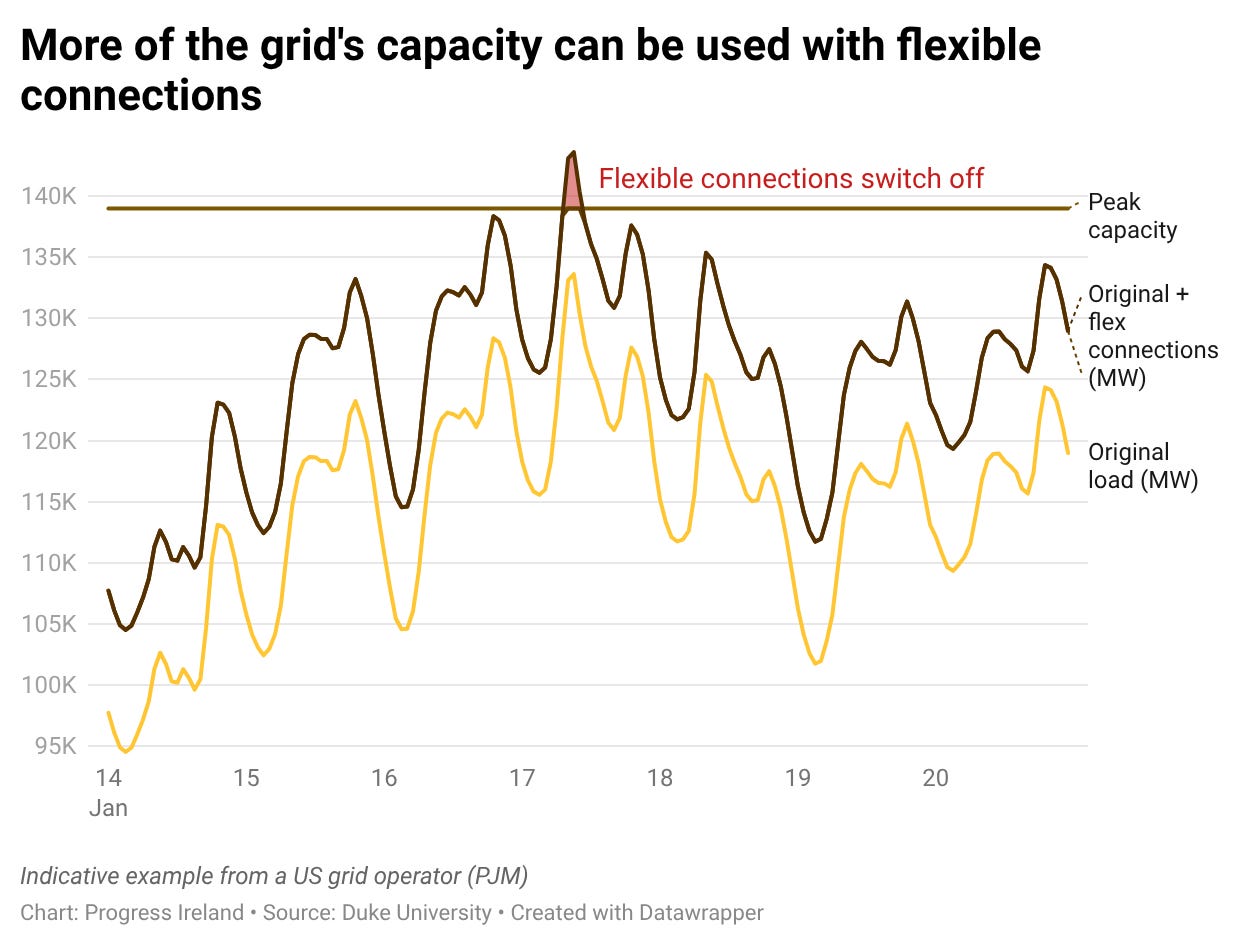
Flexible connections are suitable for a particular type of business. It’s a good option for businesses that want to connect to the grid, or expand their operations, in areas where capacity is currently limited. It’s useful for businesses that can decide when to turn their power use up or down. Logistics companies that have depots full of EVs that need charging, food and drinks manufacturers that can cook batches of their product at different times during the day, and any business with batteries they want to charge up are good candidates.
A US study found 10 per cent more energy could be used in the existing grid if businesses were allowed to connect using flexible connections. These businesses would only need to reduce their energy use for about 85 hours per year, or less than one per cent of their operating hours.
ESB ran a flexible connections pilot last year, but it hasn’t been rolled out as a generally available programme. Many other countries have flexible connection programmes in place, like the Netherlands, Germany, and Denmark.
Flexible connections are useful for a few different reasons. They let businesses connect to the grid faster, which ensures constraints in our electricity system don’t slow down growth. And, they create savings for other electricity users by spreading the cost of grid maintenance over more units of electricity.
How much can flexible connections save other electricity users? Let’s imagine 10 per cent of peak system demand (600 MW) could be connected to the grid using a flexible connection. These businesses use electricity throughout the year, turning down when instructed to by ESB. Businesses don’t always use their peak demand, so let’s say on average they use 70 per cent of those 600 MW throughout the year. They would use 3,679 gigawatt-hours (GWh) of electricity a year that would not otherwise be consumed.
This gives us additional units of energy to spread grid costs over, which saves €90 million per year for other electricity users.
Existing power lines could carry more energy
So far, we’ve covered how we can squeeze more energy out of the grid by using more electricity at non-peak times. There’s another solution available that could send more electricity over the existing power lines. It’s called dynamic line rating.
Carrying electricity generates heat, because the electrons in the line bounce off each other as energy moves through them. If a power line overheats, it sags and stops working. Traditionally, power lines have been rated based on the warmest temperatures they might experience to prevent over-heating and failure. But most of the time it’s not that warm out. This is especially so when the wind is high, because wind cools the power line down. This means that power lines can typically carry more electricity when the wind is blowing than they’re rated to carry.
Dynamic line rating software lets grid operators monitor the weather and send more electricity over wires when it’s cold out. It could help us use more wind energy when it’s available and reduce wastage in the system. Eirgrid has done two pilots of dynamic line rating, one with physical sensors on power lines, and one using a digital monitoring system, but has yet to roll it out to the entire grid.
The UK rolled out dynamic line rating on 275 km of power lines and increased the carrying capacity of those lines by an average of eight per cent. It’s now planning a wider rollout, and expects to save £50 million over the next five years.
Ireland currently wastes 6.7 per cent of wind energy per year due to the constraints in the carrying capacity of local power lines, and that figure is expected to triple by 2028. We pay for this wastage in two ways. First, the state pays wind farms to compensate them for switching off when the lines are overloaded. Then, we pay for gas to cover the shortfall in energy supply.
If we achieved half of the capacity uplift the UK did, and could use four per cent of the wind Ireland wastes, electricity users could consume an additional 112 GWh of wind that is currently wasted. This would save around €12 million a year in costs by 2028.
Hard problems
Ireland has a long way to go to fix all the hard problems in our electricity system. The state needs to build tons of new physical infrastructure, from power plants to power lines, and increase the supply of electricity to get prices down. To ease pressure along the way, we should try to get the most out of the existing grid.
Last updated: